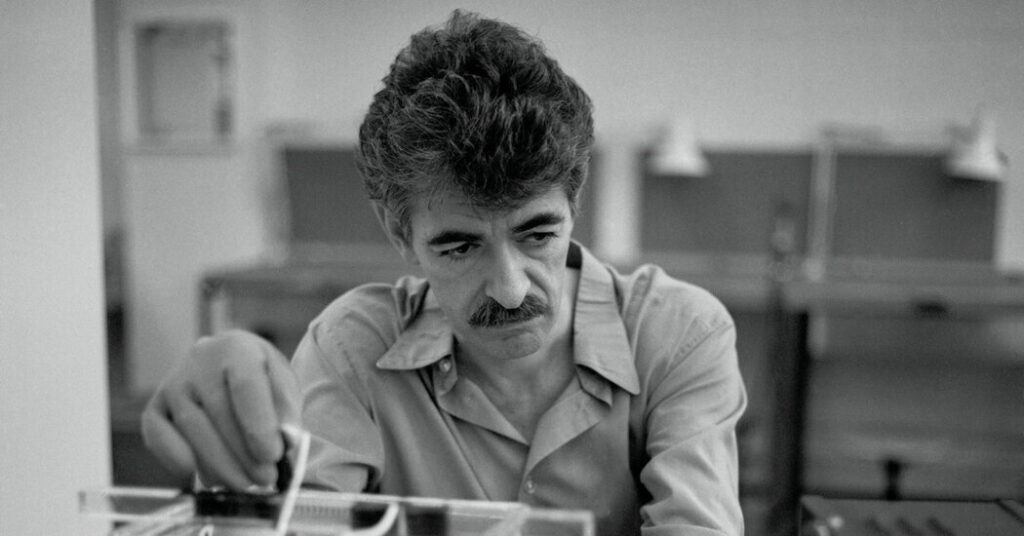
Thomas Gentille, a master jeweler whose idiosyncratic conceptual pieces resembled tiny minimalist sculptures or paintings — though he hated labels and movements and, if pressed, would describe his work simply as “nonobjective” — died on March 6 in Manhattan. He was 89.
The cause of death, at a hospital, was leukemia, Susan Grant Lewin, a friend and collector, said.
Mr. Gentille (pronounced jen-TILLY) had more in common with artists like Agnes Martin and Donald Judd than he did with Harry Winston. He didn’t use jewels and rarely incorporated precious metals, working primarily in wood, aluminum, glass and acrylic. He also liked zinc, pumice, resin and sawdust. He developed a surface technique using eggshells. He had a Formica period.
He made different kinds of jewelry, but mostly brooches. They were roughly the size of a man’s palm, in geometric shapes — rectangles, trapezoids, circles — that might be pierced with a hexagonal screw or have another shape bolted on top. A delicate slice of acrylic, for example, might be screwed in at a perpendicular angle to a slim rectangle of plywood.
He was meticulous, technically innovative and spent months, and often years, on a single piece. You would not find his work at Bloomingdale’s, but in galleries and museums, including the Metropolitan Museum of Art in New York and the Victoria and Albert Museum in London. That made Mr. Gentille unique, but not exactly anomalous. Alexander Calder made jewelry, and so did Salvador Dalí.
Studio jewelry, art jewelry or author jewelry, as it is variously known — in other words, “art as a wearable medium,” as Barbara Paris Gifford, a senior curator at the Museum of Arts and Design in Manhattan, put it — has a history in the United States that dates to the years before World War II, when the leaders of the Bauhaus design school fled Europe. As they began teaching here, they expanded ideas about what art and design could be, bringing with them their manifesto that good design should be for everyone.
“It was about equalizing the arts,” Ms. Gifford said. Along with furniture, tableware and textiles, she added, “jewelry comes to the fore.”
By the mid-20th century and into the 1960s, jewelry makers had begun following the art movements of the era while also discovering Scandinavian design and the work of Native Americans. Craft was ascendant.
“Studio jewelers are not working with gold and precious stones, because that takes all the attention,” Ms. Gifford said, “and they want their own ideas to come through.”
Mr. Gentille came to the discipline by accident. He was studying painting at the Cleveland Institute of Art in the late 1950s when he took a jewelry elective during his senior year. His epiphany, he said, happened on the first day of class, when he learned how to test the tension of the thin blade inserted into a jeweler’s saw frame by plucking it with his finger. If the tension was just right, “it resists, it sings, it makes wondrous music,” he wrote in the catalog for a 2010 show of his work at Gallery Loupe in Montclair, N.J.
He liked the way the tool “fought back,” he said. He was hooked.
“Painting never fought me back,” he told Ursula Ilse-Neuman, the curator emerita of jewelry at the Museum of Arts and Design, in a 2009 oral history for the Smithsonian Institution. “It just did what I wanted the paint to do. But there was something about jewelry that was going to fight me, and I knew it had to be a battle in order to make it work.”
Thomas Gentille was born on Aug. 11, 1936, in Mansfield, Ohio, one of two sons of Beatrice (Giberson) Gentille and Thomas Gentille Jr., a truck driver. When Thomas was 12, the family moved to Lorain, Ohio, and his parents started a laundry business.
He attended the Cleveland Institute of Art on a full scholarship, graduating in 1958. The following year, he was drafted into the U.S. Army and stationed at Fort Dix, N.J., and in Germany. He trained as a machine-gunner and taught history and science to servicemen without high school diplomas so that they could earn their degrees.
When his service was completed, he moved to New York City, apartment-sitting for friends before taking over the lease of a sixth-floor walk-up on East 84th Street, between Second and Third Avenues, where he lived for the rest of his life.
Mr. Gentille’s first job was at the Museum of Contemporary Crafts (now the Museum of Arts and Design), where he worked as a carpenter and painter for exhibitions. Over the years, he made a living doing other odd jobs, including coat-check attendant.
One summer, he took a position as a cook at the Haystack Mountain School of Crafts, on Deer Isle in Maine. As a student in the summer program there, he had learned to weave from Jack Lenor Larsen, the pioneering textile designer, who gave him $100 to buy tools for making jewelry. Mr. Gentille would later teach at the school and set up its first jewelry studio.
He also taught at Parsons School of Design in Manhattan and at the 92nd Street Y (now 92NY), where he expanded the organization’s jewelry program.
Mr. Gentille’s 1968 book, “Step-by-Step Jewelry,” a primer on jewelry making, became a bible for many, including Robert Lee Morris, the celebrated jewelry designer, whose gutsy cuffs, talons and breastplates — modern urban warrior pieces, he called them — reinvented fashion jewelry in the late 1970s. Mr. Morris taught himself the craft by reading Mr. Gentille’s book while living on a commune in Wisconsin.
When Mr. Morris moved to New York City and opened Artwear, a gallery for wearable art like his own and that of other mavericks, including Ted Muehling and Cara Croninger, the first show he had, in 1977, was of Mr. Gentille’s work. (Artwear, originally on East 74th Street, soon moved to SoHo, where its rock ’n’ roll ethos drew customers like Madonna, Bianca Jagger and the staff of Interview magazine.)
“It was payback for the book, which was the trigger for my life,” Mr. Morris said in an interview. “Thomas epitomized the opposite end of the spectrum that Artwear represented: I was completely over in the fashion end, and Thomas was completely in academia. He represented a level of perfection.”
Mr. Morris continued: “His stuff didn’t sell much. What he made was artwork for museums and for wealthy collectors.”
But “having Thomas’s work in the gallery,” he said, “gave it a level of respect and a level of prominence.”
It takes a confident person to wear a piece by Mr. Gentille; the work commands attention. Helen Drutt, a former gallerist and collector of his work, said that although wearing one of his brooches is no different than wearing a cameo, “it draws attention because it does not have a surface anticipated in jewelry.”
Prices for Mr. Gentille’s work range from about $6,000 to $20,000. He is currently represented by Hannah Gallery by Klimt02 in Barcelona, Spain.
In the oral history, he told Ms. Ilse-Neuman, the interviewer: “I think you can express everything in jewelry, and that’s what I’m trying to do. And I think one of the things that people like about jewelry is that jewelry is a perfect world contained within itself. The outer world is not a perfect place.”
Mr. Gentille left no immediate survivors. His brother, Terry, a textile designer, died in 1987.
Mr. Gentille said a question he was often asked was what he was giving to the person who wears his work.
“Well, directly, I’m giving them nothing,” he said in the oral interview. “I don’t want to give them anything. What I want them to do is take from the work what’s there: color, scale, forms.”
He added, “By trying to give them nothing, in one sense, I’m trying to give them everything.”
Kitty Bennett contributed research.
Penelope Green is a Times reporter on the Obituaries desk.
The post Thomas Gentille, Artist Who Made Wearable Sculpture, Dies at 89 appeared first on New York Times.