The Federal Reserve didn’t lower interest rates at its meeting this week. With a war driving up energy prices, the markets will need to hope that the Fed doesn’t do so in the months ahead, because a rate cut would be a sign that the economy is in deep distress.
It’s true that at their current level, interest rates aren’t providing much, if any stimulus to the economy, which is looking vulnerable. U.S. employers cut more jobs than they created in February, overall economic growth has been weak and inflation was higher than anyone would desire, even before the start of the U.S. and Israeli attacks on Iran. The stock market has stalled, too. All things being equal, lower interest rates could provide a welcome boost.
But the double whammy of the war in Iran and the Trump administration’s revived tariffs are putting upward pressure on prices, both in the United States and the rest of the world. The oil shock set off by Tehran’s retaliatory strikes in the Persian Gulf region — especially, in the Strait of Hormuz — are already beginning to have painful effects.
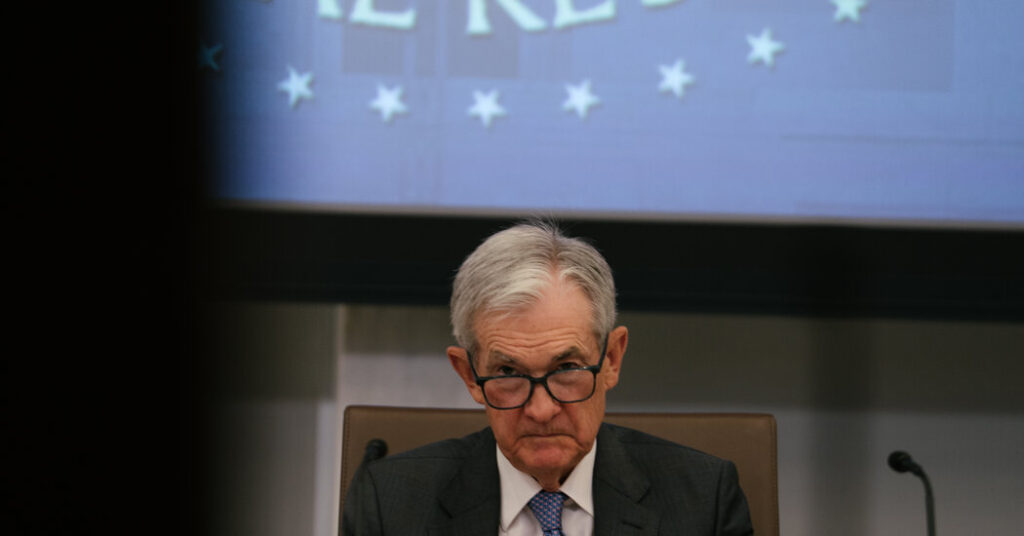
Under these circumstances, the Fed has little real choice. It projected one more rate cut later in 2026. But it has to wait to see how high prices will go — and the answer still isn’t clear. “The thing I really want to emphasize is that nobody knows,” Jerome H. Powell, the Fed chair, said in a news conference on Wednesday.
Since the start of the war, energy prices, including those of oil, gasoline and liquefied natural gas, have been rising sharply. A range of other global commodity prices have also moved higher since the start of the war in the Gulf. Fertilizer, which is critical for farming and food security, has become more expensive, too. Asian countries are particularly hard hit by the oil cutoff, and European countries by the shortage of liquefied natural gas.
These costs will ripple through the global economy in coming weeks and while the United States, a major energy producer, is more insulated than many countries, it is still imperiled. For the Fed, cutting interest rates while inflation is accelerating would be a dangerous gambit. We don’t yet know how long the war in Iran — and the mounting oil shock — will last. Oil prices, already up more than 45 percent this month, could easily climb much further.
Recall what happened after Russia invaded Ukraine in February 2022. The price of Brent crude jumped above $120 a barrel, but not until June. The price at the pump for a gallon of unleaded gasoline exceeded $5 that month, according to AAA, and the rate of inflation in the United States, as measured by the Consumer Price Index, rose above 9 percent. That was the highest rate of inflation in the country since the oil shocks of the 1970s and the 1980s.
We’re not near those levels now, and the global economy has become much less oil-dependent year by year. But one fifth of the world’s oil and a substantial amount of natural gas normally flow through the Strait of Hormuz. If Iran can continue to restrict traffic through that waterway for several months, energy prices are likely to keep rising.
That could lead to red-hot inflation. In the estimation of J.P. Morgan researchers, if Brent crude (currently about $103 a barrel) climbs above $125 a barrel and remains there for weeks or months, the economy would be in a real danger zone.
This month, government bond yields have already risen sharply in a range of countries, with the 10-year U.S. Treasury note hovering below 4.3 percent, up from just under 4 percent before the war.
The continuing uncertainty surrounding Mr. Trump’s tariffs isn’t helping either. Further inflationary effects are expected but estimating how much is difficult when the tariff levels themselves are still up in the air. Administration studies, court battles, and international negotiations are likely to shift these taxes on imports frequently for a second year.
Given these threats, the world’s central banks, including the Fed, could be inclined to keep monetary policy tilted in a hawkish direction.
They might have to raise rates if the war unleashes inflation fierce enough to make people expect prices to rise quickly for years to come. In economic jargon, this would mean that inflation expectations are becoming “unanchored.” Once rapidly rising prices are widely anticipated in a society, a vicious, self-perpetuating cycle can set in, one that can be excruciatingly difficult to stop. Ever since the Paul A. Volcker ran the Fed from August 1979 through August 1987, heading off a hardening of inflation expectations has been a fundamental concern of central bankers.
A Dreaded Word
Unfortunately, inflation isn’t the only threat the economy faces. There’s another problem associated with sharply rising oil prices: recession.
The risks of a slowdown tend to rise appreciably when energy costs levitate and remain high.
“Recession is once again a serious threat,” Mark Zandi, chief economist at Moody’s Analytics, wrote this week. “Even before the recent disconcerting events in the Middle East” he said, the risk of a recession had risen to roughly 50-50, according to an economic model run by his firm.
The oil shock only increases the odds, he said.
Forecasting recessions is difficult, and I’m not about to try. There has not been one in the United States since the end of the pandemic recession in April 2020, though various indicators have signaled “recession” repeatedly.
There may be no big inflation surge this time, and no recession. It’s quite possible that the war in Iran will end soon, that normal tanker traffic through the Strait of Hormuz will resume, and prices will subside. But we just don’t know.
Surging costs typically have major political implications. The inflationary spiral associated with the war in Ukraine contributed to a sharp decline in the popularity of former President Joseph R. Biden Jr. “Affordability” is already a political issue in the United States, and the tariffs and the war in Iran could make it an acute one in a national election year.
This isn’t something the Fed can completely ignore, yet the central bank, still led by Jerome H. Powell, is struggling to maintain its independence in the face of demands by President Trump that it slash interest rates. Mr. Powell’s term as Fed chair ends on May 15. But Kevin Warsh, who has been nominated by President Trump as Mr. Powell’s successor, may not be confirmed by the Senate by that date. Mr. Powell said on Wednesday that he expected to continue as Fed chair temporarily if that happened.
So the Fed is in a tough position. It is difficult to see how an independent central bank, facing an inflation threat, could lower interest rates now. But a recession, or financial meltdown, would change that calculus immediately.
As I’ve been warning for weeks, the risks for investors have risen sharply during the Trump administration.
Given the challenges facing the Fed, a quiet period without headlines or fireworks may be the best the markets can hope for.
Jeff Sommer writes Strategies, a weekly column on markets, finance and the economy.
The post The Best We Should Hope For From the Fed: Nothing appeared first on New York Times.