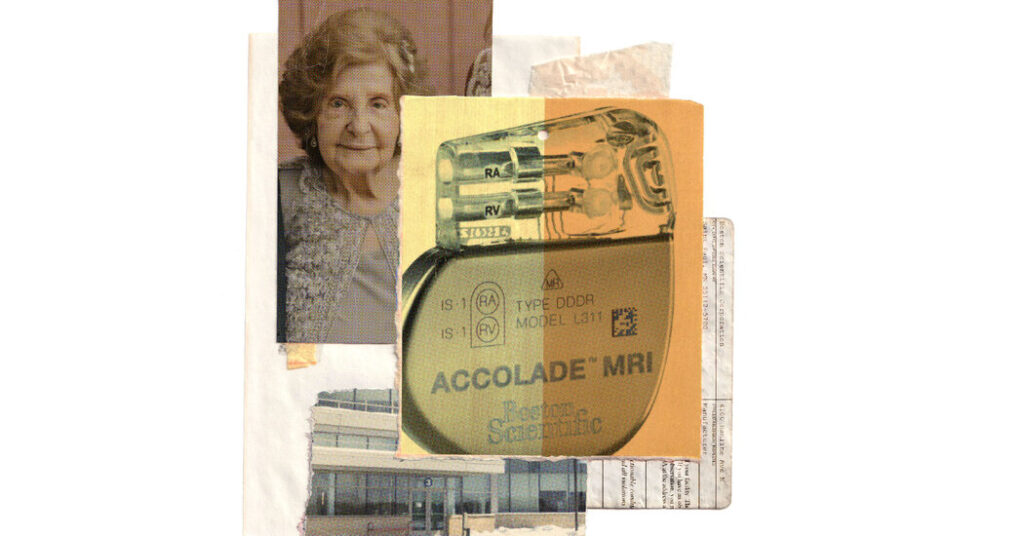
Gladys Knepper, at 93, had a morning routine that never wavered. She woke up at six and made her bed. She got a pot of coffee going and went outside to pick up her copy of the Dubuque Telegraph Herald.
So when a neighbor in Dyersville, Iowa, noticed that Ms. Knepper’s newspaper was still on her doorstep on Mother’s Day in 2024, she knew something was wrong. Inside, she found Ms. Knepper sprawled on the floor.
It was the first in a series of blackouts that doctors initially attributed to the inevitable deterioration of an older woman. Ten days after her fall, they discovered the real problem: her pacemaker. She underwent surgery to get a new one but by then, her heart was severely damaged. She died three weeks later.
Boston Scientific, the company that made the device, would later conclude that the battery inside it had failed. Two years earlier, a person in Finland had died as a result of the same malfunction. And for years, factory tests had revealed pacemaker batteries that were failing unexpectedly, according to internal company records and government inspection documents obtained by The New York Times.
Boston Scientific issued a recall for that device, its Accolade model, in December 2024, six months after Ms. Knepper’s death. The company said the issue was limited to 13 percent of the pacemakers on the market — about 200,000 devices that were made before September 2018.
But the problem is far broader. Last spring, inspectors from the Food and Drug Administration found that a pacemaker battery made more recently had also failed, according to a report that has not previously been made public. And company documents reviewed by The Times show that dozens of test batteries made between 2019 and 2023 did not work properly after they were subjected to conditions similar to those that had caused pacemakers to falter in the real world.
Pacemakers are surgically implanted devices that deliver an electric pulse to keep the heart beating at the right speed. They run on batteries meant to last as long as a decade or more. When batteries fail to deliver the necessary power, devices can switch into an irreversible emergency backup setting known as Safety Mode, which is designed to keep the heart beating until a person can get a new pacemaker. Safety Mode can be dangerous for patients who depend on their pacemakers to constantly keep their hearts beating, because it can sometimes fail to engage.
Last August, Boston Scientific updated its recall to expand the population of affected Accolade pacemakers to more than 1.3 million. To fix the issue, the company announced a workaround: Patients could receive a software update, which would periodically test their devices and alert doctors if the batteries were at risk of triggering Safety Mode and needed to be replaced. On Thursday the company was expected to amend the recall again, updating the software further and expanding the affected population to 1.6 million people.
The Accolade announcements arrived on the heels of a 2021 recall of a different line of Boston Scientific pacemakers called Ingenio. Taken together, battery problems in those products are linked with at least seven deaths and more than 800 injuries, according to company filings.
Boston Scientific’s chief medical officer, Dr. Kenneth Stein, acknowledged in an interview that the company, which is the world’s third-leading manufacturer of pacemakers by sales revenue, has struggled to get to the bottom of the issue. “It’s turned out to be a very complicated problem, one that’s required a lot of really diligent investigation,” he said, adding that he stood by the safety of the pacemakers. “I have full faith and confidence in our quality and safety processes.”
Makers of heart devices like pacemakers and defibrillators have a history of selling flawed products that have led to injuries and deaths.
In 2005, the device maker Guidant came under scrutiny after it delayed warning the public about flaws in one of its defibrillators, which were traced to several deaths. Boston Scientific had a close-up view: It bought Guidant in 2006 and then spent years dealing with the aftermath, which led to criminal charges and the recall of more than 50,000 devices.
The controversy led to more stringent standards for when device companies must report problems to the public and to regulators, but safety experts say a crucial gap remains: The decision about when to issue a device recall is often left to the companies themselves.
“It’s essentially the fox guarding the hen house,” said Dr. Rita Redberg, a cardiologist at the University of California, San Francisco, who studies medical device safety. Studies show that device-related deaths are often undercounted, either because they are misclassified as injuries, or because the deaths are not reported. “The company whose income depends on selling this device is charged with deciding whether the patient died related to a problem with their device.”
Dr. Stein said that Boston Scientific carefully weighs when to warn about its devices, and aims to first ensure it understands why a problem happened. That’s because removing a surgically implanted pacemaker carries its own risks. “If you issue a field action notification that’s too broad, or that doesn’t include the right, actionable recommendations, then people will get harmed by undergoing procedures that they don’t need,” he said.
But doctors and patients should be the ones weighing the costs and benefits of removing a problematic device, said Dr. Robert Hauser, a cardiologist who has been studying the safety of heart devices for decades. Waiting until a problem’s cause is uncovered to alert people about it comes with unacceptable dangers, he said.
“It’s like having a commercial aircraft model crashing a lot and not grounding the plane just because you don’t know what’s wrong with it,” Dr. Hauser said. “It takes your breath away.”
‘Snippety Snappity’
In 2018, doctors at the University of Iowa Hospital in Iowa City implanted an Accolade pacemaker into Gladys Knepper’s chest.
Ms. Knepper, who had raised nine children on a cattle farm, had developed an uncharacteristic lethargy in her 80s that doctors blamed on an aging heart. After the surgery, her energetic personality quickly returned, said her daughter, June Knepper.
“She was so snippety snappity,” her daughter said. Ms. Knepper did her own laundry, cooked herself meals and took her medications independently.
Boston Scientific had introduced two new pacemaker lines in recent years in an effort to boost sales in a crowded market. The first, Ingenio, debuted in 2012. Accolade, an update on Ingenio, came out two years later.
Ms. Knepper’s implantation came during a time when Boston Scientific was not adequately checking the quality of its batteries, an F.D.A. inspection would later find. The company tested batteries in its factory, but between 2013 and 2021, it did not routinely analyze the results, agency inspectors reported, effectively blinding it to potential problems.
The first public notice that something was wrong with Boston Scientific’s pacemaker batteries came in June 2021, when the company announced a recall of Ingenio devices, which it said were failing when they needed a boost in power.
Pacemakers normally use very little battery when they do the day-to-day business of helping a person’s heart beat. But they require more power when they transmit data, either to a patient’s bedside monitor or during doctor visits. That sometimes caused the Ingenio batteries to falter, sending the pacemakers into Safety Mode.
Safety Mode is hard-wired into the company’s pacemakers and other heart devices, like defibrillators. It uses the same settings for everyone, which can be dangerous for some patients. That’s because the pacemaker may mistake muscle activity for a real heartbeat. When this happens — such as when a person exercises — the pacemaker stops working.
Unlike warnings about food or medicines, recalls of surgically implanted devices don’t typically recommend that the product be immediately returned, because replacement surgery has a small chance of causing complications. Instead, the company recommended replacing the pacemakers when they reached three or four years of remaining life expectancy.
The news about the Ingenio recall barely made headlines. The problem, the company said, was limited to about 48,000 Ingenio devices. Only 65 battery incidents had been reported, and it hadn’t led to any deaths (the company would later update its recall to say that it had been linked to three).
By then, Boston Scientific was no longer selling Ingenio pacemakers. It had moved on to its Accolade line, which used different chemistry for its batteries. One of Accolade’s biggest selling points: Its battery was the longest-lasting in the industry, the company said.
‘This has been escalated’
The next year, Boston Scientific filed a series of safety reports with the F.D.A. indicating that it was having problems with its Accolade pacemakers.
In January 2022, just seven months after the Ingenio recall, doctors told Boston Scientific that an Accolade pacemaker had triggered Safety Mode and needed to be replaced. The problem, a company analysis later concluded, was that the battery appeared to have “high internal impedance,” a condition where electrical resistance prevents a battery from delivering the necessary power, much like a kink in a garden hose. This was the same problem that had afflicted the Ingenio pacemakers.
Four months later, in May 2022, the patient in Finland with an Accolade pacemaker fainted several times and fell, which caused a fatal brain bleed. That pacemaker also had a battery with high internal impedance.
By the end of 2022, Boston Scientific had opened an internal investigation into the issue. “A definitive cause of this high impedance behavior has not been determined to date,” one of its safety reports said. “This has been escalated.”
Compounding the problems spotted by doctors, at some point after 2021, Boston Scientific had finally begun routinely analyzing its own battery tests. These retrospective reports “identified failing products,” F.D.A. inspectors later found, but the company did not look further into the matter. A spokeswoman for the F.D.A. declined to comment on the inspection, referring questions to the company.
Boston Scientific said in a statement that it was working with the agency to address the findings. It also said that batteries failing during factory tests did not necessarily mean that devices in the field were faulty.
However, from 2022 through 2024, reports from doctors and hospitals of patients being harmed by their Accolade pacemakers climbed steadily, according to an analysis of public F.D.A. safety reports that Dr. Hauser performed last year.
Signs of Trouble
In the months leading up to Ms. Knepper’s fall in 2024, her daughter June had noticed that something was wrong with her pacemaker. At doctors’ visits, readings showed that the estimate for remaining life on the device jumped around: two years left at one visit, then two and a half years at the next.
After her mother fell, June Knepper suspected that the pacemaker could have been the cause. She called the company’s technical assistance line because she couldn’t get the device to connect to her mother’s bedside monitor, according to an internal Boston Scientific report.
Ms. Knepper moved to a nursing home, where she experienced more fainting spells, which led her back to the hospital. Doctors checked that her heart was beating, June Knepper said, and decided she was dehydrated. They gave her fluids and sent her back to the nursing home.
One day June Knepper saw an episode for herself. Her mother suddenly jerked backward in her wheelchair and blacked out. “She was just back there, laying with her legs straight out and just stiff, and I was pumping on her chest, saying, Mom, Mom,” June Knepper recalled. “I opened up the door, and I was yelling down for people to come and help.”
At the emergency department, June Knepper said she demanded that the doctors evaluate the pacemaker. This time, they wheeled a large black box into her room and connected to the device.
The screen displayed a large red banner, June Knepper said. Two words jumped out: “Safety Mode.”
After that, she said, the doctor said he would replace her pacemaker first thing the next day.
Key test failures
When Boston Scientific issued its Accolade recall in December 2024, the company said it had found the cause.
Before September 2018, the company said, some workers were failing to remove a chemical byproduct that developed during the manufacturing process. The batteries that contained the byproduct, which looked like white dust, failed at a higher rate than those that did not. As a result, the initial recall covered only pacemakers made before that date.
About three months after the Accolade recall, F.D.A. inspectors showed up at Boston Scientific’s battery factory near Minneapolis. The inspection found that when the company tested sample batteries in the factory for longevity, they were failing in large numbers.
Inspectors pointed to one 2024 battery report that showed 185 out of 252 battery samples — or nearly three quarters — failed a key test designed to evaluate whether they were lasting as long as expected. “This includes a failure as recent as a sample manufactured in July 2021,” the report said.
The F.D.A. also faulted Boston Scientific for not routinely evaluating the results of “pulse” tests that measure how batteries performed when they were subjected to short periods of higher power demands.
When the company did analyze the results, they found that the batteries had frequently failed.
One internal report reviewed by The Times from last August found that for extended-life pacemaker batteries, 372 of 881 batteries — or about 42 percent — failed the test, an “extremely high failure rate,” according to the report.
Those tests included dozens of batteries manufactured after 2018. In its statement to The Times, Boston Scientific said that the internal testing was “part of a multi-step process evaluating preliminary signals,” but that once it investigated further, most of the devices were found to be safe. It also said that it was in the process of adding pulse testing as an “explicit design requirement.”
At least one Boston Scientific executive took note of the gravity of the situation. During an employee meeting last August, Joseph M. Fitzgerald, the head of Boston Scientific’s cardiovascular unit, explained that the agency’s recent visits “didn’t go nearly as well as we believe they should go,” according to a video of the meeting obtained by The Times.
As a result, he said, the company was rolling out a yearlong quality improvement program called Project Guardian to address the issues raised by the agency.
“The chance that we could get in deeper doo-doo,” he said, “is not tolerable.”
‘Still some variability’
Last March, doctors with the federal Veterans Affairs department published a study analyzing the records of 47 patients with Ingenio or Accolade pacemakers that had entered Safety Mode. Roughly a third of the patients experienced a major complication as a result, the study found. Ten people were admitted to the intensive care unit. Two people died.
Dr. Hauser, the device safety researcher, conducted his own study last year, finding that Boston Scientific’s Safety Mode has been linked to more serious injuries than similar backup settings designed by competing pacemaker manufacturers such as Abbott, Medtronic and Biotronik.
He wrote to the head of the F.D.A.’s medical device unit and shared his findings, but he said the agency had not taken any action. The F.D.A. declined to comment.
“Safety Mode is the problem,” Dr. Hauser said. “Safety Mode is what is causing the adverse events. ”
Dr. Stein, Boston Scientific’s chief medical officer, said the company informed doctors of the limitations of Safety Mode as part of the routine information it sends them when they implant pacemakers. “It’s always better to have a fail-safe than to not have one,” he said. “We can point to hundreds of patients where Safety Mode has been a benefit,” he added.
He also said that the F.D.A.’s public safety reports, which Dr. Hauser used to conduct his study, are not intended for comparison between different devices or companies. Manufacturers are required to submit the reports anytime they are told of a device problem, but the F.D.A. has also said they can offer an incomplete picture because many problems are never reported.
Dr. Stein acknowledged that the battery malfunction has persisted in pacemakers made after 2018, but said it was at a much lower rate than batteries made before then.
The manufacturing problems identified in 2018 were the “primary” cause of the 2024 recall, he said, but “there is still some variability” in pacemaker batteries made more recently.
Nevertheless, he said, “On the whole, given what we ask them to do, these devices are remarkably reliable.”
Pacemakers come with a shelf life — each one has a label that says when it must be implanted by. When the company expanded its recall in August to include 1.3 million devices, it said it applied to all pacemakers with a use-by date of before June 30, 2025. On Thursday, Boston Scientific expanded the recall once again to include newer devices in two of its product categories: so-called “dual chamber” pacemakers with an extended-life battery, and a specialized type of device called a “cardiac resynchronization” pacemaker.
Those devices, Boston Scientific said, have a 7.6 percent chance of needing to be replaced early because they might encounter a high impedance battery issue at some point in their life span.
The company said in its statement to The Times that most patients — those whose hearts do not solely rely on the pacemakers to function — are not at risk when their pacemakers enter Safety Mode.
The software fix expected to be unveiled Thursday, the company said, “effectively mitigates the previously reported risk of Safety Mode.” But to receive the benefits of the update, patients need to schedule a visit with their doctor and receive it. A spokeswoman for the company said a “majority” of people with the affected devices received the previous software update, but declined to specify the percentage.
A lasting legacy
Ms. Knepper’s funeral was held at the Basilica of St. Francis Xavier, the Catholic church whose twin spires tower over the small town of Dyersville. In addition to her eight surviving children, she left 25 grandchildren and 49 great-grandchildren.
After her mother’s death, June Knepper said she tried to get answers from Boston Scientific. Records show that despite her calls and emails, the company refused to share its pacemaker analysis with her, sending it only to her mother’s doctor. (The company said it believed doctors were best positioned to discuss device-related information with patients and families.)
It wasn’t until she got a call from a reporter in February that she said she learned another person had died after their pacemaker experienced the same battery malfunction. She said she also didn’t know that Boston Scientific had later recalled the device.
She still questions why her concerns about her mother’s pacemaker were not taken more seriously. “It just makes me so mad,” she said, “because nobody would listen.”
Susan C. Beachy contributed research.
Katie Thomas is an investigative health care reporter at The Times.
The post She Died After Her Pacemaker Battery Failed. Its Maker Knew of Problems for Years. appeared first on New York Times.