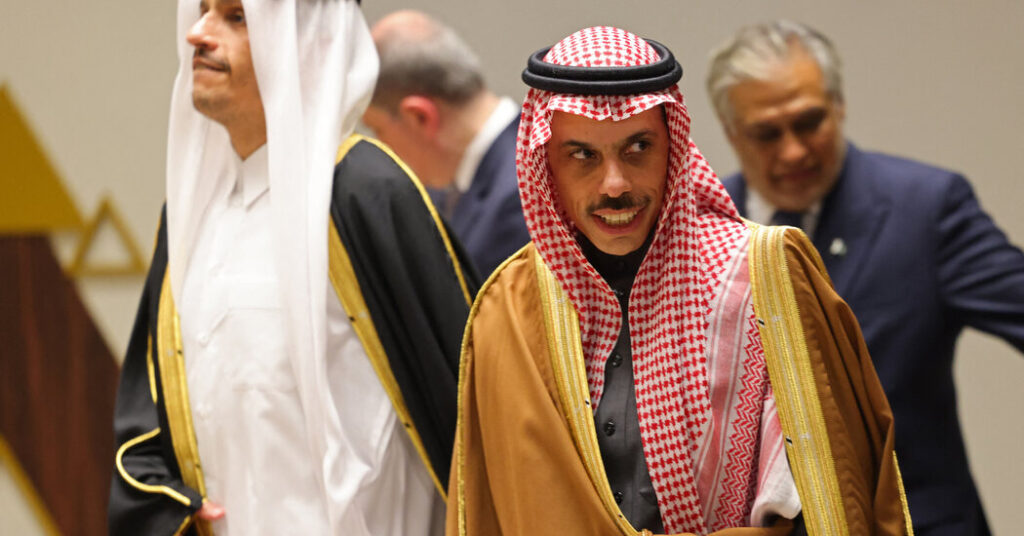
Hours after eight ballistic missiles exploded over the Saudi capital, the kingdom’s foreign minister warned that his government had limited patience with Iran and reserved the right “to take military actions if deemed necessary.”
“We will not shy away from protecting our country and our economic resources,” the minister, Prince Faisal bin Farhan, said at a news conference early Thursday morning.
When asked what would prompt a military response, the prince declined to elaborate. “Do they have a day, two, a week?” the prince asked. “I’m not going to telegraph that.”
He added that “what little trust” there was between the kingdom and Iran had “completely been shattered.” The countries re-established diplomatic relations in 2023.
Since the American-Israeli assault on Iran began on Feb. 28, Iran has retaliated by firing thousands of missiles and drones at Persian Gulf countries that host American military installations.
At first, Saudi Arabia was largely spared of that onslaught, fielding significantly fewer attacks than its neighbors, but that has changed as the war has expanded.
On Wednesday, there was an attack on Iran’s South Pars gas field, part of the world’s largest offshore natural gas field, with President Trump saying that Israel was responsible for the strikes. Hours after the attack, on Wednesday night, two waves of incoming ballistic missiles were intercepted over Riyadh, according to the Saudi defense ministry.
The interceptions reverberated over the city in loud booms, and four foreign residents were injured as fragments of munitions fell to the earth.
The attacks on Riyadh happened during a gathering there of foreign ministers and senior diplomats from the Gulf and regional countries, including Egypt, Pakistan and Turkey. They had traveled to Riyadh to discuss the Iranian attacks across the region.
Prince Faisal said that he believed the timing of the attacks was intentional, calling it an attempt to intimidate the diplomats present and saying it was “the clearest signal of how Iran feels about diplomacy.”
“All I can say is, we were not intimidated,” Prince Faisal said.
On Wednesday evening and Thursday morning, the Saudi defense ministry also reported dozens of incoming drones, including one that it said struck a major oil refinery on the kingdom’s Red Sea coast.
The ministry said on Thursday that a ballistic missile targeting a key energy export terminal on the Red Sea, the port at Yanbu, had been intercepted. The port serves as the endpoint of a Saudi oil pipeline built to circumvent the Strait of Hormuz, a crucial waterway for oil tankers that has mostly been choked off by Iranian attacks.
The Saudi authorities have generally not named the source of attacks on the kingdom, leaving open the question of whether they think some strikes could have been carried out by Iraqi militias aligned with Iran, or by other parties.
Since the war began, Iranian diplomats have denied that their country was behind the attacks on the Gulf countries, according to Prince Faisal. “All of these denials fall, I have to tell you, on deaf ears,” he said on Thursday.
Asked whether Saudi Arabia would prefer a quick end to the war, or a longer fight in which Iran’s military capabilities were further degraded, the prince said that he cared only about halting the attacks on Saudi Arabia and its neighboring countries.
“We’re going to use every lever we have — political, economic, diplomatic and else-wise — to get these attacks to stop,” he said.
Vivian Nereim is the lead reporter for The Times covering the countries of the Arabian Peninsula. She is based in Riyadh, Saudi Arabia.
The post Saudi Official Warns Patience Is Limited as Iranian Attacks Barrage Kingdom appeared first on New York Times.