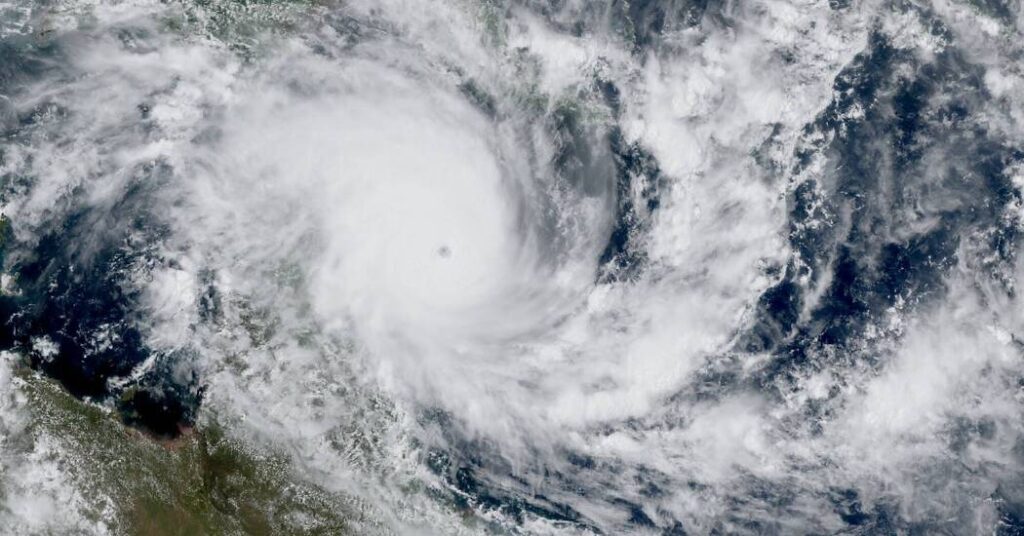
A remote part of Australia was bracing for a tropical system that was expected to make landfall in northern Queensland on Friday as the most intense of the country’s hurricane categories. Forecasters and government officials warned of severe impacts, including significant damage to property and extensive power outages.
The Bureau of Meteorology, Australia’s weather service, issued warnings across parts of the Cape York Peninsula, a remote and sparsely populated region at the far northern tip of the country.
Angus Hines, a meteorologist at the bureau, said some “major weather hazards” were possible as Narelle made landfall, with maximum wind gusts expected to exceed 250 kilometers per hour — just over 155 miles per hour. That would make the storm a Category 5 cyclone according to the bureau’s five-point system, which is equivalent to a Category 4 hurricane on the Saffir-Simpson scale that governs North American storms.
“Winds of that speed are only likely right around the crossing point,” Mr. Hines said. Across a broader stretch of northern Queensland, however, he added that wind gusts between 120 and 160 k.p.h. (about 75 to 99 m.p.h.) were expected. “Which are still extremely strong winds that will cause damage,” he said.
“It is a big system, “ the Queensland premier, David Crisafulli, told the local news media.
Mr. Crisafulli said he had sent emergency crews to the region ahead of the storm and warned that damage was expected to be “significant.”
“This is an area that knows what to do during heavy rainfall, large winds and tropical cyclones,” he said. “But this may be the biggest system that many people have seen in living memory.”
Narelle is arriving near the end of Australia’s tropical cyclone season, which typically runs from November to April, although cyclones can occasionally form at other times of the year. Since 1980, an average of 10 tropical cyclones have developed each season.
In addition to damaging winds, heavy rainfall is expected to pose a serious threat as the system approaches and crosses the coast on Friday. The heaviest rain is expected between Cape Melville and Cape Tribulation, extending northward and to inland areas west of Coen. Mr. Hines said 24 hour rainfall totals between 100 and 350 millimeters, or around four to 14 inches, were possible. That would most likely lead to flash flooding in vulnerable regions.
Perilous conditions are also expected along the coast, forecasters warned. On Friday morning, tides are expected to rise well above normal levels as Narelle nears and crosses the coast, particularly in Princess Charlotte Bay. Dangerous flooding will be possible there, and residents have been warned about the risk of damaging waves.
As Narelle tracks inland over the Cape York Peninsula on Friday, Mr. Hines said, the system is expected to weaken, potentially dropping to a category two storm. Despite this, he said that the storm “will be with us and talked about and producing weather impacts” into early next week.
Late Friday night into Saturday morning, Narelle is forecast to move into the warm waters of the Gulf of Carpentaria. There, Mr. Hines said, it is likely to regain strength, potentially intensifying into a severe category 3 tropical cyclone on Saturday. It is then expected to make a second landfall along the eastern Northern Territory beginning late Saturday. He added that a third possible landfall, near Kalumburu at the northern most tip of Western Australia, could occur between Monday and Tuesday.
Nazaneen Ghaffar is a Times reporter on the Weather team.
The post Remote Part of Australia Braces for ‘Significant’ Tropical System appeared first on New York Times.