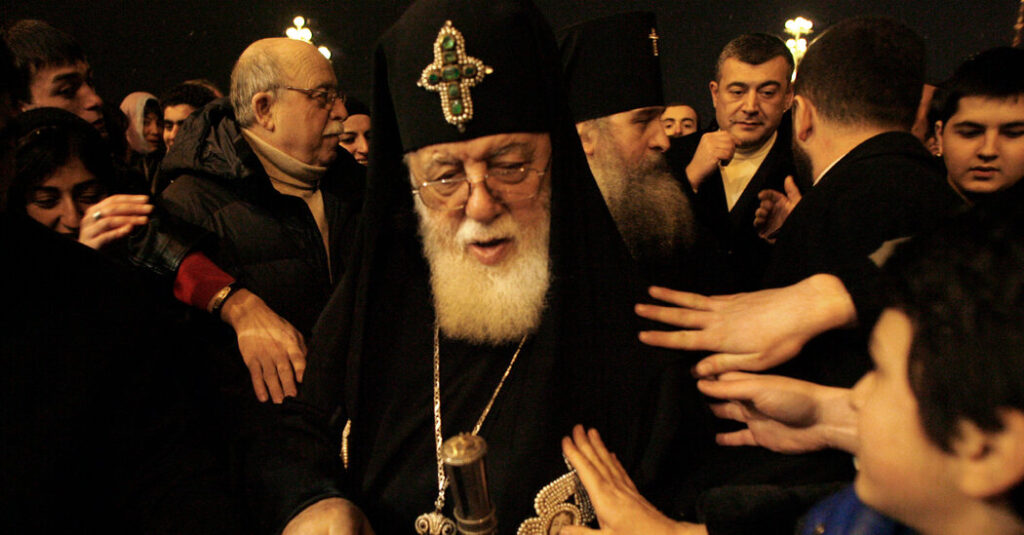
Patriarch Ilia II, who led the Orthodox Church in Georgia for almost a half-century and transformed it into the linchpin of the country’s national identity, died on Tuesday in Tbilisi, the capital. He was 93.
His death, in a hospital, was confirmed in a statement by the church. On Wednesday, the Georgian government declared five days of national mourning, which will culminate on Sunday, when the patriarch will be buried at Tbilisi’s ancient Sioni Cathedral.
Thousands of Georgians accompanied the coffin on Wednesday as it was transferred from the patriarchate in Tbilisi’s Old Town to the Holy Trinity Cathedral, the country’s largest church, where he was to lie in state until Sunday.
As Georgia navigated the transition from Soviet repression and civil strife to modern statehood, Ilia II provided a sense of continuity and spiritual stability during tense periods — from the economic collapse of the 1990s to the 2008 war with Russia over two secessionist territories and Georgia’s current drift away from the West.
As the longest-serving patriarch in the history of the Georgian Orthodox Church — one of the oldest Christian institutions in the world — Ilia II transformed the church into the country’s most resilient and venerated institution.
“His word had significance in society — everyone listened and paid heed to him,” Armaz Akhvlediani, a Georgian lawmaker who was close to Ilia II for many years, said in an interview. “The patriarch was able, with extraordinary wisdom, to lead the Georgian people through all these terrible roads and paths so as to always remain on the side of normalcy, on the side of the best interests of the church and the state.”
Georgia prides itself on having been one of the first nations to adopt Christianity as a state religion, and its population remains deeply devout. When Ilia II became leader in 1977, however, the church consisted of only a few dozen open parishes and a handful of monasteries. He oversaw an extensive expansion and worked to secure the recognition of the church’s independence. Today, the Georgian Orthodox Church has more than a thousand parishes.
Following the end of Soviet anti-religious suppression, new challenges emerged in Georgia. The country was plunged into civil war, with street battles in central Tbilisi and breakaway regions claiming independence. This post-Soviet power vacuum elevated the role of religion but also made it increasingly difficult for the church to navigate the society’s political polarization.
In the 1980s, Ilia II supported and often sheltered leaders of the Georgian national anti-communist movement. In 1989, anticipating the arrival of Soviet tanks to crush dissent, he called for protesters to move from the central square in front of the Parliament building to a nearby church. The protesters remained, and 21 people were killed in the subsequent crackdown.
Throughout the 1990s, at the height of civil strife, Ilia II sought to mediate between opposing factions. In the 2000s, as Georgia underwent rapid liberal reforms and drifted toward the West, he tried to maintain ties with Russia and its Orthodox Church, which he had been connected with through his education in Moscow.
In 2013, five years after the 2008 war, Ilia II met with President Vladimir V. Putin in the Kremlin, telling him, “I believe that the problems existing between us will be eliminated, and we will continue to be brothers.”
After the Russian invasion of Ukraine in 2022, Ilia II called for an end to the hostilities but also did not recognize the independence of the Orthodox Church of Ukraine, saying that “the government of Ukraine, being at war, has its own position towards it, and does not consider religious depth.” In his traditional Easter epistle in 2023, he called for peace and reconciliation.
“We live in a difficult period, an explosive time when the threat of nuclear catastrophe is real,” he wrote. “Therefore, we think especially about peace, which is a precious divine gift.”
In a condolence note on Wednesday, his counterpart in Russia, Patriarch Kirill, said that their friendship predated the Soviet collapse and that they had been “personally linked by very kind and trusting relations.”
Mr. Akhvlediani, the Georgian lawmaker, called Ilia II “a great diplomat.” But he also said that the patriarch had “simply made no compromises when it concerned the integrity of Georgia and its independence.”
Beyond geopolitics, Ilia II addressed the tension between Georgia’s deeply rooted conservatism and a modern-day push for L.G.B.T.Q.+ rights. In 2014, he introduced a Day of Family Purity in response to the International Day Against Homophobia, Biphobia and Transphobia. Both days are observed on May 17, with the Day of Purity marked by large conservative religious processions in central Tbilisi.
He also responded to Georgia’s declining birthrate by promising to personally baptize the third child and any subsequent children of any family married in the church. By 2026, nearly 50,000 children had been baptized through this initiative.
Beyond his ecclesiastical duties, Ilia II was a prolific composer and an artist who painted icons and frescoes. He is survived by a sister, who is a nun, and a nephew, who is a bishop in the city of Batumi, Georgia.
Ilia II was born Irakli Ghudushauri-Shiolashvili on Jan. 4, 1933, in Vladikavkaz, a city in Russia’s mountainous North Caucasus region. His family had moved there in the 1920s from a nearby Georgian village. After finishing school, he enrolled in the Moscow Theological Seminary and later the Moscow Theological Academy, graduating in 1960. He was tonsured a monk and ordained under the name Ilia in Tbilisi in 1957.
Upon finishing his studies, Ilia II returned to serve in the Black Sea port of Batumi. As one of the most educated young clerics in what was then a diminished church, he rose quickly through the ranks, becoming patriarch in 1977.
In 40 days, the church’s top clergy will convene to elect a new prelate, a process expected to be completed within two months.
Ivan Nechepurenko covers Russia, Ukraine, Belarus, the countries of the Caucasus, and Central Asia.
The post Patriarch Ilia II, a Spiritual Figure of Stability in Georgia, Dies at 93 appeared first on New York Times.