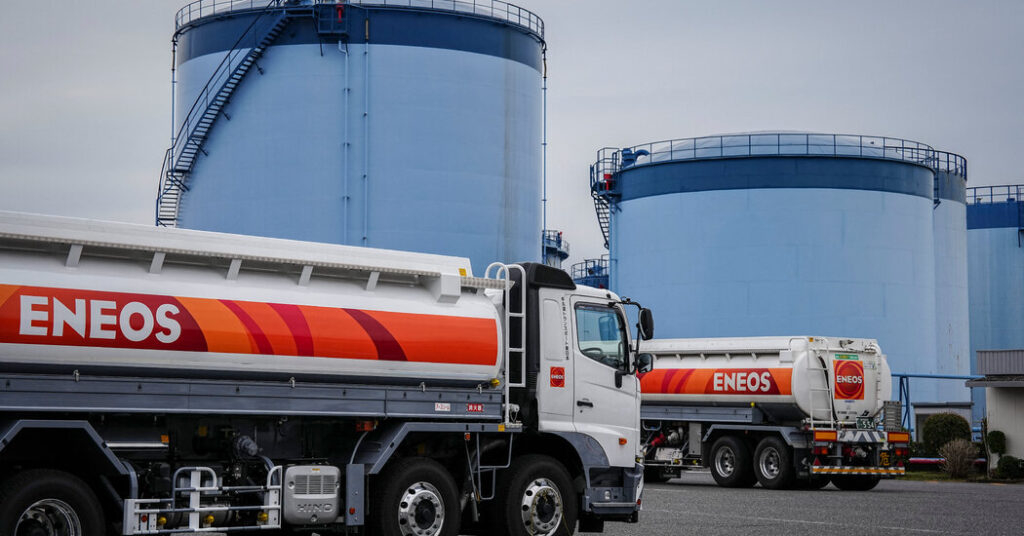
Oil prices continued to climb steadily and stocks across Asia dropped on Thursday after attacks on major energy facilities in Iran and Qatar injected new uncertainty into the outlook for energy supplies.
Global oil prices top $112 a barrel.
-
The price of Brent crude rose to $112 a barrel on Thursday, an increase of over 4 percent. Brent, the global benchmark for crude oil, settled on Wednesday at $107.38 a barrel, bringing the cost of the commodity up over 48 percent since the war began.
-
West Texas Intermediate crude, the U.S. benchmark, rose about 1 percent to $96 a barrel. W.T.I. settled at $96.32 on Wednesday.
-
Oil and natural gas prices shot up on Wednesday after Iran and Qatar said Israel had struck South Pars, a vast offshore gas field the countries share, in an airstrike that affected Iranian facilities. Hours later, a state-owned Qatari energy company said that a major energy hub in the country, Ras Laffan Industrial City, had sustained “extensive damage” from missile attacks. Qatari officials blamed Iran for the attack.
-
Investors and analysts across the world have been focused on the Strait of Hormuz in the Persian Gulf since the United States and Israel attacked Iran on Feb. 28. Shipping traffic exiting through the strait has been effectively halted because of the risk that vessels could be attacked.
Gasoline prices go up again.
-
Gas prices rose on Wednesday, and stood at a national average of $3.84 a gallon, according to the AAA motor club. The increase has raised the cost for drivers by almost 29 percent since the war began.
-
The Trump administration said on Wednesday that it would temporarily waive the Jones Act, a maritime law that restricts the way cargo, including energy supplies, is shipped within the United States. Analysts and some shipping executives expect the move to have only a marginal impact on gasoline prices.
-
The price drivers pay for gasoline tends to track the price of crude oil, which has climbed sharply since the start of the war and the closure of the Strait of Hormuz, a vital shipping lane for energy supplies from the Middle East.
-
Diesel prices have increased even more quickly and stood at $5.07 on Thursday, up 35 percent since the start of the war.
Stocks fall in Asia.
-
Stocks traded lower on Thursday across Asia, where countries import vast quantities of oil and gas. The Nikkei 225 in Japan fell more than 2 percent and the Hang Seng Stock Index in Hong Kong dropped over 1 percent.
-
Futures for the S&P 500 pointed to a slight increase when stocks resume trading in the United States. The S&P 500 fell 1.4 percent on Wednesday, bring its loss since the war began to 3.7 percent. Jerome Powell, the chair of the Federal Reserve, noted on Wednesday that the inflationary impact from the war was likely to keep the Fed from lowering interest rates in the near future.
The post Oil Prices Keep Climbing on Heightened Fears Over Energy Supplies appeared first on New York Times.