What do we owe others? That question hovers like an accusation over “Kontinental ’25,” a sharp, unforgiving satire about life, death and the politics of learned hopelessness, among other weighty subjects. By turns unsettling and queasily amusing, this is a movie that will hit anyone who has responded to a grim news alert by hurriedly swiping left, anyone who has ignored strangers begging for food (or doesn’t even see them), anyone who has sunk into apathy. It’s a sneak attack of a movie, one that invites your laughter, even as it jabs you in the ribs.
Orsolya (Eszter Tompa), who’s married with children, works as bailiff in a city in northwest Romania. Outwardly, she seems decent and reasonable, as well as earnestly concerned about other people. Her job, though, comes with its demands, as she earnestly spells out for an indigent older man, Ion (Gabriel Spahiu), early in the story. Accompanied by some needlessly aggressive gendarmes, she has come to evict Ion, who has been squatting in the boiler room of a building.A large commercial concern plans to tear it down, Orsolya explains, and build a luxury hotel called the Kontinental Boutique in its place.
The eviction clearly isn’t meant to be personal, not at all, even if there’s little that’s more personal than what we call home. It’s just that Orsolya has a job to do and the law on her side, while for his part, Ion only has his meager belongings. He’s in desperate straits; before long, he is also dead. Orsolya is devastated by his death, but for her, it’s complicated. “You are not to blame,” a co-worker reassures her as she weeps. “Legally, yes, I know,” Orsolya responds, perhaps a little too readily, too forcefully. And so it goes as, with plenty of tears, she repeatedly explains what happened and ostensibly why. You’re not to blame, other people reassure her, which begs the question: Who actually is to blame?
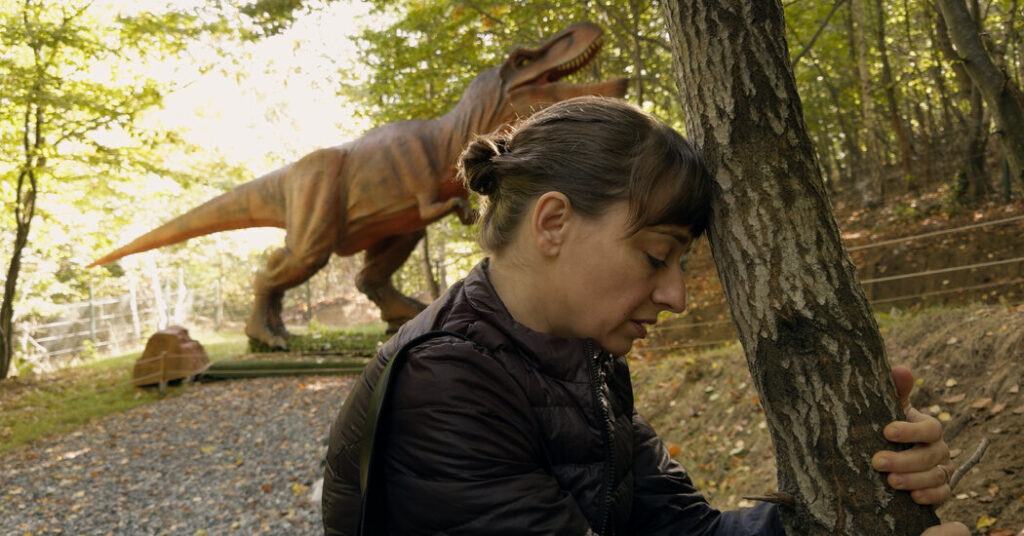
The Romanian writer-director Radu Jude cranks up this tough, spare story with nicely calibrated timing and some narrative sleight of hand. During the movie’s first minutes, it simply tracks the shambolic fellow later identified as Ion, who’s initially wandering through a woodsy outdoor attraction featuring ridiculous animatronic dinosaurs. Although he’s alone, he occasionally conducts an audible, profane conversation with himself as he walks through the park collecting empty bottles. He’s an opaque, distant figure — physically and otherwise — and his mumblings are lightly comic. After a spell, he eats and drinks, and wanders into a busy city area where he asks for handouts. And then Ion returns to his squat, and suffers a lonely, agonizing death.
Jude uses the brief glimpses of Ion’s life and his abject death to introduce the movie’s themes, which he then transposes onto the guilt-wracked Orsolya. She’s an appealing character, at least at first, and far more developed than Ion, who’s largely a plot device. Much of the rest of the movie consists of direct, unfussy scenes of her in her everyday life, including exchanges with other people in which she explains what happened. These encounters reveal facets of her personality, and also inspire self-interested reactions. One friend expresses her detailed disgust about another unhoused man; Orsolya’s mother, in turn, uses her daughter’s despair to vent a blast of splenetic nationalism.
For the most part — and Ion’s death excepted — Jude’s touch throughout “Kontinental ’25” remains relentlessly light, which only deepens and darkens the satire. As Orsolya keeps weeping, she keeps insisting on her innocence, keeps looking for absolution and, crucially, keeps failing to do anything to prevent a similar death. As the movie progresses, her tears continue to fall, but they soon begin to wash away Ion’s memories. All that’s finally left is Orsolya’s anguish and Jude’s scorching indictment of a world that provides so much — nice cafes, family vacations, spacious apartments — to those who can pay for such privileges, while the many Ions of the world pay the far costlier price.
If this were a different movie, Orsolya could easily prove too blunt an instrument, like one of those cudgel-like characters that some filmmakers use to hammer in ideas about capitalism and bourgeois complicity. (Never mind that the usual audience for such movies is equally bourgeois and complicit.) Jude can go broad, certainly; his movies include the crudely farcical “Dracula” and the deliriously overstuffed “Do Not Expect Too Much From the End of the World.” Yet part of what makes this one resonant is that he doesn’t hector or lecture you, or offer the kinds of soothing, empty palliatives that American filmmakers tend to be fond of. If Jude doesn’t bother with those kinds of ritualistic gestures, it’s because he knows they’re not what it would take to make a better world — and we know it too.
Kontinental ’25 Not rated. Running time: 1 hour 49 minutes. In theaters.
Manohla Dargis is the chief film critic for The Times.
The post ‘Kontinental ’25’ Review: Do Unto Others (or Not) appeared first on New York Times.