The escalating conflict in the Middle East has narrowed the Federal Reserve’s path to lower interest rates this year, as surging energy prices have injected fresh uncertainty into the economic outlook.
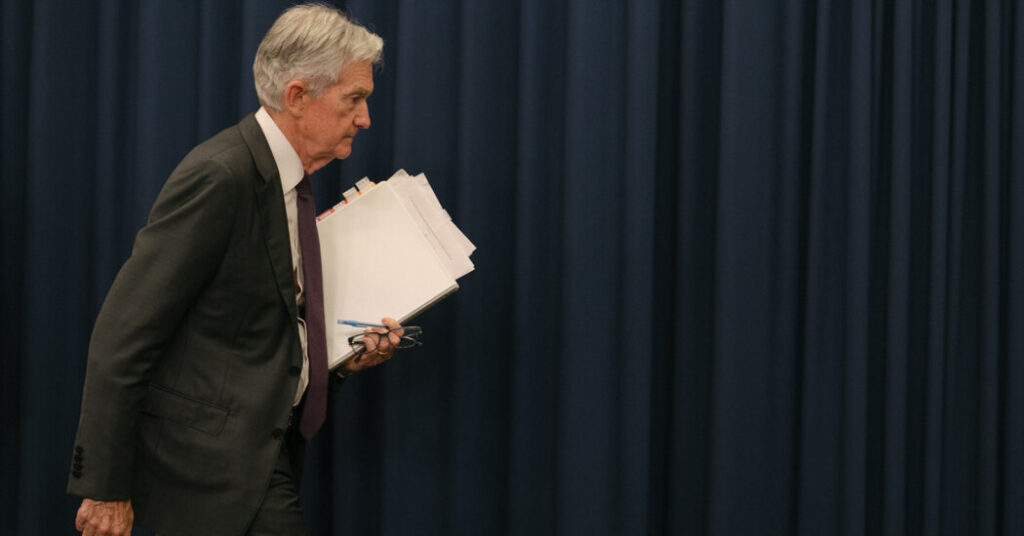
Jerome H. Powell, the Fed chair, sought on Wednesday to keep the central bank’s policy options open after officials voted to hold borrowing costs steady at their first meeting since the onset of the Iran war. But even as Mr. Powell tried to avoid sending an explicit signal in any direction about where rates might be headed, it quickly became clear that a cut this year is by no means guaranteed.
Mr. Powell quickly jettisoned projections published by the Fed on Wednesday that showed a majority of policymakers supporting at least one quarter-point reduction by year’s end. At a news conference, he said that officials had “no conviction” in their forecasts at a moment when it was unclear how long the war would last and, in turn, how long energy prices would stay elevated. At one point on Thursday, Brent crude, the international benchmark for oil, topped $118 a barrel. Just a month ago, it traded around $70.
The only other point that Mr. Powell seemed willing to stress about the Fed’s latest estimates was that there was growing skepticism from several policymakers about the degree of support needed for the economy. In December, eight officials expected two or more cuts this year. Five were in that camp as of this week. Seven officials forecast no adjustments at all. Even so, just one policymaker saw a rate increase next year.
On Wednesday, Mr. Powell described rates, which are set at 3.5 percent to 3.75 percent, as “borderline” restrictive, meaning the central bank’s policy settings are only marginally weighing on economic growth. That was the right place to be, he said, with inflation still too high for the Fed’s liking, the unemployment rate relatively stable around 4.4 percent and the risks to both pulling in opposite directions.
If rates are already close to a “neutral” level that neither speeds up nor slows growth, it will be hard to build the case for cuts without a meaningful deterioration in the labor market. In fact, Mr. Powell made clear that cuts were conditional on inflation moving back toward the Fed’s 2 percent target this year, a process that could easily be disrupted by the war.
“If we don’t see that progress, then you won’t see the rate cut,” he said.
Traders in futures markets heeded that warning, and as of Thursday scaled back their expectations for rate cuts this year.
Further complicating the Fed’s plans is that Mr. Powell is slated to step down as chair in roughly two months if President Trump’s pick for the top spot, Kevin M. Warsh, is confirmed by the Senate. That process has become much more complicated, however, because of a criminal investigation opened by the Justice Department against the Fed.
Mr. Warsh is widely expected to support lower rates to some degree, although perhaps not as aggressively as Mr. Trump would like. Still, he could find it hard to rationalize any relief in borrowing costs if inflation is moving in the wrong direction.
Economists say it is too early to know how high inflation will rise in the coming months because of soaring energy prices. Even before the conflict began, Dean Maki, the chief economist for Point72, a hedge fund, worried that sticky price pressures stemming from the services sector and the lingering impact of Mr. Trump’s tariffs would keep underlying inflation at or above 3 percent this year.
As of January, the Fed’s preferred inflation gauge — the core Personal Consumption Expenditures index — stood at 3.1 percent, up from a low of 2.6 percent last April. Fed officials see this metric dipping to only 2.7 percent this year, according to the latest projections.
“The risks are rising, along with the risk to the inflation outlook, that the Fed may not cut at all,” said Mr. Maki, who had expected the central bank to again lower rates in September.
Jonathan Pingle, who used to work at the Fed and is now the chief U.S. economist at UBS, said he now forecasts inflation to peak at a slightly higher level this year as growth slows and the unemployment rate edges up to 4.6 percent. That reflects the pullback in consumption that is likely to arise from surging energy prices. As of Thursday, the average gas price in the United States was $3.88 per gallon, according to AAA.
“Every incremental addition to that headline inflation forecast, in my view, is going to mean a little less growth and a little higher unemployment rate,” Mr. Pingle said. He still sees rate cuts in play in the latter half of the year because of continuing labor market weakness that he said was going to “periodically reassert itself as a source of material concern for a good chunk of this committee.” However, Mr. Pingle conceded that the timing could be pushed back in the event of a prolonged war.
Even if broad-based support for cuts emerges this year, Diane Swonk, the chief U.S. economist for the accounting firm KPMG, cautioned that the relief could be minimal in light of the successive nature of the economic shocks that have prompted companies to pull back.
“I understand the risk to the labor market, but rate cuts can’t cure what ails it if it’s systemic uncertainty that’s holding back employment,” she said. “It’s uncertainty in everything, from tariffs to artificial intelligence and what does that mean for business models to now a war. That’s persistent, and all the rate cuts in the world can’t change the demand for workers in that kind of situation.”
Rather, Ms. Swonk worried that rate cuts would instead rev up demand for borrowing, risking higher inflation amid constrained supply, which would only further exacerbate the Fed’s dilemma.
Colby Smith covers the Federal Reserve and the U.S. economy for The Times.
The post Iran War Narrows Fed’s Path to a Rate Cut appeared first on New York Times.