At the height of an election campaign in the German state of Baden-Württemberg last month, candidates from the area’s main political parties gathered for a televised debate. One of them came from a far-right party, the Alternative for Germany, or AfD.
It was a first for the state, a relatively wealthy enclave of the former West Germany that has long resisted far-right leaders. And it was a sign of the times for the nation as a whole.
In the halls of Parliament in Berlin, AfD members are pariahs, designated as suspected right-wing extremists by federal intelligence. None of the other parties will work with them to form a government. It is a strategy known as a “firewall,” and it has kept the AfD from power even as it gains popularity.
But on airwaves throughout the country, and in town-hall-style gatherings and mundane city-council sessions across eastern Germany, the AfD has become something else entirely: a mainstay of daily life.
That’s particularly true for Germans in the east who live away from major cities. They say they feel ignored by the mainstream parties that have governed the country since East and West Germany reunited in 1990.
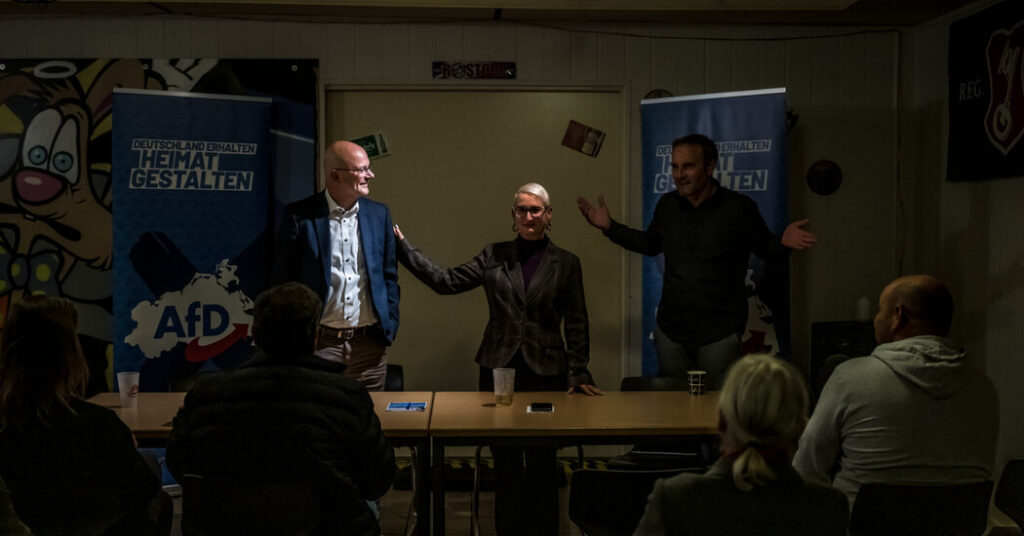
On a rainy Friday evening last fall, about 30 people crowded into a makeshift bar on the outskirts of Stavenhagen, a quiet village two hours north of Berlin where the AfD secured about 42 percent of the vote in last year’s federal election. The crowd settled in for an evening of lecture and banter with representatives of the AfD, which has become the region’s most popular political party.
“No one else does this sort of thing,” said Klaus Skotnik, who watched in Stavenhagen as his brother, Christian, an AfD state parliament candidate, voiced complaints about wind power, vaccination laws and speech restrictions in schools.
That presence in small rural towns has fed a political surge that could vault the party to real power for the first time this fall. Polls suggest that the AfD could emerge as the strongest force in a pair of eastern state elections in September — in Mecklenburg-Western Pomerania, which includes Stavenhagen, and in Saxony-Anhalt, to the west and south of Berlin.
The AfD has built a following by stridently opposing migration from the Middle East and elsewhere over the last decade as part of an anti-establishment, populist message. That growth has intensified since Russia invaded Ukraine in 2022, amid AfD opposition to Germany’s support for Kyiv. The party finished second in last year’s German federal elections, behind Chancellor Friedrich Merz’s center-right Christian Democrats.
Mainstream parties, said Enrico Schult, an AfD member of the state parliament who spoke at the gathering in Stavenhagen, “are afraid of us, and they’re right to be afraid of us.”
Mr. Merz and other mainstream politicians have shunned the AfD on the federal level, calling its rhetoric inflammatory and anti-democratic. Germany’s federal intelligence agency has classified the party branches in the states of Brandenburg, Saxony, Saxony-Anhalt and Thuringia as right-wing extremist, in part because of a history of discriminatory statements by their leaders.
Though working with the AfD to pass laws is largely taboo in the federal legislature, it is increasingly seen as necessary to get things done at a local level.
A paper by researchers at the Berlin Social Science Center found more than 100 instances of city and district politicians cooperating in some way with the AfD from 2019 to 2024. One example: In Ziesendorf, a village half an hour’s drive from the Baltic Sea, representatives from the Christian Democrats recently teamed up with the AfD to block a plan to convert an abandoned Coca-Cola factory into housing for refugees.
In Mecklenburg-Western Pomerania, mainstream parties have promised to keep the AfD out of governing coalitions even if it finishes first in the fall elections there, meaning the AfD would need to win an outright majority of seats to take power.
Yet that consensus is fraying. Stefan Kerth, a longtime member of the Social Democrats in Mecklenburg-Western Pomerania, left his party over its firewall, calling it unrealistic and against the will of the voters.
The firewall “is such a big-bubble elite ideology project,” he said. “At the local level, this is downright stupid for democratic culture.”
The AfD also enjoys a strong tailwind from Trump administration officials, who support the party’s immigration stances. Last year in Munich, Vice President JD Vance called on European leaders to drop their bans against parties like the AfD, declaring that there was no longer room for firewalls in European politics.
Some of the AfD’s success stems from history. Decades of Soviet rule left East Germans with few civic institutions and no deep relationship with the centrist political parties that grew up in the democratic West, experts say.
“There is a vacuum there for historical reasons, and the AfD is simply managing to fill that vacuum,” said Stefan Merz, senior elections director at Infratest dimap, a polling firm in Berlin.
Part of the AfD’s appeal is the simple act of showing up.
Stavenhagen is home to around 5,000 people, a few logistics companies and a potato processing plant. Those residents are not used to much attention from centrist politicians.
Yet when Christian Skotnik, the AfD candidate, held his event in Stavenhagen last fall, he gave the impression of taking the town seriously. He discussed a range of topics, including support for apprenticeship programs and proposals to resume compulsory military service in Germany. He lingered on concerns over wind turbines, a particularly hot topic in the area.
Other parties are not making similar efforts to reach those voters, said Jan Müller, a political scientist at the University of Rostock, on the Baltic Coast.
“This interaction in a small town,” he said, constitutes “a huge event” for its residents.
The AfD is also building a higher profile on television across the country. Because of its high polling, it has become more visible on public TV formats that are reserved for party leaders who have a realistic chance of winning elections. One significant moment was when the AfD chancellor candidate Alice Weidel was invited to a federal leadership debate last year.
In the recent campaign in Baden-Württemberg, the local AfD party fared well enough in polls for its leader, Markus Frohnmaier, to earn a debate invitation alongside centrist candidates.
The AfD does not always make the main broadcast debates — in another recent election campaign, in the western state of Rhineland-Palatinate, its candidate failed to reach the polling threshold for inclusion.
And the party’s power on the airwaves has not yet translated into a seat in state or federal government. The AfD finished third in the Baden-Württemberg race this month — not enough to join the local coalition government.
The other parties still refuse to work with it.
Christopher F. Schuetze contributed reporting from Berlin.
Jim Tankersley is the Berlin bureau chief for The Times, leading coverage of Germany, Austria and Switzerland.
The post In Some Areas of Germany, the Far Right Is Part of the Fabric appeared first on New York Times.