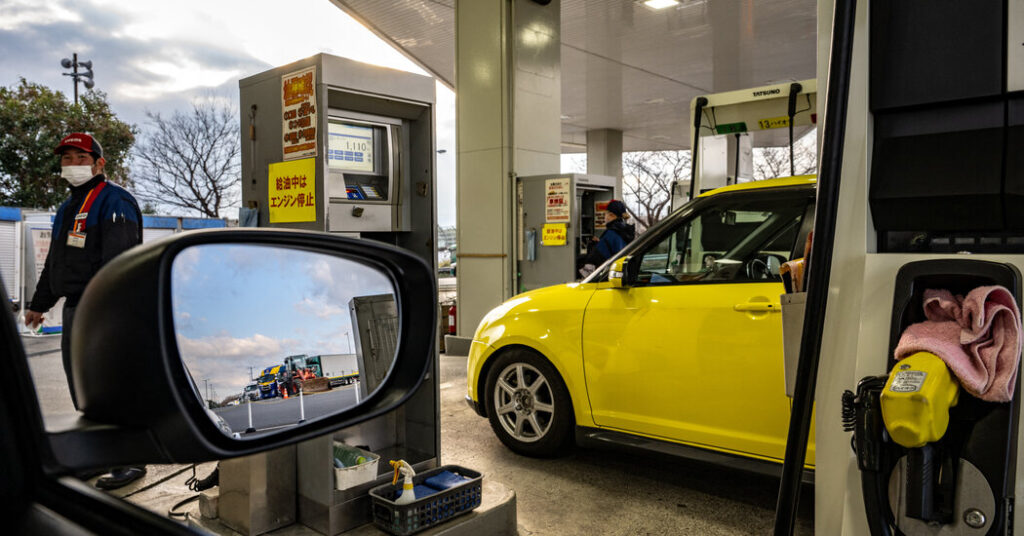
Gasoline prices in Japan reached a record high this week, presenting a challenge for the nation’s popular prime minister, Sanae Takaichi, who has campaigned on a platform of shielding Japanese households from the pain of rising prices.
Japan is heavily dependent on the Middle East for its supply of crude oil, which topped $114 a barrel on Thursday. In Japan, the average retail price of gasoline climbed to 191 yen, or about $1.20, per liter on Monday, according to data from Japan’s economy ministry. That marked an 18 percent increase from a week earlier.
The surge in fuel costs illustrates the potential for the widening war in the Middle East to strain Japanese household budgets and test the political capital of Ms. Takaichi, who secured a landslide victory in last month’s snap election on promises to “protect citizen livelihoods.” She is set to meet with President Trump at the White House later on Thursday.
Before the war, inflation in Japan had cooled in recent months, after hovering above the central bank’s 2 percent target for more than three years.
The Japanese government is deploying a suite of measures in response to the energy price rises and supply shortages. State subsidies scheduled to take effect on Thursday are aimed at bringing gasoline prices down to a target of around 170 yen per liter. The administration has also authorized the release of strategic oil reserves to bolster domestic supply.
Still, economists say these interventions may not be able to contain the impact on prices if the U.S.-Israeli war on Iran persists. With Iran now targeting major energy facilities in Qatar and Saudi Arabia in retaliation for airstrikes on its South Pars offshore gas field, disruptions to global energy flows show little sign of subsiding.
Beyond transportation, the crisis could spread to food prices given the Persian Gulf’s status as a major source of the world’s fertilizer. Japan is one of the world’s largest net importers of agricultural products.
“This is exactly the sort of shock that is bad news for an economy like Japan’s,” said Stefan Angrick, the head of Japan economics at Moody’s Analytics, an economic data and research provider.
In the near term, Japan has mechanisms to absorb volatility, he said. But if the current energy disruptions drag on, similar to the long-term upheavals following Russia’s invasion of Ukraine in 2022, “those buffers start failing and then it starts feeding through to the domestic economy,” Mr. Angrick said.
“I wouldn’t be surprised if Japan’s G.D.P. just flatlines a little bit from here,” he said.
River Akira Davis covers Japan for The Times, including its economy and businesses, and is based in Tokyo.
The post Gas Prices in Japan Hit Record High, Testing Leader’s Cost-of-Living Pledge appeared first on New York Times.