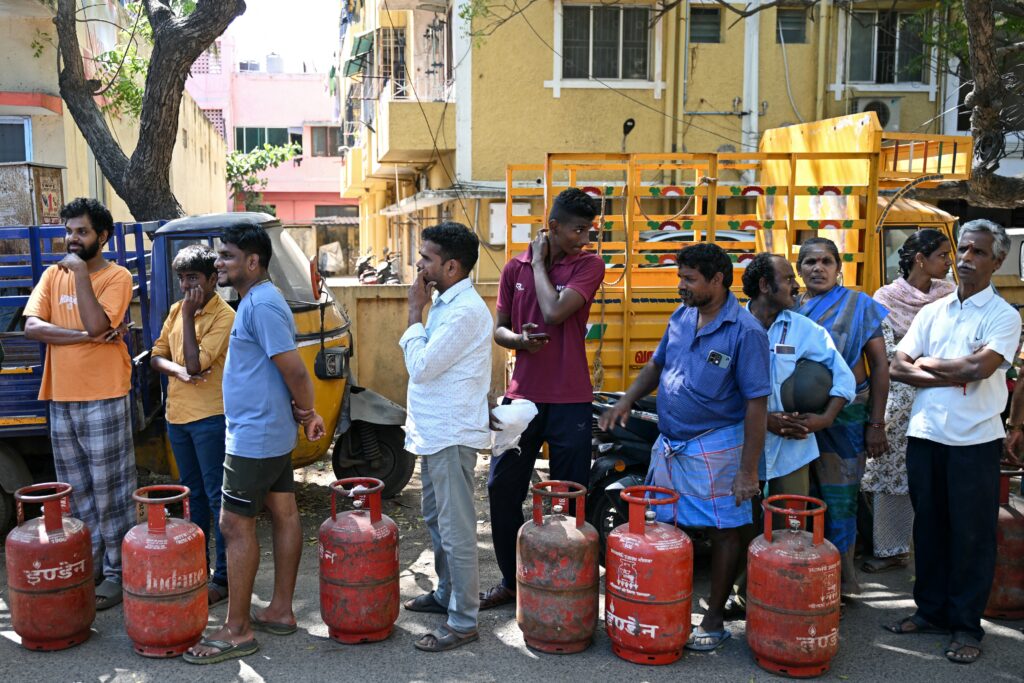
ROME — As the United States wages war with no clear endgame, large swaths of the globe are suffering worse than Americans from the economic fallout, weathering gasoline shortages, falling currencies and more severe energy shocks.
Iran’s retaliatory attacks have largely blocked the Strait of Hormuz, turning the transit point for one-fifth of the world’s crude into a trial by fire for cargo ships and sending oil prices soaring. That is triggering hikes at the pump — on average by 23.6 percent for Americans. That’s worse than much of Europe, where gasoline prices were already far higher. But it’s less painful than the 39.5 percent spike in Nigeria, 32.9 percent hike in Laos or 31.8 percent jump in Australia, according to GlobalPetrolPrices.com.
There is no repeat in America of the gas shortages that plagued the United States in the 1970s. But they are already hitting countries in Asia. Thailand ordered civil servants to work from home while panic buying causes gas pumps to run dry in some areas. Bangladesh and other nations have begun rationing fuel. To conserve precious fuel stores, Sri Lanka and the Philippines have taken the extraordinary step of moving some workers to a four-day workweek.
The shortages and price surges are set to worsen as a fresh escalation of attacks by both sides on major energy fields threatens a new phase in the war. A key benchmark of global oil prices — Brent crude — climbed to around $115 a barrel on Thursday.
“We are victims of a war that is not of our choosing,” Philippines President Ferdinand Marcos Jr. declared this month.
For much of the world outside the U.S., the problem isn’t just gasoline prices.
The bottleneck in the strait, as well as fresh Israeli strikes in Iran and Iranian reprisals on Qatar — a major producer of natural gas — have sent liquefied natural gas prices soaring well into the double digits in Europe and Asia, both net importers. European prices on Thursday surged to their highest level since the war began. That’s slamming energy-intensive companies including Italian paper producers and German chemical makers. Yet because natural gas prices are less globalized than oil, the competitors of European companies in the U.S. — the world’s largest gas producer — have enjoyed relatively stable prices since the war began.
Nearly one-third of key fertilizer components arrive from the Middle East, and the war is stalling shipments and creating shortages. That’s bad news for American farmers, but worse for poorer nations such as Sudan, Tanzania and Sri Lanka that are relatively more reliant on supplies from the Middle East. The United Nations World Food Program warned Tuesday that nearly 45 million more people could fall into acute food insecurity if the conflict does not end by summer and oil prices remain above $100 a barrel.
“This would take global hunger levels to an all-time record and it’s a terrible, terrible prospect,” the program’s deputy executive director, Carl Skau, told reporters in Geneva this week.
The stranglehold on transit is clogging supply chains for countries that depend on the Middle East for manufacturing or transiting plastics and vital industrial chemicals. Some countries are desperate — with Thailand offering to barter food and raw materials with Iran in exchange for safe passage of plastics and fertilizer for farms.
“The U.S. is the largest oil and gas producer in the world, and so relatively insulated,” Jacob Kirkegaard, senior fellow at the Washington-based Peterson Institute for International Economics, said. “But many [other] countries feel that, not for the first time, they are bearing the political and economic consequences of decisions to go to war taken by the United States.”
The currencies of Asian nations that are large net energy importers are suffering cascading losses against the dollar. The Indian rupee on Wednesday hit a record low, further driving up the already higher cost of imported energy.
Few countries are as dependent on the Middle East for their energy needs as South Korea, a country with a massive manufacturing base that is now bracing for a potential currency crisis, with the won touching a 17-year low against the dollar. Scrambling to respond to the energy shock, President Lee Jae Myung last week introduced a cap on gas prices. The government plans to release 22.46 million barrels of oil from its strategic reserves over the next three months.
“If the war is prolonged, international oil prices continue to rise, or especially if there are disruptions in the supply and demand of crude oil, it appears that our exchange rate could collapse along with it,” Kim Dae-ho, director of the Global Economic Research Institute, told South Korean news agency Yonhap News TV.
In Japan, Shin-Etsu Chemical is raising its prices by about 20 percent. While the company produces chemicals at facilities around the world, its Japan facilities have been relatively harder hit due to heavy dependence on imported oil products. Its manufacturing in the U.S., by comparison, relies more heavily on cheaper, domestically produced natural gas, which is unaffected by the stranglehold of Hormuz.
“The situation in the U.S. is completely different. The raw materials differ, and energy conditions are also different” because of the abundance of natural gas production, company spokesman Tetsuya Koishikawa said. “This price increase is a measure unique to Japan and applies only to products manufactured in Japan.”
In the Middle East, closer to the bombs, missiles and drone attacks, nations are facing some of their worst economic turbulence since the 1990-1991 Gulf War. If the war drags on through April, the annual economic output of Qatar and Kuwait could plunge by a striking 14 percent, with the United Arab Emirates and Saudi Arabia seeing contractions of about 5 percent and 3 percent respectively, according to Goldman Sachs.
In Europe, the region’s fortunes also stand to suffer worse from the war than the U.S. economy.
ING, the Netherlands-based bank, has downgraded forecasts for the 20 nations in Europe that use the euro to 0.9 percent growth for 2026, down from 1.2 percent predicted earlier, given the energy and other price and logistical shocks, said Carsten Brzeski, the bank’s global head of macroeconomic research.
That compares to a slightly less painful overall hit predicted in the U.S., where forecasts have shifted estimates to 2.4 percent growth from 2.6 percent.
The difference in impact on consumers could be more pronounced — with annual inflation in the euro zone forecast to jump to 3 percent from 2.1 percent, compared to expected increases in the U.S. of 3 percent to 3.3 percent, Brzeski said.
The hardest hit European sectors are those “that have already been hit by tariffs, or have already been under pressure, and that is farmers, the chemical industry, the automotive industry,” Brzeski said.
The region is scrambling to respond. Leaders of the European Union’s 27 nations are convening in Brussels on Thursday to focus on propping up the bloc’s economy, a discussion now set to be dominated by the fallout of the U.S.-Israeli war on Iran. They will seek ways to blunt the economic impact and respond to the war, which has divided European leaders as President Donald Trump takes aim at Europe’s reluctance to get involved.
European Commission President Ursula von der Leyen said the war, now in its third week, has already raised the European bill for oil and gas imports by 6 billion euros (about $6.9 billion), and she has proposed allowing more state aid to industries, lowering grid fees and energy taxes, and adjusting the supply of carbon emissions permits. That is not as aggressive as the interventions some officials have called for, including capping gas prices or suspending key climate policies.
The imbalance in impact has some companies in Europe, already stung by Trump’s tariffs, fretting about new advantages for their U.S. competitors.
Lorenzo Poli, chief executive of Cartiere Saci in Verona, Italy — one of the region’s leading makers of paper products and packaging — said the company relies on natural gas for 95 percent of its energy. Its bill for natural gas, Poli said, has soared by roughly 60 percent since the start of the war, triggering a 40 percent spike in overall production costs. That is a burden his competitors in the United States, where natural gas prices have essentially stayed flat, do not have to bear.
“It’s clear that it’s creating a mismatch on the market,” he said, adding “we are for sure scared” of being undercut by American competitors enjoying a “much cheaper price related to energy.”
Concerns are rising, Poli said, of a breakdown in supplies in Europe for everything from toilet paper to tissues. He said he has no idea when natural gas prices might ease. “You have to ask your blond president, not me,” he said.
Axel Ebbecke, chief executive of A. Ebbecke Verfahrenstechnik, a German producer of specialized industrial powders, said the war had sent shipping costs for key ingredients arriving from the Middle East soaring by 40 percent as cargo vessels must sail thousands of miles out of their way to detour around the Cape of Good Hope.
One positive, Ebbecke said, was increased sales to the U.S. military, including new specialized masks his company makes for when fires break out aboard ships. That growing market, coupled with what he expects to be higher German electricity prices due to the war — on top of prices that he said are already three times higher than in the U.S. — has led him to consider relocating more operations to the United States.
“We are just in concrete planning in Florida,” he said.
Lee reported from Seoul. Rebecca Tan in Taipei, Ellen Francis in Brussels, Stefano Pitrelli in Rome and Chie Tanaka in Tokyo contributed reporting.
The post Economic fallout of U.S.-led war is hitting the rest of the world harder appeared first on Washington Post.