On nearly every corner on a main street in downtown Budapest, images of President Volodymyr Zelensky of Ukraine and two of his biggest European Union supporters are being used to rally voters to re-elect Hungary’s governing party.
Their faces stare down from billboards financed by the government of Prime Minister Viktor Orban, with some showing a smirking Mr. Zelensky asking for a handout, flanked by two top E.U. officials, Ursula von der Leyen and Manfred Weber, stonily pointing to his palm. “Let’s send a message to Brussels: We won’t pay!” the signs proclaim.
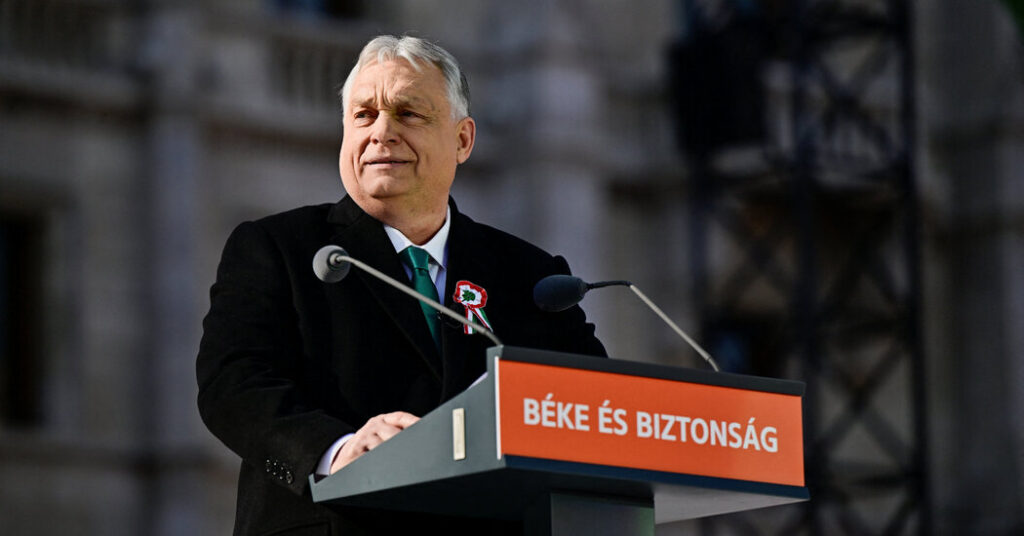
Mr. Orban has long balked at supporting Ukraine in its four-year war with Russia. But he has recently made it the cornerstone of his Fidesz party’s campaign platform, ahead of what polls indicate are remarkably close parliamentary elections set for April 12.
In recent weeks alone, Mr. Orban and Mr. Zelensky have sparred over the arrests of Ukrainian bank employees in Budapest and Russia’s transfer of Ukrainian prisoners of war to Hungary. Perhaps most urgently, the Hungarian leader is blocking a 90-billion-euro loan from the European Union to Kyiv that he agreed to as recently as December, over demands that Ukraine fix a damaged oil pipeline before rising fuel costs hurt Hungary’s economy.
On Thursday, leaders of other European Union countries will try anew to persuade Mr. Orban to let the loan proceed. The Hungarian leader has at times relented to E.U. pressure in the past, but he has shown little sign of doing so ahead of the election; he appears to be calculating that antipathy toward Ukraine, and its potential economic drain, is a winning political stance in a country that has never been an enthusiastic supporter of aid to Kyiv.
“If President Zelensky wants to receive his money from Brussels, then he must reopen the Friendship oil pipeline,” Mr. Orban said in a video posted on X on Tuesday. He added, “It seems to me they are using the entire oil blockade to intervene in the Hungarian elections.”
Mr. Zelensky has taken note. He told an Irish blogger recently that Mr. Orban had based his election campaign around a hatred of Ukraine and “me personally” — and has taken several opportunities to fire back verbally.
The pipeline has become Hungary’s main sticking point over the loan. Also known as the Druzhba pipeline, it runs through Ukraine and supplies Russian crude oil to Hungary and Slovakia. But it has been disrupted since Jan. 27, when it was hit in western Ukraine by what Kyiv and the E.U. say was a Russian attack.
Mr. Orban accused Ukraine of orchestrating an “oil blockade” and ordered troops to protect energy infrastructure in Hungary. His foreign minister, Peter Szijjarto, shocked Brussels in late February by announcing that Hungary would refuse to proceed with the €90 billion E.U. loan for Ukraine until the oil supply resumed.
The weeks since have been filled with tit-for-tat verbal attacks and rhetorical escalations.
On March 5, Mr. Orban threatened to use force to reopen the pipeline.
The same day, Mr. Zelensky said the pipeline could be repaired in “a month and a half” although Ukraine “sees no technical or safety reason to do so.” That timeline would probably put the repair just after the Hungarian election.
He also made a thinly veiled threat of his own, saying that if “a certain person” blocked the E.U. loan, then “we will give that person’s address to our armed forces, to our guys, so they can call him and speak to him in their own language.”
Mr. Orban quickly fired back. Mr. Zelensky’s “threats are not about me,” he wrote on X hours later. “He is threatening Hungary.”
Gabor Gyori, an independent political analyst with the Policy Solutions research organization in Budapest, said Mr. Orban was seeking to win over the very few voters who remain undecided in the heated race between Fidesz and the opposition party, Tisza, led by the politician Peter Magyar.
“All of this feeds into Viktor Orban’s claim that Ukraine is a major threat to Hungary — not only anymore for energy policy reasons, which was the key argument until recently, but now also potentially militarily,” Mr. Gyori said. “It could shift a few votes at the last minute.”
Mr. Orban’s allies piled on. Prime Minister Andrej Babis of the Czech Republic called Mr. Zelensky’s comments “absolutely unacceptable.” Slovakia’s prime minister, Robert Fico, warned that “if the Ukrainian president continues like this, it may happen that other EU member states will also block the 90-billion loan.”
Mr. Fico has also said he would halt emergency electricity supplies to Ukraine until the pipeline was fixed.
Viktor Shlinchak, a Ukrainian analyst, said he found the statement politically imprudent.
“In recent weeks, Zelensky has been trying not to mention Orban, and this, in my opinion, is the only correct strategy — not giving Orban other hooks during the election campaign” to use Ukraine “to stir up his electorate even more.”
Hungary’s newfound opposition to the loan comes despite the fact that it would cost Hungary, Slovakia and the Czech Republic nothing. The three countries agreed last December to the no-interest loan, which required unanimous approval under E.U. regulations, on the condition that they were exempted from contributing.
Ukraine would need to repay the loan, which is backed by the European Union’s budget, only if Russia paid reparations.
The Kyiv government needs the cash to buy air defenses and military equipment, and it has been rapidly depleting its existing funding. It is expected to run out of money within months. That is why Hungary’s cooperation has taken on urgency.
While trying to convince Hungary, the E.U. has also been prodding Mr. Zelensky to fix the pipeline, despite his hesitance. He has pointed out that it helps to fund the Russian war effort by facilitating oil deliveries.
“I am saying openly: I am against it,” Mr. Zelensky recently told reporters, according to the BBC. “But if I am given conditions that Ukraine will not receive weapons, then, excuse me, I am powerless on this issue. I told our friends in Europe that this is called blackmail.”
European Union officials have urged him to allow E.U. inspectors to visit the pipeline and even offered to foot the bill for repairs — an offer that Ukraine has accepted.
The announcement, which came on Tuesday, was widely interpreted as a sign that Mr. Zelensky had caved to European pressure. Even so, he repeated in a letter to top E.U. officials that fixing the pipeline would take until late April or early May, because damage to a key pumping station had made the repair difficult.
In their own letter, Ms. von der Leyen, the president of the European Union’s executive arm, and António Costa, the president of its political one, reminded Mr. Zelensky that unanimity is needed to secure both the €90 billion loan and a new package of sanctions aimed at crippling Russia’s economy — both of which Kyiv wants.
If Hungary cannot be brought around, officials have hinted that backup options exist to keep Ukraine funded temporarily — but it is not yet clear what those would be.
Hungary has continued to express skepticism about the bloc’s attempts to broker some sort of agreement, leaving the success or failure of the effort uncertain. Mr. Orban said that he spoke on Tuesday with Mr. Costa and Mr. Fico, and that “I made it clear that Hungary’s position remains unchanged.”
“If there is no oil, there is no money,” he said.
Lara Jakes, a Times reporter based in Rome, reports on conflict and diplomacy, with a focus on weapons and the wars in Ukraine and the Middle East. She has been a journalist for more than 30 years.
The post E.U. Loan for Ukraine Becomes Election Leverage for Orban appeared first on New York Times.