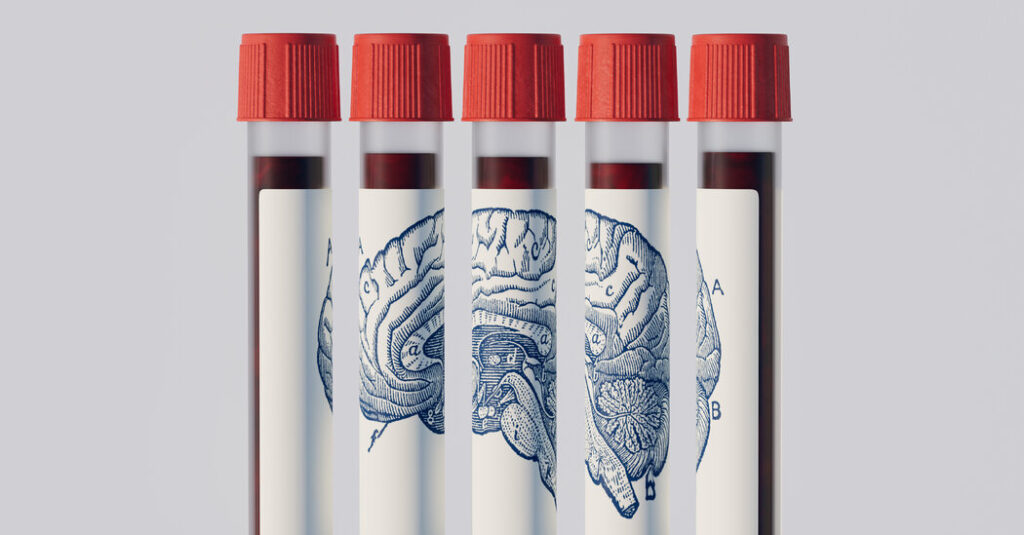
Could a simple blood test predict your risk of getting dementia years, or even decades, before you experience memory loss?
That’s the potential promise of a new class of biomarker tests. Two were approved last year by the Food and Drug Administration to help diagnose people with Alzheimer’s disease if they have symptoms of dementia. Scientists are now studying whether these types of tests can also identify who is at risk for Alzheimer’s long before symptoms appear: One recent paper found they might be able to predict the onset of dementia symptoms as many as 20 years ahead of time.
The push to diagnose Alzheimer’s at the earliest possible stage, even before symptoms occur, coincides with a push to develop treatments to prevent or delay cognitive decline. Clinical trials on a few drugs are currently underway, with results expected in 2027.
But the tests aren’t perfect. Here’s what to know about their current capabilities and shortcomings, and what they might be able to do in the future.
How do the tests work?
In the brain, Alzheimer’s is characterized by two proteins, amyloid beta and tau, that become dysfunctional, forming plaques and tangles that damage neurons. Amyloid plaques can emerge up to 20 years before dementia symptoms start to occur, whereas tau tangles come later, often coinciding with the onset of cognitive impairment.
“We think of tau tangles and neurodegeneration as the raging fire that does the most damage in people with Alzheimer’s disease,” said Dr. Eric Reiman, the chief executive of the Banner Alzheimer’s Institute and a founder of ALZpath, a biotech company that developed and sells one of the tests. “I think of amyloid plaques as the smoldering kindling, not causing much damage itself, but leading to that raging fire.”
An Alzheimer’s diagnosis is partially based on the presence of amyloid plaques in the brain. Traditionally, that has been confirmed using PET scans and cerebrospinal fluid tests, but those tests are expensive and invasive, and many patients do not receive them. Because of this, researchers have been looking for a blood test to use as a diagnostic tool instead.
Initially, scientists tried to develop blood tests for amyloid, but they ran into several challenges. “Amyloid in blood is really complicated to measure,” said Thomas Karikari, an associate professor of psychiatry at the University of Pittsburgh. For one, there’s “a lot of amyloid that gets into blood that’s also made from non-brain sources, like the heart,” he said.
But researchers discovered that blood tests measuring a modified form of tau could be a good proxy for amyloid buildup in the brain. That’s because, while tau tangles come later, the tau protein starts to become modified and dysfunctional around the same time amyloid plaques form. The tests that are currently available are referred to by a number — like pTau181 or pTau217 — that indicates the location of the modification on the tau protein.
Scientists aren’t exactly sure why amyloid accumulation is so closely linked to tau modification, but one theory is that it’s the amyloid plaques that cause the modifications to occur.
The tests can tell someone that the amyloid is “bothering the tau, and that unfortunately they’re at increased risk for getting the tau tangles and cognitive decline,” said Dr. Reisa Sperling, a professor of neurology at Harvard Medical School.
How accurate are the tests for people with dementia symptoms?
The tests have been shown to be about 90 percent accurate at detecting the presence of amyloid plaques, helping doctors determine whether a patient’s cognitive impairment is being caused by Alzheimer’s or if they should consider a different disease.
“With these blood tests, we really think that there is a possibility of providing many more people with a diagnosis, which is really exciting,” said Dr. Suzanne Schindler, an associate professor of neurology at WashU Medicine in St. Louis.
The accuracy of the tests depends on how much modified tau is in the blood. If the levels are very low, experts feel fairly confident a person does not currently have amyloid deposits in the brain, and if the levels are high, then there is a very strong chance the patient does. But people with levels in the middle are more ambiguous. In those cases, experts often recommend getting a PET scan or cerebrospinal fluid test to confirm an Alzheimer’s diagnosis.
What if you have no symptoms but are worried about getting Alzheimer’s someday?
There’s a lot of excitement about using the tests to screen people who might develop Alzheimer’s symptoms in the future, and some direct-to-consumer lab test start-ups, like Function, already offer them. But the experts interviewed for this article tended to recommend against that, for now.
For one, the tests are less accurate at detecting amyloid plaques in people without cognitive impairment. If someone has a negative test, that person very likely does not have signs of Alzheimer’s in the brain, said Dr. Christopher Rowe, the director of the Australian Dementia Network at the University of Melbourne. But if the test comes back positive, he estimated, it’s a 50/50 chance whether the person has plaques or not.
“I’m being a little pessimistic perhaps, but the message is if you do have a positive result, there’s a fair chance it’s a false positive,” he said.
Even if amyloid plaques are present, it doesn’t mean they’ll lead to cognitive impairment. In some ways, plaques in the brain can be thought of like plaques in the arteries, Dr. Rowe said. Just like having atherosclerosis doesn’t guarantee that a person will have a heart attack, having amyloid buildup doesn’t guarantee that someone will develop dementia.
According to one recent study from the Mayo Clinic, depending on how much amyloid plaque someone had in the brain, the chances of developing mild cognitive impairment or dementia ranged from 56 to 84 percent.
“If you’re positive on these tests, that does not necessarily mean that you will develop symptoms of Alzheimer’s,” Dr. Schindler said. “But it definitely means you’re at higher risk.”
And unfortunately, if someone does have amyloid plaques in the brain, there isn’t much that can be done about it right now. A couple of studies have found that physical activity and other lifestyle interventions may help lower tau blood levels or delay tau tangles from developing. But until the results from the clinical trials aiming to delay dementia come out, that’s the extent of the current options.
Will the tests ever be used to predict Alzheimer’s?
Many experts think the tests will eventually be used for pre-dementia screening. Some even speculated that they would be used widely, similar to mammograms or colonoscopies.
Scientists are working to improve the tests’ prediction capabilities, including by developing algorithms that incorporate dementia risk factors like age, sex, race and genetics.
“Let’s say you come and you are 67 and you’re a woman and depending on your family history you want to know, What is my risk in two years, five years, 10 years?” Dr. Sperling said. “That’s the kind of data that I think people are working on right now, the individualized risk prediction.”
It also depends on the findings from the dementia prevention clinical trials (both Dr. Reiman and Dr. Sperling are involved in them). The trials are testing two drugs that treat Alzheimer’s by removing amyloid plaques from the brain. The hope is that if this is done early, the tau tangles won’t develop, which would prevent neurons from dying. If that pans out, the experts said, there will be good reason to identify people with signs of Alzheimer’s in their brains before they possibly develop cognitive decline.
But that’s still a big if. Other studies testing earlier versions of the drugs were not effective at preventing or delaying dementia in people at risk for Alzheimer’s.
“It’s a remarkably exciting time, but data wins at the end of the day,” said Dr. Reiman, who led one of the earlier studies. “There’s no guarantee. We’ve always been burned, but there’s reason to be especially hopeful.”
Dana G. Smith is a Times reporter covering personal health, particularly aging and brain health.
The post Could a Blood Test Predict if You’ll Get Alzheimer’s? appeared first on New York Times.