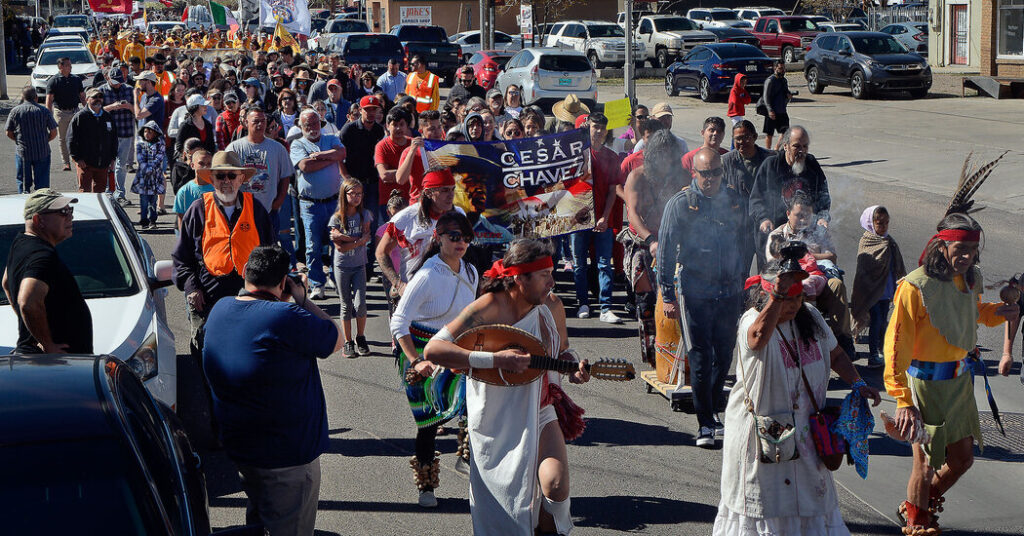
In Albuquerque, N.M., motorists drive across the historic Barelas neighborhood on Avenida Cesar Chavez. Where the avenue meets Broadway, they can pay their respects to the labor hero at the Cesar Chavez memorial. On the southeast side of town, children play after school at the Cesar Chavez Community Center.
All these places may be soon renamed, along with the hundreds of other streets, schools and institutions across the United States that had honored Mr. Chavez, one of the most revered figures in the Latino rights movement, as the co-founder of the United Farm Workers union.
The revelation this week that Mr. Chavez, who died in 1993, groomed and sexually abused girls has raised the likelihood that his name will soon be stripped from places of public prominence.
In some cases, the process has already begun. This week in a number of cities, marches to honor Mr. Chavez were canceled. California lawmakers announced on Thursday that they intend to change the name of Cesar Chavez Day to “Farmworkers Day.” The University of California, Davis, said that it had removed Mr. Chavez’s name from a youth leadership conference it has run for more than 20 years.
The scraping away of the Chavez name will unfold in a country that has already been rocked by a decade of debates and violent clashes over public memorials, statues, streets and buildings that honored the Confederacy and officials who supported slavery or racist policies.
But the dynamics of this erasure may well be different. The memorials are not to a hoary man on horseback in an antiquated costume, but a near-contemporary figure whose name evoked Hispanic people’s contributions to the American story — contributions that they often felt were overlooked.
The revelations about Mr. Chavez come at a moment when the nation has been deeply at odds about who, among its prominent men and women, deserves to be glorified.
On Thursday, some civil rights leaders were already engaged in the painful process of recalibrating Mr. Chavez’s stature.
“This is crushing news — immoral, harmful and selfish,” said the Rev. Dr. Robert M. Franklin Jr., a former president of Morehouse College who is currently a professor of moral leadership at Emory University’s Candler School of Theology.
In a text exchange, he added, “Our respect and evaluation of Chavez must be revised, downward, but his positive impact and efforts to advance migrant worker rights stands on its own as noble and lasting.”
In 2012, President Barack Obama spoke at the dedication ceremony for the Cesar E. Chavez National Monument, in Keene, Calif. It would be, Mr. Obama said, one of the monuments “that tell the story of who we are as Americans.” He called Mr. Chavez “a small man guided by enormous faith — in a righteous cause, a loving God, the dignity of every human being.”
Now it falls to public officials like Tim Keller, the mayor of Albuquerque, to figure out how to untangle Mr. Chavez’s now-corrupted legacy from a city that celebrated his life and politics so thoroughly.
One issue they will need to consider: the future of Avenida Cesar Chavez. That avenue turns into Avenida Dolores Huerta just east of the Rio Grande, to honor Ms. Huerta, Mr. Chavez’s most prominent ally and a New Mexico native.
In an interview with The New York Times, as part of the paper’s investigation into the sex abuse accusations, Ms. Huerta said that in the winter of 1966, Mr. Chavez drove her to a secluded field of grapes and raped her.
Mr. Keller has called the revelations “horrifying.” In an interview, he said he would like to see Ms. Huerta’s name replace Chavez’s on the avenue.
But that is just one street. His children, he said, grew up singing songs about Chavez in school. Each year in Albuquerque, Mr. Chavez and Ms. Huerta were honored in an annual celebration named for them, which included mariachi music and a “day of service and learning.” Last year, Ms. Huerta, 95, was the guest of honor.
Mr. Keller, a Democrat who took office in 2017, has grown close to Ms. Huerta. Earlier this week, when he heard the news of Mr. Chavez’s abuse, he cried.
“It’s something that touches so close, that the first thing is grieving for Dolores,” he said.
In a statement released after the Times investigation, Ms. Huerta said she had waited to tell the truth about Mr. Chavez because she believed the truth “would hurt the farmworker movement I have spent my entire life fighting for.”
That remains to be seen. But in Republican-led Texas, the reaction from Gov. Greg Abbott was swift and pointed. He said on Wednesday that Texas would not observe the state’s Cesar Chavez holiday on March 31.
“Reports of the horrific and widely acknowledged sexual assault allegations against Cesar Chavez rightfully dismantle the myth of this progressive hero and undermine the narrative that elevated Chavez as a figure worthy of official state celebration,” Mr. Abbott posted on X.
In 2015, a massacre by a racist, white gunman at a Black church in Charleston, S.C., became a major catalyst for the calls to take down many of the nation’s Confederate monuments. Supporters of the effort saw it as a long-overdue corrective for a country that honored racists who waged war against America. Critics, including President Trump, saw it as an erasure of history.
Sheffield Hale, the chief executive of the Atlanta History Center, would sometimes suggest a middle path: allowing old monuments to remain, in some form, but with informational signs or other tools to help people better understand the complex historical context.
Mr. Hale was not sure that method could work for the memorials to Mr. Chavez. On the one hand, he said, Mr. Chavez’s contribution to Hispanic civil rights was undeniable.
“On the other hand,” he said, “if what they say is true, you know, it’s pretty horrific. And you can understand why people are jumping to do something.”
Albuquerque is home to the National Hispanic Cultural Center, which plans on hosting a series of community conversations about how to deal with the Chavez revelations.
It will not be easy. On Thursday, Zack Quintero, the center’s executive director, said the mood in Albuquerque was one of shock, heartbreak, “immense anger” and “a sense of betrayal.”
Mr. Quintero said that the story of the movement must now make room for the stories of Mr. Chavez’s victims — and remind the community “that one person does not make the entire movement what it is.”
Alan Blinder contributed reporting.
Richard Fausset, a Times reporter based in Atlanta, writes about the American South, focusing on politics, culture, race, poverty and criminal justice.
The post Cesar Chavez Avenue May Soon Be Gone. Yet to Be Confronted: His Legacy. appeared first on New York Times.