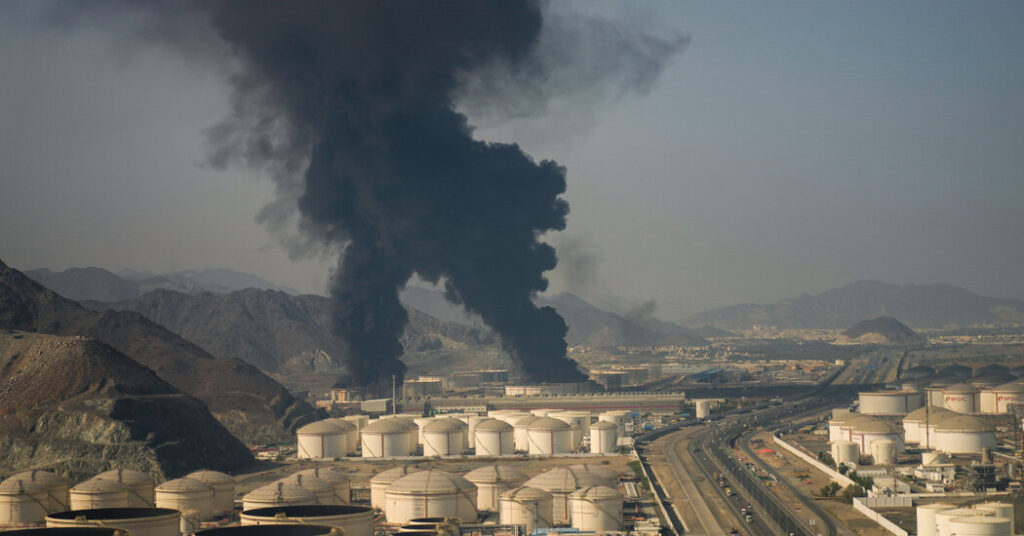
Increasing attacks on energy infrastructure in the Persian Gulf could significantly hurt the already strained global supply of oil and natural gas, pushing fuel prices much higher.
Important energy sites were attacked this week across the region. The main state-owned energy company in Qatar, the world’s third-largest supplier of liquefied natural gas, reported “sizable fires and extensive further damage” on Thursday at its facilities after those areas were also struck on Wednesday.
The escalating attacks will make it much harder for energy producers in the Gulf to repair and restart their oil and gas operations when the war ultimately ends. Asian countries, which are the biggest buyers of Persian Gulf energy, face the greatest risk of fuel shortages, but the pain of higher oil and natural gas prices will be felt across much of the globe.
“Prices will march up whether there’s damage or not,” said Bob McNally, president of Rapidan Energy Group, a research and consulting firm in Washington. “Damage just makes it even worse.”
International oil prices at one point on Thursday had jumped more than 10 percent, to around $119 a barrel. They gave up those gains after President Trump said he had told Israel not to attack Iranian energy facilities. Mr. Trump also said the war would end soon. Liquefied natural gas prices were up about 12 percent in Europe.
On Wednesday, Iran and Qatar blamed Israel for striking Iran’s South Pars natural gas field, which provides fuel that is used in power plants in that country. Hours later, Qatar accused Iran of attacking its Ras Laffan Industrial City, a large complex on the Persian Gulf. On Thursday, there were further strikes at refineries and gas facilities in Kuwait, Qatar and Saudi Arabia.
Oil and gas flows from the Persian Gulf have slowed to a trickle because Iranian attacks on ships have effectively closed the Strait of Hormuz on Iran’s southern coast. About 20 percent of the world’s oil and liquefied natural gas passes through the strait. Energy companies also paused production at many facilities, because they had nowhere to send the fuel and were running out of storage space.
Restarting plants and reopening the Strait of Hormuz could take weeks, causing a relatively brief disruption. But repairing or rebuilding facilities could take much long longer.
“A longer outage caused by damage is a bigger deal than a short outage caused by a shutdown,” said Kevin Book, managing director at ClearView Energy Partners, an independent research firm in Washington. “If the market is pricing in a short disruption that could be resolved in a cease-fire or the end of the war, it would be weeks for full functional facilities to come back on line. If it is damaged, it could be months.”
If attacks on energy operations continue, some analysts warn that oil prices could soar beyond $150 a barrel — contributing further to the steady upward march of gasoline prices. The average price for a gallon of regular gasoline reached $3.88 on Thursday in the United States, up from $2.92 a month earlier, according to AAA.
Natural gas, which is used to generate electricity and heat homes and in industrial processes, could also become much more expensive, especially in countries that do not have domestic sources of the fuel and buy liquefied natural gas from places like Qatar, the United States and Australia.
Analysts initially expected the gas disruption in Qatar to last about two months, but the attacks on Ras Laffan have very likely pushed the recovery much further into the future.
Qatar was expected to expand production in an area called the North Field East starting in November. But that seems less likely now, potentially limiting how much gas supply will grow through 2028.
“Market expectations had been for a short disruption, with a controlled restart restoring supply to pre-conflict levels by mid-2026,” said Kristy Kramer, head of L.N.G. strategy and market development at Wood MacKenzie, an energy research firm. “That outlook now appears increasingly unlikely.”
To keep energy prices from spiraling upward, the International Energy Agency last week announced its member countries, which include the Britain, Japan and the United States, would release a record 400 million barrels of oil from their reserve.
But oil reserves offer only partial relief and cannot fully offset the loss of supply from the Persian Gulf, according to an analysis by Wood MacKenzie. I.E.A. members do not have enough oil in reserve to keep the world well supplied if the war continues for weeks or months.
After Russia invaded Ukraine in 2022, strategic stock releases did little to prevent global oil prices from reaching $125, and the supply gap from the Gulf shutdown is significantly greater, the Wood MacKenzie analysis said.
If the attacks on energy infrastructure escalate, oil and gas supplies could be so disrupted that policymakers around the world would effectively lose all control of fuel prices.
“There’s concern now that there’s going to be tit-for-tat escalation,” said Mr. McNally, who advised President George W. Bush on energy issues. “This would be deeply unfortunate.”
Ivan Penn is a reporter based in Los Angeles and covers the energy industry. His work has included reporting on clean energy, failures in the electric grid and the economics of utility services.
The post As Oil Prices Spiral, Damage to Infrastructure ‘Makes It Even Worse’ appeared first on New York Times.