Cliff Kupchan is the chairman of Eurasia Group.
Most observers are rightly focusing on the near-term effects of the war in Iran. In addition to the mounting human cost, the war has caused the largest supply shock in oil market history by volume and percentage of global supply affected.
But equally important, if less visible, are the long-term impacts that war will have on the global economy. Iran will very likely have a government that is hostile to the United States after the war is over. As a result, political risk surrounding the Gulf will cause structurally higher prices in many sectors, boosting inflation rates and degrading the appeal of further investment in the Middle East.
Iran’s government will remain hard line. New Supreme Leader Mojtaba Khamenei is, by reputation, an authoritarian figure with close connections to the Islamic Revolutionary Guard Corps, the elite and ideological branch of Iran’s armed forces. He will have to share power with other conservatives including Mohammad Baqer Ghalibaf, speaker of the parliament, and Gen. Ahmad Vahidi, who heads the IRGC. Moreover, Iran’s decentralized strategy for the war included mapping layers of succession for all key posts, ensuring that even if the U.S. or Israel kills the current crop of leaders, other hard liners will easily replace them.
The end of the war, therefore, is unlikely to usher in a stable peace. That reality means the Strait of Hormuz will become a source of geopolitical risk for a long time — a live wire down the middle of the global economy. Iran’s leaders prize regime survival above all else, so they may ultimately agree to forgo uranium enrichment and longer-range ballistic missiles. But their strategic policy toward the U.S., especially after the blood spilled in this war, will be one of hostility.
Iran will still have enough drones, mines and speedboats to harass or sink tankers. Tehran might not even have to shoot much for investor perceptions to change. From now on traders will act based on the knowledge that Iran might at any time attack, and that new perception will create new risk premia in critically important sectors.
Take oil. Given that roughly 25 percent of global crude seaborne exports transit the strait, even if there were a near-term ceasefire, the price would likely remain in the $80 per barrel range for several months, both because of the aforementioned risk premia and because it will take producers time to ramp output back up. Before the war, many analysts thought Brent would hover around or below $60 per barrel this year. Because of new risk perceptions, 9-month oil futures contracts are currently selling at around $85, probably reflecting around a $25 premium.
The same argument holds for liquefied natural gas (LNG), where roughly 20 percent of global exports pass through the Strait. Except for LNG, the premia will likely be greater. That’s because liquefaction is a volatile process; LNG can’t even be safely produced, much less exported, if shelling is occurring close to the plant. Qatar’s state-owned LNG company, the world’s largest exporter, had stopped production at its Ras Laffan complex even before it was damaged yesterday by a missile strike. Unlike oil, gas markets are regional: European benchmark gas prices have soared since the start of the war, as have spot LNG rates; an even bigger spike has occurred in Asian markets. Asia in particular does not have great alternatives for diversifying away from Qatari LNG.
A permanent threat from Iran will also hit the global fertilizer and food sectors. Roughly one-third of global fertilizer trade transits the Strait of Hormuz. Fertilizer prices are already up sharply, with urea and other nitrogen products up roughly 25-30 percent in some markets, and they will likely rise further. Agricultural commodity prices have also moved higher, with corn up 6 percent from prewar levels and wheat at its highest level since mid-2024.
Aluminum markets work in a similar manner — Gulf countries account for 9 percent of global aluminum output. Aluminum production uses vast amounts of electricity, which is sensitive to oil and gas prices, and the metal’s price is also affected by shipping choke points, such as the Strait of Hormuz.
And all these new risk premia will cause higher prices globally, which will in turn stoke inflation rates.
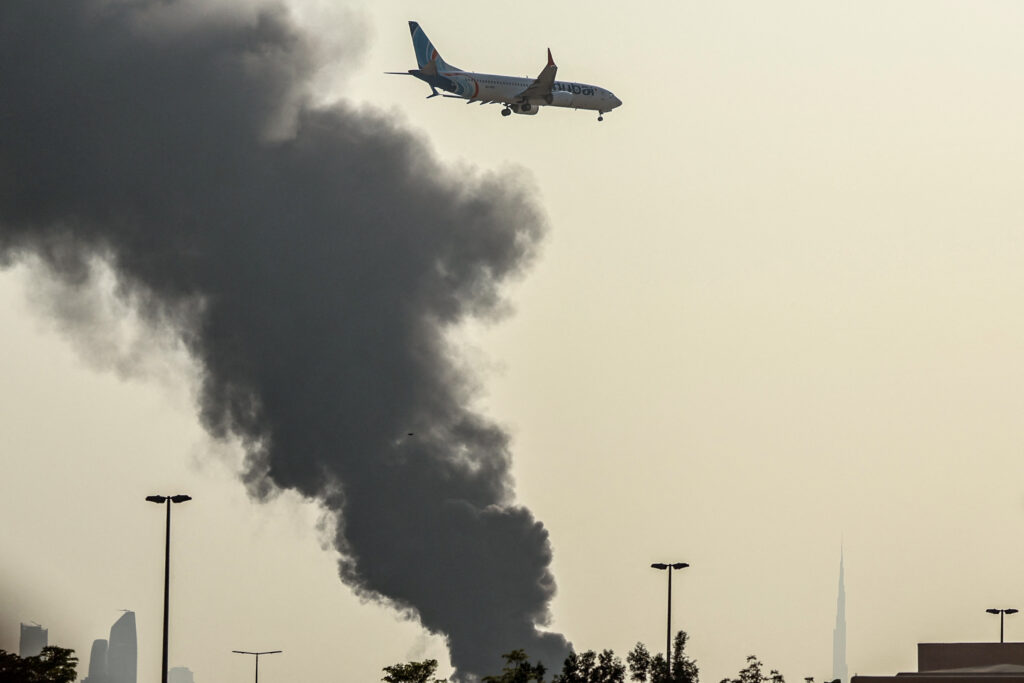
Finally, the Gulf countries — prominently the United Arab Emirates, Saudi Arabia and Qatar — will struggle over coming months to regain their reputations as safe investment climates. These markets are central to global trade and investment not only in hydrocarbons, but also in artificial intelligence, defense and other arenas. Capital is a coward, going only where it feels safe. Once unimaginable images of office and hotel towers burning after Iranian strikes will pierce investor sentiment.
That effect is already apparent. The Dubai stock market has taken a huge hit since the start of the war, down over 15 percent. Emaar Properties, a bellwether listing for the real estate sector in Dubai, is down 30 percent over that same period. The region will recover to some extent. The U.S. will likely help rebuild and increased regional integration is likely in the aftermath of the war. But it will take a long time for the Gulf to reestablish itself as one of the world’s safe havens for global capital.
The post After the Iran war, the Gulf will never be the same again appeared first on Washington Post.