On Tuesday, a Brussels court ordered a retired Belgian diplomat to stand trial for what prosecutors say was his role in the killing of Patrice Lumumba.
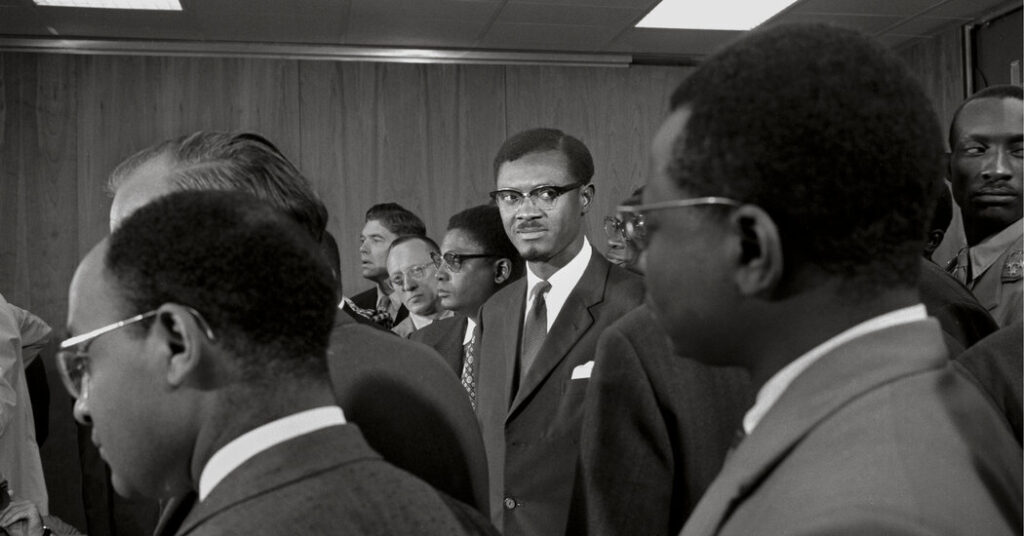
Mr. Lumumba helped liberate Congo from brutal Belgian rule in 1960. After only a few weeks as prime minister, he was toppled and assassinated. His death was one of the 20th century’s most significant political killings.
Historians say Mr. Lumumba’s assassination shows how African politics then were bound to Cold War rivalries, and that his death has come to symbolize the thwarted hope for true African independence.
Here is a look at Mr. Lumumba’s rise and fall, and why he still matters today.
How did he rise?
Mr. Lumumba’s career was brief. He was born in 1925 in Kasai province in the south of what was then Belgian Congo, a country that had been ruthlessly exploited under Belgium’s King Leopold II in previous decades.
Mr. Lumumba was educated in missionary schools and worked in a low-level post office job. Early in his career, he had supported Belgium, but his views rapidly evolved. He was invited by Belgium to tour the country but was later convicted of embezzlement from his job at the post office and spent a year in jail. The charge appeared politically motivated.
On his release in 1958, he led a national political party pressing for independence and acquired a large following through his vitality and oratorical skill.
The previous year, Ghana had gained independence from Britain, a seismic event on the continent, and Mr. Lumumba attended a conference on decolonization in the Ghanaian capital, Accra. There, he delivered a speech that established him as a star in the movement for a unified, independent Africa.
He was imprisoned again after riots in Congo, but his political party won a plurality of the vote in the early 1960 elections, and he became prime minister.
On Independence Day, June 30, he delivered an impromptu, nationally broadcast speech before Belgium’s king and diplomats. He described Belgium’s rule as “humiliating slavery which had been imposed on us by force.”
“We are proud of this struggle, of tears, of fire, and of blood, to the depths of our being,” he said.
The speech was criticized as incendiary, but helped cement his reputation across Africa.
How did he fall?
Mr. Lumumba’s government never achieved stability, in part because he failed to gain control of the country’s military. Amid an upsurge of violence partly aimed at foreigners, Belgium, which had also sought to retain control of the army, sent troops.
The mineral-rich southeastern province of Katanga seceded with Belgian support, and the United Nations established its first peacekeeping mission in Africa to stop the surge of interethnic and political violence and to block Katanga’s secession.
The crisis quickly became a focus of Cold War tensions. Though Moscow offered Mr. Lumumba little support, some in Washington viewed him as an erratic leftist who had to be stopped before he dragged Congo into the Soviet orbit.
An Army colonel whom Mr. Lumumba had promoted, Joseph-Désiré Mobutu, effectively announced a coup that September. Troops arrested Mr. Lumumba as he fled.
Mr. Lumumba was held at military barracks before being transported to Katanga. He was beaten, tortured and executed by firing squad on Jan. 17, 1961. His body was dissolved in acid. A U.N. report blamed Belgian mercenaries and officials from Katanga for his death.
“History will one day have its say, but it will not be the history that is taught in Brussels, Paris, Washington or the United Nations,” he wrote in his final letter to his wife, Pauline. “Africa will write its own history.”
What is his legacy?
Mr. Lumumba is revered as the Nelson Mandela of his day. His bespectacled face, with its distinctive side-parted Afro, adorns posters and T-shirts across the continent.
Some recent historians have argued that his record in government does not match his iconic status. Even so, his life is the subject of biographies, a feature film, “Lumumba,” a 1990 documentary by Raoul Peck, “Lumumba: Death of a Prophet,” and the 2024 documentary “Soundtrack to a Coup d’Etat.”
Mr. Mobutu, the colonel, went on to rule as a dictator for more than three decades and proved a reliable ally of Washington while brutally suppressing dissent. This further burnished Mr. Lumumba’s legacy, as did the uncovering of various plots against his life.
The Central Intelligence Agency had plotted to poison Mr. Lumumba, going so far as to fly an expert in surreptitious poisonings to the Congolese capital. The plan failed.
What about Belgium?
On Tuesday, the court ruled that the retired diplomat, Étienne Davignon, 93, must face war crimes charges over the killing of Mr. Lumumba. The ruling was the culmination of a criminal complaint that Mr. Lumumba’s children filed 15 years ago and part of a process in which the country has gradually faced its responsibility for crimes committed during the colonial era.
In 2001, a parliamentary inquiry said that Belgium bears “moral responsibility” for the assassination, and in 2022, Belgium returned a single gold-capped tooth to his family in Congo.
Matthew Mpoke Bigg is a London-based reporter on the Live team at The Times, which covers breaking and developing news.
The post ‘Africa Will Write Its Own History.’ Who Was Patrice Lumumba? appeared first on New York Times.