“We don’t work as Democrats or Republicans,” Chief Justice John Roberts said in 2016.
At his confirmation hearing in 2017, Justice Neil Gorsuch, who was nominated by President Trump, echoed the chief justice.
“I do not see Republican judges, and I do not see Democrat judges,” he said. “I see judges.”
Political scientists and the public see something different. Social science data shows a significant correlation between justices’ partisan affiliations and their judicial work. And public confidence in the Supreme Court is testing new lows partly because of the perception that politics is warping the justices’ work.
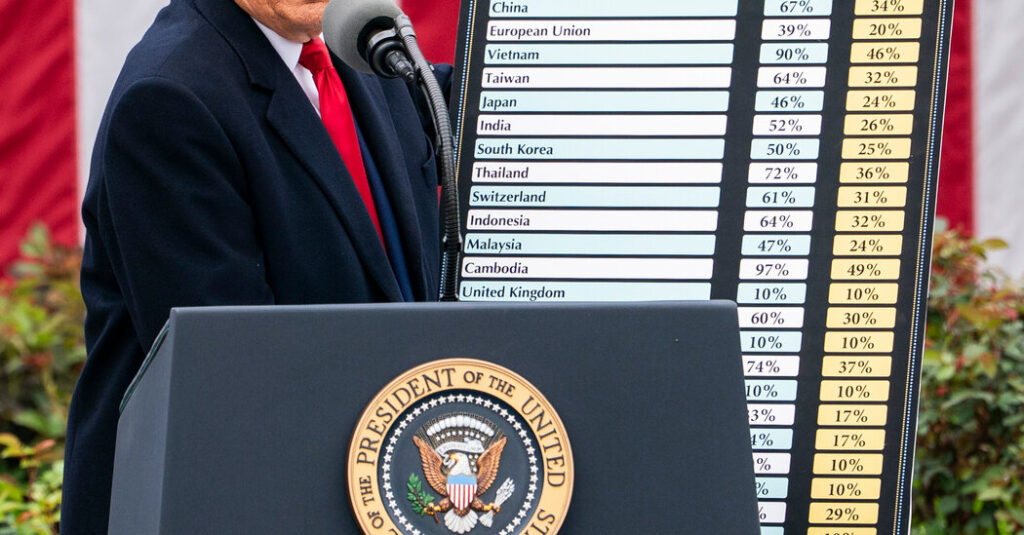
On Sunday night, Trump offered an intemperate critique of the Supreme Court and its decision to reject his beloved tariffs program, in a social media post that inadvertently made the case for the court’s independence.
The president differed from Justice Gorsuch on one point. He did see, as he put it, “Democrat Justices” who “just vote Democrat” and “Republicans” who “do not do this.”
Trump added that Republican justices “go out of their way, with bad and wrongful rulings and intentions, to prove how ‘honest,’ ‘independent,’ and ‘legitimate’ they are.”
You can put “honest,” “independent” and “legitimate” in scare quotes, but it’s still a gift.
‘A Weaponized and Unjust Political Organization’
Put aside for a moment Trump’s extraordinary Supreme Court winning streak in the first year of his second term, one that gave him at least temporary victories on immigration, grants, personnel, agencies and troops. He was focused on last month’s tariffs decision, in which Chief Justice Roberts and Justices Gorsuch and Amy Coney Barrett joined the three Democratic appointees to reject his plan.
In criticizing the court, Trump only called attention to the unusual coalition that ruled against him.
Nevertheless, having thought it over, Trump drew a surprising conclusion: The court, he said, had become too political.
“Our Country was unnecessarily RANSACKED by the United States Supreme Court, which has become little more than a weaponized and unjust Political Organization,” he wrote, before turning to an evergreen grudge.
“They wouldn’t even call out The Rigged Presidential Election of 2020, because they said that I, as President of the United States, did not have ‘standing’ to challenge it,” Trump continued, getting the general idea of the case right but the details wrong.
The court did reject, in December 2020, a brazen lawsuit by Texas asking the justices to throw out the election results in four battleground states that Trump had lost. The court’s brief order said that Texas lacked standing. Trump’s motion to intervene was denied as moot.
Was Gorsuch’s Nomination in Peril?
In his post Sunday night, Trump said Republican appointees “openly disrespect the Presidents who nominate them.”
That reminded me of an incident at the very beginning of Trump’s first term.
In February 2017, Justice Gorsuch, then an appeals court judge, was making the rounds in the Senate to gather support for his nomination. He was asked about some of Trump’s attacks on judges at the time, which then seemed extraordinary and now have become routine. Justice Gorsuch called the president’s comments “disheartening” and “demoralizing.”
Months later, after Justice Gorsuch had been confirmed, The Washington Post reported that those remarks had infuriated Trump, causing him to question his nominee’s loyalty and prompting him to tell aides that he was tempted to rescind the nomination. Trump called the report “fake news.”
A Testy Relationship
Between now and early summer, the Supreme Court is set to decide the lawfulness of major elements of Trump’s agenda, including his efforts to limit birthright citizenship, to fire the leaders of independent agencies and to end deportation protections for hundreds of thousands of Haitian and Syrian migrants.
Will his musings Sunday night hurt his prospects? He seemed to think so.
“This statement about the United States Supreme Court will cause me nothing but problems in the future,” Trump wrote, “but I feel it is my obligation to speak the TRUTH.”
Other Legal News
-
In remarks at Rice University, Chief Justice Roberts sounded fed up with personal attacks on judges, Ann Marimow reported. “It’s got to stop,” he said.
-
The Trump administration has been using “sue and settle” schemes with friendly adversaries that smell of collusion to score quick policy reversals. Zach Montague investigated and explained the phenomenon.
-
A federal judge’s rejection of grand jury subpoenas seeking to gather information for a criminal investigation of Jerome Powell, the Federal Reserve chair, is only the latest in a stunning string of setbacks for the president’s retribution campaign. Mike Schmidt and Alan Feuer surveyed the wreckage.
Late Ballots and Partisan Splits
While we’re on the subject of the role politics plays in judging: I was struck by one remarkable fact in preparing for an argument the Supreme Court will hear on Monday.
A 15-judge panel of the Fifth Circuit managed to sort itself into perfect lock-step partisanship last March in the case, which asks whether federal laws permit states to accept ballots mailed before Election Day that arrive shortly afterward.
You may be more cynical than me. You may believe that politics explains the entirety of judicial behavior, at least in election cases. But I would like to think that the partisan affiliations of 15 federal appeals court judges with life tenure should not perfectly predict their votes on a question of substantial complexity.
Yet the panel’s 10 Republican appointees sided with the Republican National Committee, which had challenged a Mississippi law with a five-day grace period. The five Democratic appointees dissented.
That split, over whether to rehear a three-judge panel’s ruling striking the law down, is a terrible look for the judiciary, and it gets worse. In some instances of seemingly partisan behavior by judges, it is at least possible to say that the results were dictated by “judicial philosophy” rather than politics. But here, the statutes, historical materials and concern for federalism point in various directions. It is hard to discern a consistent jurisprudential rationale for the perfect divide, only a political one.
The Politics of Voting
Trump has long criticized mailed ballots generally and ones that arrive after Election Day specifically. About 30 states have laws that let at least some voters mail ballots on or before Election Day, but have them count if they are received by election officials within a fixed time afterward.
Though the evidence is mixed, the conventional wisdom is that allowing late ballots helps Democrats more than Republicans.
In any event, a three-judge panel of the Fifth Circuit, made up entirely of Trump appointees, ruled in 2024 that the state law conflicted with federal ones that set a national Election Day for federal offices. It invalidated the state law.
The case is a sort of logic puzzle. Federal laws set Election Day as a deadline for casting ballots. Casting a ballot could mean one of several things: marking it, sending it, having it received by election officials and having it counted. The federal laws don’t say which, and states are ordinarily allowed to run elections unless Congress says otherwise.
Mississippi, like other states that allow a grace period for receiving ballots, says votes are “cast” when voters make their final choices by marking and submitting their ballots. The panel disagreed, saying that the only permissible reading of the federal laws is that votes are “cast” when ballots make their way into the hands of election officials rather than the post office, even though they still have to be processed and counted.
It was, Judge Andrew Oldham wrote for the panel, “obvious that a ballot is ‘cast’ when the state takes custody of it.”
The Meaning of Election Day
The federal laws that set a single Election Day were enacted in 1845, 1872 and 1914. Both sides agree that in the early days of the republic, voting was done in person on Election Day. They also agree, as a veterans’ group said in a brief to the court, that “in every federal election since 1918, at least one state has accepted mail ballots received after Election Day, and that most states have adopted post-election receipt deadlines at some point since the Election Day statutes were enacted.”
Those laws were not challenged until recently, the brief said. Accepting the challengers’ position, it added, “would mean federal elections have been conducted illegally for over a century — but no one noticed until now.”
It is not unusual to let people satisfy legal deadlines by putting the required document in the mail. Tax returns must be postmarked by April 15 (coming up, people!). Prisoners’ appeals are timely if they submit their filings to the prison mail system by the stated deadline. And the Supreme Court’s own rules allow litigants to meet deadlines by mailing the required papers on or before the due date.
Motivated Lawyering and Principled Judging
Probably the most trenchant analysis of the case that I have read was in a newsletter from Adam Unikowsky, a lawyer at Jenner & Block. (He was skeptical of “a heretofore unnoticed requirement that ballots must be received by Election Day” and concluded that “if Mississippi wants to accept ballots that arrive after Election Day, that is up to Mississippi.”)
Judge Stephen Higginson praised the analysis in his dissent from the full court’s decision declining to rehear the Mississippi case.
Judge James Ho, who had joined the three-judge panel’s opinion invalidating the law, responded by saying that Unikowsky’s views “may just reflect the institutional bias at many of the nation’s largest law firms.” The judge said the court should treat Unikowsky’s analysis as “motivated lawyering designed to reach a predetermined result.”
Judges, on the other hand, he wrote, must “apply the law in a consistent and principled manner.”
It may be that lawyers engage in motivated reasoning while judges can be counted on to be consistent and principled. But the math suggests otherwise.
Mailbag
Return to Sender
The mailbag this week was full of curiosities, strong opinions and delightful digressions. But it yielded no questions in The Docket’s sweet spot: ones of interest to a general readership. Some of those would be welcome.
I’d love to hear your questions on the law, the courts or whatever is on your mind. Send them my way at [email protected].
What I’m Reading
-
A remarkably vulgar dissent from Judge Lawrence VanDyke of the Ninth Circuit, one that prompted a five-word response from two colleagues: “We are better than this.”
-
“How to Disagree,” in which Cass Sunstein makes the case for lowering the temperature, most of the time. The article will be published in The Cornell Law Review.
-
“Beginning a Law Review Article,” in which Sam Bray offers tips on how to make legal scholarship more inviting. Here’s hoping.
Closing Argument
Ballot Selfies and Free Speech
Susan Hogarth was proud of having voted in a 2024 primary election in North Carolina, and so she posted a photo of her completed ballot on social media to pat herself on the back and encourage others to take part in democracy. Such photos are commonplace and have a name: ballot selfies.
State election officials sprang into action, firing off a letter to Hogarth that said the selfie violated a state law. They demanded that she take it down.
Hogarth instead filed a First Amendment challenge to the law. Last week, Judge Louise Flanagan ruled against Hogarth, deepening a split in the lower courts over the constitutionality of ballot selfies. The judge said the law was justified because it helped frustrate vote-buying schemes.
In an online debate, Rick Hasen, an election law expert, endorsed that view. “A law barring the photographing of ballots may seem strict, and an affront to freedom of expression,” he said, “but it is one which is necessary to promote election integrity.”
The First Circuit took the opposite view in 2016, striking down New Hampshire’s ballot selfie prohibition on free speech grounds. “New Hampshire may not impose such a broad restriction on speech by banning ballot selfies in order to combat an unsubstantiated and hypothetical danger,” Judge Sandra Lynch wrote for a unanimous three-judge panel.
She invoked a classic metaphor from Justice Felix Frankfurter’s 1957 opinion in Butler v. Michigan. “The ballot selfie prohibition,” Judge Lynch wrote, is like “‘burning down the house to roast the pig.’”
Adam Liptak is the chief legal affairs correspondent of The Times and the host of The Docket, a newsletter on legal developments. A graduate of Yale Law School, he practiced law for 14 years before joining The Times in 2002.
The post A Gift From Trump to the Supreme Court appeared first on New York Times.