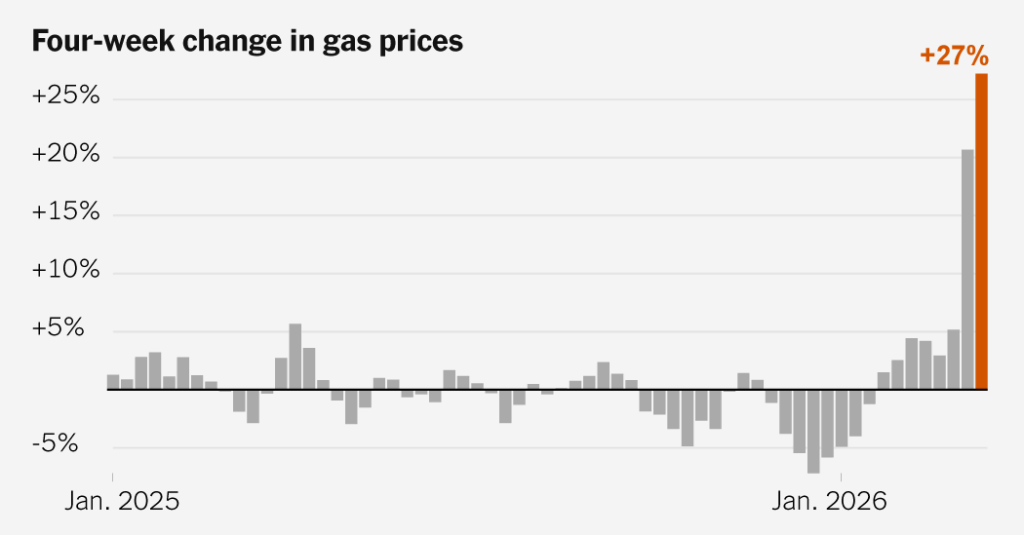
Since the start of the war in Iran, the average price of gas in the United States has climbed by nearly a dollar.
In mid-February, gas cost around $2.90 per gallon. By mid-March, it was up to $3.70, according to the Energy Information Administration.
It’s the second-largest four-week increase in at least 30 years — bigger than the one at the start of the war in Ukraine in 2022, or the ones associated with the post-recession surge of 2009 and the OPEC production cuts in 1999.
The only bigger jump came after Hurricane Katrina in 2005, when gas supply fell significantly.
The typical U.S. driver travels around 1,000 miles each month. Depending on the car, those higher prices translate to as much as $50 more a month.
No state has been spared. Average prices are up by more than 50 cents per gallon everywhere, and by more than a dollar in New Mexico, Arizona and Colorado, according to the AAA motor club.
Crude oil prices drive gas prices, and oil has spiked since the start of the war because of supply disruptions: Major oil exporting countries in the Persian Gulf can’t get their product through the Strait of Hormuz, a critical and narrow waterway along Iran’s southern coast.
Prices have continued to rise despite the release of strategic oil reserves. The increases are having the biggest effect on lower-income households, who spend a larger share of their earnings on gasoline than higher-income Americans.
But if you look at the history of gas prices, this month’s spike appears a little smaller.
Consider the last 50 years:
Americans are more insulated from oil shocks today than decades ago. Petroleum makes up a tiny share of electricity generation (less than 1 percent, down from 11 percent in 1980). Oil prices hit consumers on the road most of all, but even there, less so: The country’s cars are more efficient, on average, and a growing share of Americans are driving electric vehicles.
Still, there are plenty of old and less efficient cars on the road. And those owners will face these prices at the pump over and over — prices that might go higher still.
Francesca Paris is a Times reporter working with data and graphics for The Upshot.
The post Why This Jump in Gas Prices Feels Different appeared first on New York Times.