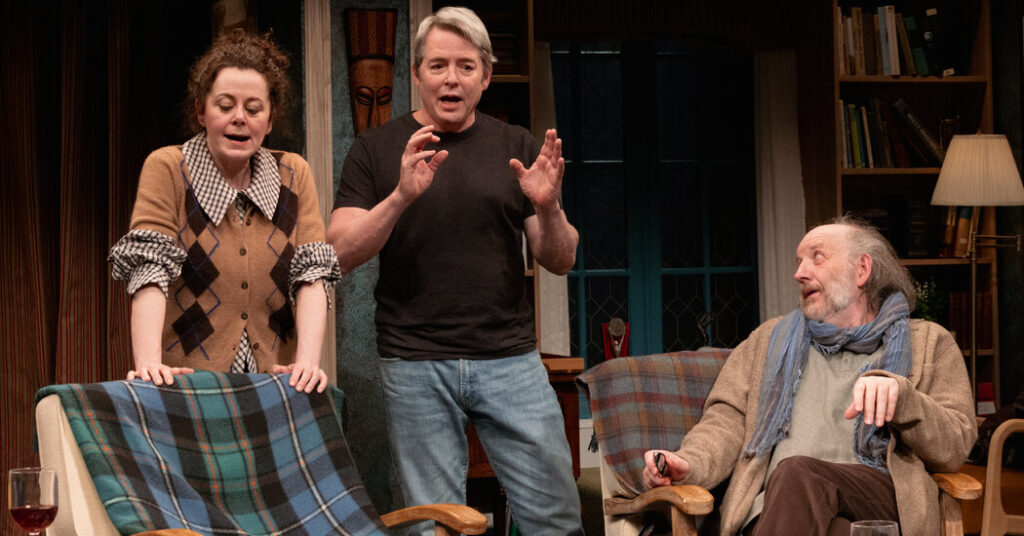
As rehearsals for a new play are about to start in London, the show’s lead actor, Jay (Matthew Broderick), is eager to meet the playwright, Ruth, at last. But Ruth is flying from her home in Belfast and running late, so Jay and the show’s director, Leigh (Max Baker), end up shooting the breeze.
Jay is a Hollywood star, so of course he’s in recovery, of course acting is his religion, and of course he has an Academy Award, which, he claims, “means nothing to me.” By way of explanation, he adds, “I’ve never sought external validation.”
Conversely, the craven Leigh is discombobulated by his sudden proximity to American-style confidence and flash — when Jay makes a reference to “Baldwin” in a discussion about using the N-word, Leigh assumes he’s talking about Alec rather than James.
In the early scenes of “Ulster American,” at Irish Repertory Theater, the playwright David Ireland is toying with fairly standard — but reliably amusing — stereotypes and culture clashes. The two men banter agreeably, with Jay sketched out as a pseudo-boundary-pusher who asks questions like “Do you think there are any circumstances where it’s morally acceptable to rape someone?”
At this point in the play, Ireland is not so much shaping characters as burying land mines, which will start detonating when Ruth (Geraldine Hughes) eventually turns up. Let’s just say that by the end of Ciaran O’Reilly’s production, the fight director, Rick Sordelet, will have earned his fee.
Like Ireland’s “Cyprus Avenue,” which ran at the Public Theater in 2018, “Ulster American” explores issues of identity related to Irishness and Britishness. The two shows share explosive endings, though the earlier work is a bleak tragedy — the lead character, a bigoted Belfast Unionist, is convinced his infant grandchild is the Sinn Fein president Gerry Adams, and the consequences are horrifying. “Ulster American,” for its part, is very much a dark comedy.
And for a while, it works as such. The two male characters might be familiar types, but the script keeps providing satisfying zingers, usually for Jay. (“I benefit from the patriarchy, yet I am nonetheless demeaned by it,” he says at one point. Also: “Only thing I ever want to read from a theater critic is a suicide note.”)
Ruth’s arrival expands the focus. She quickly sets Jay straight about the character he portrays in her play: Like her, she explains, he is a Unionist from Northern Ireland, which makes him British. This comes as a shock to Jay, who thought the play was about “the struggle for Irish freedom, written by an Irish Catholic.” Instead, it’s actually “a story about the murder of Irish Catholics written by a British Protestant.”
Mind you, he initially loved Ruth’s play so much that he forwarded it to his friend Quentin Tarantino.
This is where “Ulster American” starts to collapse under the weight of its inconsistencies. Leigh boasts about keeping Ruth’s career alive yet sounds unaware of her politics, and Jay’s character is only loosely coherent. He claims to be coproducing the American debut of the Turkish filmmaker Nuri Bilge Ceylan, but shows no deep understanding of cinema and culture and calls James Cameron “the American Tarkovsky” (which is wrong on two counts, though at least he’s heard of the Russian art-house director Andrei Tarkovsky).
We are also supposed to believe that this supposedly proud Irish American, who at one point claims, “I have a contract with my Irish ancestors!,” has never set foot in either the Republic of Ireland or Northern Ireland, and doesn’t grasp what is at the root of the Troubles. Ireland posits that Irish Americans are largely Catholic and as such have little understanding of the loyalist perspective. Then again, as an American, period, Jay has little understanding of the rest of the world and, well, the author has a point there.
This might all have worked out if the production had been dynamic enough to make up for the play’s lapses, and if Broderick had mustered a charismatic performance. But that is not the case. Five years after its premiere at the Edinburgh Festival Fringe in 2018, “Ulster American” landed a London staging starring Woody Harrelson, an actor you can easily imagine portraying a Yankee blowhard. Broderick is game — he really throws himself into a physical tussle — but not particularly believable as star who’s a bit dim yet still radiates mega-wattage. The production would need an even crazier ending than the one it already has to completely redirect our attention from that fundamental problem.
Ulster American Through May 10 at Irish Repertory Theater, Manhattan; irishrep.org. Running time: 1 hour 20 minutes.
The post ‘Ulster American’ Review: Matthew Broderick as a Star Blinded by Privilege appeared first on New York Times.