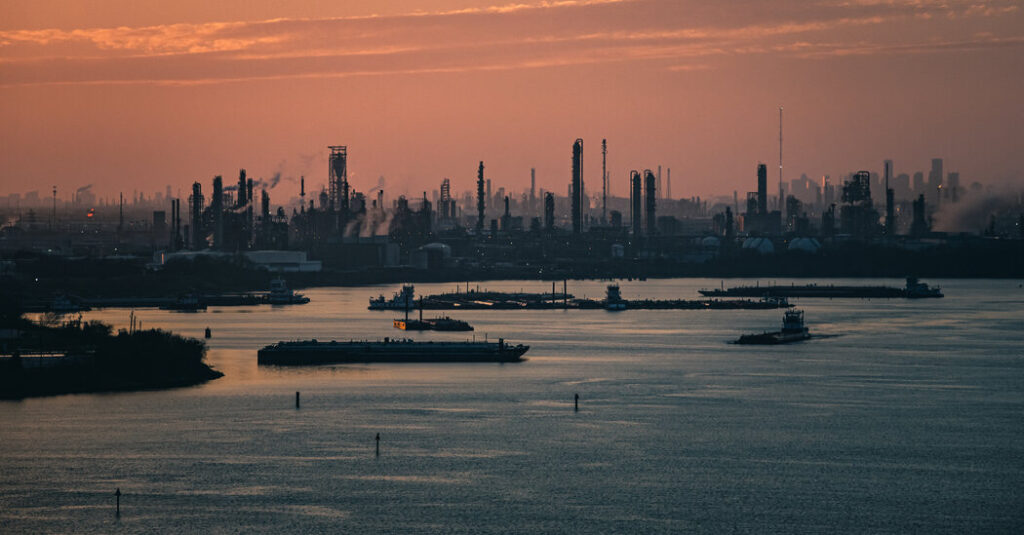
The Trump administration said on Wednesday that it would temporarily relax a maritime law that restricts the way oil is shipped within the United States, as it seeks to stem the rise in fuel prices resulting from the war in the Middle East.
Relaxing the law, known as the Jones Act, could reduce the cost of transporting fuel and agricultural products by ship between American ports, but analysts and some shipping executives expect the move to have only a marginal impact on gasoline prices.
President Trump is waiving the Jones Act requirements for 60 days “to mitigate the short-term disruptions to the oil market as the U.S. military continues meeting the objectives of Operation Epic Fury,” Karoline Leavitt, a White House spokeswoman, said on X.
Ms. Leavitt added that the waiver would allow “vital resources like oil, natural gas, fertilizer, and coal to flow freely to U.S. ports.”
The Jones Act dictates that only ships made in the United States can pick up cargo at American ports and transport it to another U.S. port. Such vessels, which must also be crewed by Americans, cost customers more than foreign ships. The restriction has been waived before, for instance after Hurricane Maria devastated Puerto Rico in 2017 and in 2021, when an energy pipeline was shut down by a cyberattack.
The introduction of cheaper foreign vessels is expected to shave only pennies off the cost of gasoline, which has jumped 29 percent to an average of $3.84 per gallon, from $2.98 on Feb. 28, when the United States and Israel started their attacks on Iran, according to AAA.
American tankers cost about $50,000 a day more to hire than foreign vessels, said James Lightbourn, the founder of Cavalier Shipping, a ship financing advisory firm. Using non-American ships could cut transportation costs by about 5 cents per gallon of oil, Mr. Lightbourn estimates. The largest component of gasoline prices is the cost of oil, which has surged around 40 percent since the start of the war, as Iran responded by effectively shutting down oil exports from the Persian Gulf.
The Jones Act, passed in 1920 to ensure that the United States had sufficient shipping capacity, does not apply to vessels transporting goods from foreign countries.
Shipbuilding executives and union leaders say the United States needs the law to protect its maritime industries. The American Maritime Partnership, a group that represents American shipowners, shipbuilders and some maritime workers, said in a statement that it was “deeply concerned” that the waiver would be abused by foreign shipping companies. It said the waiver is meant only to address an immediate threat to military operations, referring to the section of the Jones Act on when waivers can be granted.
“Every vessel movement under this waiver must be publicly disclosed and justified according to federal law,” the group said. “We will be watching closely, and so will the American public.”
But the law’s critics say it piles costs on businesses and consumers — particularly those in Alaska, Hawaii and Puerto Rico, whose economies rely far more on American shipping — and has led to a reduction in the share of goods transported by water.
“The Trump administration’s decision to grant Jones Act waivers amidst war and rising energy costs exposes both the law’s economic burden and the flimsiness of its national security rationale,” said Colin Grabow, an associate director at the Cato Institute, a research organization that favors less government regulation of business.
Christopher Knittel, associate dean for climate and sustainability at the Massachusetts Institute of Technology, said academic research had found that the Jones Act added about 1.5 cents to the cost of gasoline.
“It’s not a huge number, but adds up given how much gasoline we consume,” he said.
In another move aimed at preventing oil price rises, the United States said last week that it was going to release 172 million barrels of oil from its strategic reserves over four months, beginning next week. Crude oil prices rose despite the decision.
Peter Eavis reports on the business of moving stuff around the world.
The post U.S. Suspends Oil Shipping Rules to Ease Gas Price Pressures appeared first on New York Times.