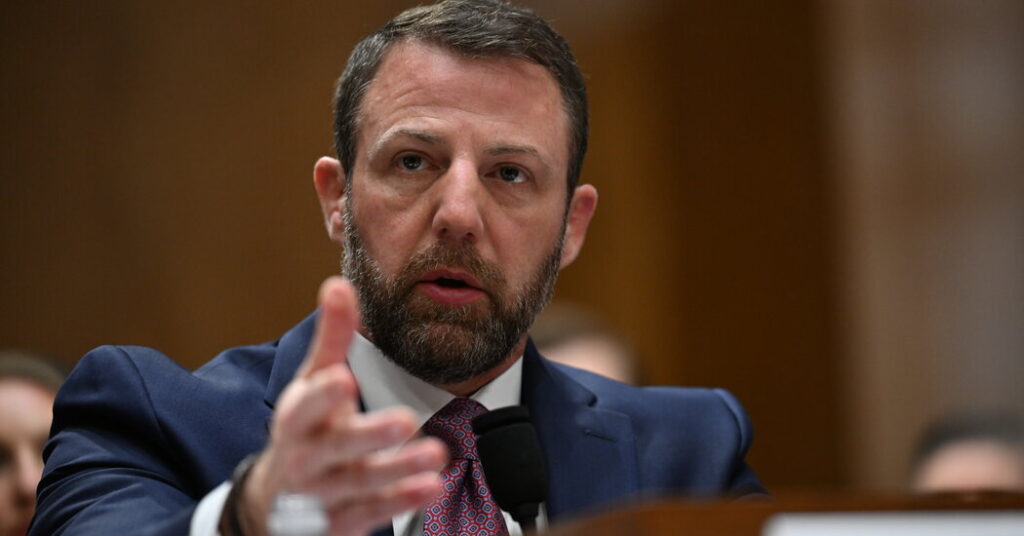
Senator Markwayne Mullin, President Trump’s nominee to lead the Department of Homeland Security, said Wednesday that if confirmed he would “absolutely” revoke a policy that has dramatically slowed the flow of federal disaster aid under the current secretary, Kristi Noem.
Since June, Ms. Noem has required that her office approve any contracts or grants of $100,000 or more, creating significant delays and uncertainty for disaster-struck states and communities waiting for recovery assistance. An investigation by Senate Democrats this month found that the policy had delayed Federal Emergency Management Agency projects by three weeks, on average.
“That’s called micromanaging,” Mr. Mullin, an Oklahoma Republican, told Senator Andy Kim, Democrat of New Jersey, at a confirmation hearing on Capitol Hill. “I’m not a micromanager.”
The statements provided the first clear signals of how Mr. Mullin might approach federal disaster policy differently than Ms. Noem if he is confirmed to lead the Homeland Security Department, which includes FEMA. Under Ms. Noem, FEMA shed thousands of employees as the Trump administration moved to shift more responsibility for disaster response to states.
But Mr. Mullin also echoed statements by Ms. Noem and Mr. Trump that FEMA should defer to states and communities and respond to fewer disasters, while speeding the flow of aid. And though the administration had briefly explored the idea of abolishing FEMA, Mr. Mullin said the agency needed to be “restructured, not eliminated.”
He defended steps to reduce federal agencies, including FEMA, saying many of them “got very bloated” in recent years. If confirmed, he said he would ensure FEMA will be “adequately staffed to respond to our nation’s disasters” and pledged “to be very responsible for the taxpayer dollars.”
But, contrasting himself with Ms. Noem, he pledged to let FEMA leaders take control of their agency and said he would prioritize hiring an administrator to lead the organization. Since Mr. Trump took office last year, three people have run FEMA on an acting basis, but Mr. Trump has not nominated any permanent candidates for the role.
“We’re already looking at some in the case that we do get confirmed,” Mr. Mullin said.
That heartened some emergency managers, who have stressed that federal law requires FEMA’s leader to have a background in disaster response. Samantha Montano, an associate professor of emergency management at the Massachusetts Maritime Academy, called it “a good sign in terms of where he stands on FEMA.”
But Ms. Montano said she was still concerned that the Trump administration’s vision for a leaner disaster agency could hamper its ability to help communities. Even before the current administration began cutting the federal work force, research by the U.S. Government Accountability Office found that FEMA lacked the necessary staff to tackle increasingly frequent and complex disasters.
Over the past year, FEMA has faced relatively few tests of its capabilities, with no hurricanes making landfall on U.S. shores and a relatively quiet wildfire season in the West. Disaster activity could soon increase, however, as meteorologists forecast that the chaotic El Niño climate pattern will form this year.
Mr. Mullin said he planned to move forward with stalled efforts to overhaul FEMA.
“I do believe the definition of insanity is doing the same thing and expecting the same results,” Mr. Mullin said. “How can we deliver the mission better for the American people?”
FEMA and Homeland Security officials did not immediately respond to questions about Mr. Mullin’s comments. A spokeswoman, Victoria Barton, said on Tuesday that the agency was “working through the process right now on the transition.” Ms. Noem is still on the job through March 31, and Mr. Mullin is awaiting confirmation.
Mr. Mullin’s Republican colleagues in the Senate largely used his hearing to pressure Democrats to end a partial government shutdown affecting FEMA and the rest of the Homeland Security Department as the minority party seeks new restraints on federal immigration enforcement.
Senator Josh Hawley, Republican of Missouri, told Mr. Mullin that tornado victims in his state have been waiting months for disaster aid.
“They’re being told, ‘Sorry, there’s nothing we can do, because FEMA’s shut down,’” Mr. Hawley said.
But such delays began months before the partial shutdown did, and Democrats have blamed the lengthy financial reviews that Ms. Noem implemented for the problems. Disaster aid work is not typically affected by shutdowns because it is usually paid for by a disaster relief fund that Congress often funds outside of the annual budgeting process.
Scott Dance is a Times reporter who covers how climate change and extreme weather are transforming society.
The post Trump’s Homeland Security Pick Says He’d End Policy That Slowed Disaster Aid appeared first on New York Times.