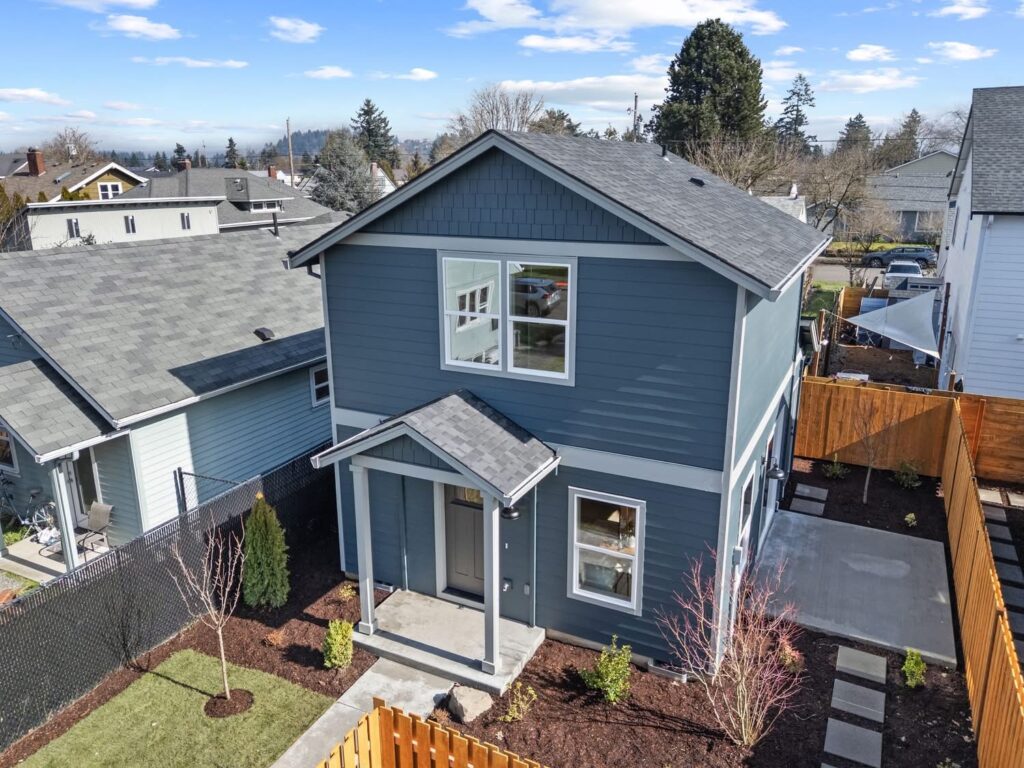
Not so long ago, the house that Laurel Moffat owns in Portland, Oregon, would have been illegal.
Moffat’s 900-foot space is part of a duplex, sharing a wall with another home. And the two homes are both in the backyard of an older house.
“I’d been looking on and off for three years. I was frustrated. Homes in Portland are really expensive,” said Moffat, 30, a health policy analyst for the state of Oregon.
She could afford a house above $400,000, around her county’s median home price. But in that price range, she mostly found fixer-uppers and condos with high fees, until she discovered her duplex. “I could afford a much higher-quality house as a first-time home buyer. … For a new build, that wasn’t possible except for these infill homes.”
As the housing cost crunch has spread from coastal cities to nearly every town in America, and consensus has coalesced around the idea that an undersupply of housing is to blame, many communities have changed their laws to allow more “middle” or “infill” housing in existing neighborhoods. This makes for denser living than a single-family house on a lot, but far less dense than a big apartment building.
Portland now has duplexes, triplexes, fourplexes and sixplexes. Townhouses that stack one behind another, going deep into a lot, rather than all facing the street. Houses in backyards and on wheels. “Cottage clusters” of tiny homes.
While other cities, counties and states have allowed these housing options, Portland has done more than most to create incentives for their construction.
“You can legalize any kind of housing that you want in your city. But whether or not it gets built depends on if it’s a financeable and sellable product,” said Francis Torres, a housing expert at the Bipartisan Policy Center.
Portland determined that the key factor was square footage. specifically a measure known as “floor-area ratio.”
In most of the city, the updated regulations limit the size of a single-family house to half the square footage of its lot— so on a typical 5,000-square-foot lot, the house can be a maximum of 2,500 square feet.
But if developers build something with multiple housing units, they are allowed to go bigger. On that same lot, a duplex could be 3,000 square feet, or a triplex could be 3,500 square feet, or a four-plex could be 4,000 square feet. And developers can count on making more money from those multiple units collectively than from a single-family home.
It seems to have worked: In the first year after the rules went into effect in 2021, 88 percent of new building permits were for middle housing and accessory dwelling units, far outpacing single-family homes. And fourplexes were three times as popular as duplexes and triplexes. The city said last year that it had permitted 1,400 of the denser homes in three years.
While profitable for developers, the new, smaller units tend to be more affordable for buyers, sometimes selling for $300,000 less than neighboring single-family homes.
Overall, the county’s home prices have continued to rise. But as a result of the new approach to housing, the curve has started to bend downward. And the increased availability of middle housing has brought prices down for those sorts of homes, dropping from an average of more than $800,000 in 2018 to about $615,000 in 2024.
“We are leading the nation in new starter homes,” said Neil Heller, a zoning consultant who lives in Portland and worked on the city’s housing policies. “Where most people don’t see starter homes at all and it’s an extinct species, we are reviving them here.”
Heller said Portland had to make a lot of changes to its zoning code, such as allowing homes to be built without their own streetfront, and allowing cottages to be sold on their own instead of as condos.
The city’s efforts were reinforced by changes at the state level. As Portland crafted its Residential Infill Project, Oregon banned single-family-only zoning on most lots in the state in a 2019 law.
The first large U.S. city to do away with single-family zoning was Minneapolis, which had required all lots to be open to duplex and triplex construction earlier that year.
The Minneapolis policy was trumpeted in national headlines. But local housing activists have been disappointed with how it has played out. A court battle slowed down the change. In 2022, Minneapolis permitted 63 new two- to four-unit buildings, according to the Bipartisan Policy Center. Portland, with one-and-a-half times the population, permitted 273 in a year.
“For a lot of housing activists, it feels like we took a step forward, we have a win. And then we don’t see actual physically more housing being built, more people being housed,” said Meghan Howard, a Minneapolis real estate agent and activist.
Minneapolis did not initially offer further incentives for developers to build duplexes or triplexes. If a lot allows for a 2,500-square-foot home, a developer could simply choose to build one single-family house up to 2,500 square feet, or a duplex of two 1,250-square-foot units, or a triplex that fits three homes into the same amount of space.
“It makes for very small, awkward units,” Heller said. When he was hired to work on the zoning code in neighboring St. Paul, he tried not to repeat Minneapolis’s mistakes and offered the Portland model.
In Portland, developers can build up to four units on any lot, or six if they make some of them subsidized affordable units. Trevor Newhart, 34, moved into one of the subsidized units in a six-plex last year.
During a rambling career in which he has worked as a carpenter, fire fighter, farmhand and now bookkeeper, Newhart wasn’t sure whether he would ever own a home. “I absolutely love my place,” he said of his 900-square-foot three-bedroom home. “It’s modest. It’s perfectly economically built, space-wise. Everything works great, but you can never really open two doors at the same time. But who needs two doors?”
Newhart’s previous reservations about becoming a homeowner hadn’t been just about whether he could afford it, but about whether a system in which single-family homeowners always want their homes to increase in value matched his personal ethics. He’s glad to be in a dense community, in a home he bought through a community land trust. “We had a missing 80 years where you couldn’t do that. I’m really happy we’re back on the other side of that.”
One of his neighbors in the building, Monica Bradley, had almost given up on the hope of homeownership. “What I would have been able to qualify for probably would need a lot of work, and there, again, do you have the money to do that?” Bradley said. As a single mother, working as a bodyworker, there were times she could barely make ends meet.
Now, in the $320,000 townhouse that she bought with a subsidy, she marvels at “the sense of security that we feel now, where there’s no lease ending, there’s no rent raise.”
“I feel bad for the neighbor who suddenly had six units built next door,” Bradley said. “I can understand where that can be uncomfortable, just to say it up straight.”
Portland’s first residential infill law passed its city council 3-1 in 2020, and the second part of the plan passed unanimously two years later. Some of the other areas of Oregon that have been forced into zoning changes by the state law have resisted them.
But Oregon state representative Mark Gamba, who has pushed for more housing legislation at the state level, argues that a construction boom brings benefits even for people who already own homes in the neighborhood. “You’re not going to get a new grocery store to move into an area if it’s not dense enough to support that,” he said. “If you can create a little more density, you can attract more services to an area.”
Gamba said the new units aren’t bringing housing prices down as much as he might have hoped, in part because they still represent a small portion of the housing stock. “But I think in the long run, it’s going to help,” he said.
And for the people who buy the units, it’s a type of housing that barely existed before. “It’s helping those young families that have good enough jobs that they can get a mortgage for $350,000, but they can never get a mortgage for $500,000,” Gamba said. “You’re opening the door for a lot of folks that otherwise would never have the opportunity to buy housing.”
The post This city figured out the secret to reining in an out-of-control housing market appeared first on Washington Post.