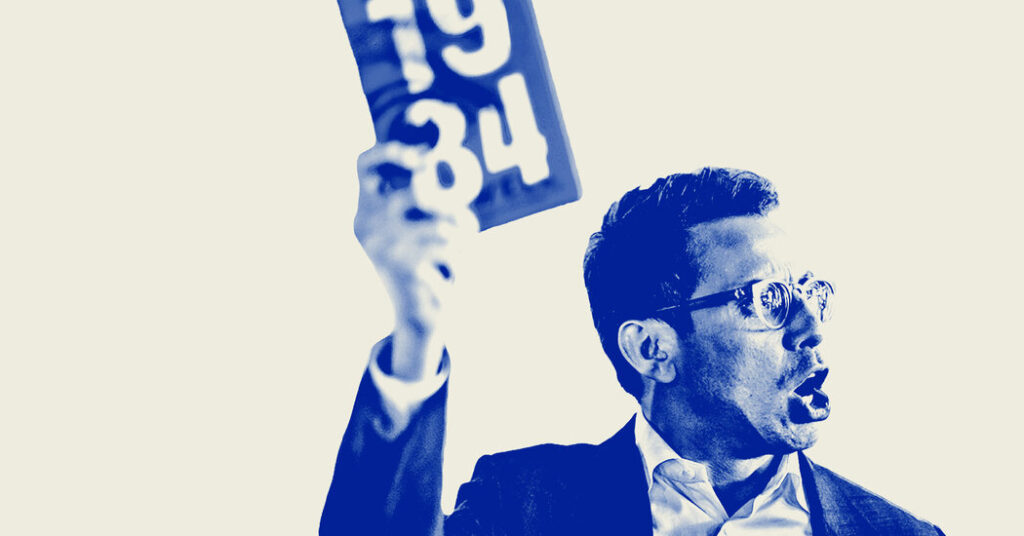
What does a relatively unknown candidate for governor of Florida reveal about antisemitism in American politics? In this episode, the columnist Michelle Goldberg discusses the Republican primary candidate James Fishback, his trollish antisemitic views and his appeal to young male voters.
Below is a transcript of an episode of “The Opinions.” We recommend listening to it in its original form for the full effect. You can do so using the player above or on the NYTimes app, Apple, Spotify, Amazon Music, YouTube, iHeartRadio or wherever you get your podcasts.
The transcript has been lightly edited for length and clarity.
Dan Wakin: I’m Dan Wakin, an Opinion editor at The New York Times. My colleague, columnist Michelle Goldberg, recently wrote a profile of 31-year-old James Fishback, a Republican candidate for Florida governor. Fishback has become a sensation among some young Florida Republicans with his commitment to affordability and his fierce opposition to immigration and U.S. support for Israel.
He also embraces a kind of trollish racism and antisemitism. Given Fishback’s views, I wanted to ask Michelle what it is about Fishback that resonates so much with young Republican voters. Michelle, thanks for being here.
Michelle Goldberg: Thanks for having me.
Wakin: This column of yours really connected with audiences. It was one of the most widely read pieces of the year in The New York Times so far. Thousands of people have left comments, but for those who are unfamiliar, give us some background on James Fishback.
Goldberg: Sure. For me, Fishback as a person is almost less interesting than the movement around him. Fishback is somebody who’s been trying to make it in Republican politics, or conservative politics, for a long time. He’s sort of on the outskirts of the MAGA movement. He was in the news a bit years ago when he wrote a piece for The Free Press about his anti-woke high school debate league.
Later, he started an anti-woke exchange-traded fund that he launched at Mar-a-Lago. These projects ended in scandal and disgrace. And recently, as he’s decided to run for governor, he has shifted and adopted the positions of Nick Fuentes, who some listeners might know as a famous young neo-Nazi-esque troll and very influential conservative pundit.
Fishback is in Florida arguing that the state’s gun laws are too strict and that its abortion laws are too lax. This is a place where abortion is banned after six weeks, where they have stand-your-ground laws. He’s extremely anti-immigrant, although he is the son of an immigrant himself. His mother is Colombian.
But I think what really sets him apart is this insistent focus on Israel and this kind of wink-wink attitude towards antisemitism. When I was standing among the crowds that came to see him, it was often when he brought up Israel that you could feel the energy pick up in the audience, that people would start cheering and applauding. I think that is at the core of his connection to some of these audiences.
Wakin: That deep appreciation, let’s say, of his anti-Israel views — how connected is that to antisemitism per se?
Goldberg: Antisemitism, anti-Israel attitudes or anti-Zionism can be hard to tease apart. I don’t think it’s antisemitic to say that I think Palestinians deserve equal rights and representation in the land in which they live — all of which at this moment is controlled by Israel.
Among the part of the right that takes “America first” isolationism very seriously, there is a significant amount of resentment over Israel’s role in dragging America to war. And again, I don’t think that’s antisemitic.
Jonathan Greenblatt, the head of the Anti-Defamation League, gave a speech recently saying that it’s antisemitic to blame Israel for this war. That’s an unsustainable position when you have Marco Rubio out there saying that America had to strike when it did because they knew Israel was going to hit and then Iran was going to hit back. Rubio has since tried to temper that, but people who heard it were not crazy to think that Israel was the one driving the bus here.
The administration has had so many shifting rationales and has never really made a coherent case for why they’ve started this war. I don’t think you have to be an antisemite to look askance at the role of Israel in American foreign policy right now.
Fishback at some moments is openly antisemitic in ways that have absolutely nothing to do with Israel. For example, he was visiting a university and was talking about the junk food served in cafeterias, that it’s enervating. And he called it “goyslop.” And goyslop, if you don’t know, is a far-right antisemitic term for junk food that Jews foist upon non-Jews in order to, I don’t know, sap their vitality or something.
Wakin: Is this a thing? The sapping of vitality through bad food? I mean, not literally, but is it a thing that people actually believe?
Goldberg: Yeah. It’s where antisemitism and the MAHA movement overlap — it’s in the middle of that Venn diagram. How widely spread this conspiracy theory is, I cannot say. But it is a conspiracy theory, and one that Fishback is very happy to indulge in, and has nothing to do with Israel. It’s similar to the way he speaks about Israel basically being the reason that his audience doesn’t have any of the things they want. That Israel is the monocause behind all of Florida and the United States’ problems.
Fishback is obviously tapping into antisemitic animus. Some people in the crowds told me they don’t have anything against Jews, that they’re Christian and love everyone — which is also what Tucker Carlson often says. Not all of them are that savvy or well versed in antisemitic tropes. But some people will just tell you that they’ve recently learned about how Jews run the banking industry.
Wakin: You noted Fishback’s polling in Florida for the governorship is 5 to 6 percent of the vote, so it’s a tiny amount of actual support according to polls. Why did you think it was important to go and cover him — to go to Florida and really dig in deeply — if he has such a tiny sliver of potential support?
Goldberg: Because those same polls show him leading among Republicans under 35. I was less interested in writing about where I think the Republican Party is today than where it’s going.
We’ve all seen stories about viciously antisemitic and racist group chats among young Republicans and polling about far-right attitudes among them. The conservative writer Rod Dreher has written about the presence of groyperism — groypers are what the followers of Nick Fuentes are called. Dreher has written about how pervasive that is among young Republicans around the administration. It seemed like a way to see that movement not online, which is where I usually encounter it, but in person.
Wakin: Are you concerned that this surge of groyperism among young Republicans represents the danger that this could be the future of the Republican Party, because these young people are going to get older and will presumably continue to vote Republican?
Goldberg: One hundred percent — and whether or not they continue to vote Republican, there’s going to be a future where my kids are going to live in a world in which antisemitism is pervasive in a way that it really wasn’t when I was growing up. I was looking around at some of these events and thinking, if in 20 or 30 years a real antisemitic party contends for power in the United States, this is a glimpse of where it’s starting.
Wakin: You could say antisemitism is becoming politically normalized — would that be accurate?
Goldberg: Absolutely. And we can talk about antisemitism on the left as well. I disagree with a lot of people, including those who write to me, who say that it’s an equal phenomenon to antisemitism on the right. But it certainly exists.
Antisemitism exists today in a way that feels somewhat new and novel. It wasn’t there in the same way a decade ago. But there’s a real effort to try to marginalize it; people are trying to frantically put the lid on it. But you can’t put the lid on mass opinion.
Just recently, a young Republicans chapter at the University of Florida, a couple of days after they hosted a big Fishback event, was disbanded over images of some of their leaders giving Nazi salutes. You can disband the chapter, but the people are still there. You can take Tucker Carlson off of Fox News, but he still has one of the most popular podcasts in the United States.
We have a president who regularly engages in antisemitic tropes, even though he’s extremely pro-Israel and almost philosemitic in some of his approaches to politics. But he regularly traffics in antisemitic-adjacent conspiracy theories about the globalists who are running the world. And he’s also part of a movement that treats it as liberatory to be able to engage in ethnic slurs and demonization. Somehow, some of the people in this movement thought that you could demonize Somalis and Haitians and Muslims, and then hold the line at Jews. It’s preposterous when you treat taboos as fundamentally oppressive. Of course the next generation is going to wonder, why are these taboos the only ones that we’re supposed to respect?
Wakin: I want to go back to something you said a little while ago, that you don’t see antisemitism on the left as equal to the kind of antisemitism you see on the right. How are they different?
Goldberg: I don’t want to deny that it’s there, and it’s certainly been there in parts of the pro-Palestinian movement — obviously not all of it, or even the majority of it. Here’s where I disagree with a lot of other Jewish writers and thinkers: I don’t believe that anti-Zionism is antisemitism. If you do, then of course you will see antisemitism everywhere because there are many people on the left — maybe even most people on the left — who don’t believe that the necessity of maintaining Israel as a Jewish state is more important than the necessity of giving equal rights to all of the people who live between the river and the sea. There’s a lot of left-wing opinion that often gets dismissed by Israel supporters under the rubric of antisemitism, some of which I agree with, some of which I don’t agree with, but still feel is legitimate.
I do not believe that New York’s mayor, Zohran Mamdani, is an antisemite. I also draw a distinction for people who are extremely committed to multiracial democracy and criticize Israel for that reason. That is a stance that is protective of Jews in the United States. To me, a multiracial, pluralistic democracy — the aspiration toward that, which has always been somewhat taken for granted in America until quite recently — is, to me, why Jews have been uniquely safe and have thrived in the United States. I think very differently about the people who are trying to protect that than the people who are trying to destroy it.
Wakin: How have anti-Zionism and antisemitism become so closely associated in our time? What has created the entrenchment of that equation?
Goldberg: Frankly, a lot of the Jewish establishment has worked extremely hard to treat those two terms as synonymous — and I don’t even mean rhetorically, but legally.
There’s the International Holocaust Remembrance Alliance’s definition of antisemitism. The I.H.R.A. definition — forgive me if this sounds recondite or obscure, but it’s actually important for understanding a lot of policies, including Donald Trump’s crackdowns on universities. This definition of antisemitism holds that not all criticisms of Israel, but substantial numbers of criticisms of Israel and Zionism, are forms of antisemitism. This has been written into law in many places, including Florida, that this is how we define antisemitic bigotry. We’ve seen college campuses adopting this definition, sometimes under duress.
And it does a number of things: One, it reifies the idea that antisemitism and anti-Zionism are the same thing, which ironically is also a conflation that you see a lot among actual antisemites, who treat Jews and the Israeli government as a single entity. But it also ends up creating a lot of infringements on free speech.
What I saw in Florida is that these are conservative kids who have grown up among this ferocious backlash to wokeness. They’ve been told that any policy telling you what you can or can’t say, in the name of being sensitive or protecting a minority group, is a kind of woke tyranny. And now they’re being told by their leaders that Israel is the exception.
Not only does it create an oppositional, defiant desire to say things that they’re not supposed to say, but it also creates a question of, why? I have an understanding of how pro-Israel lobbying works — it’s less of a mysterious string-pulling power than it is just a very organized American political movement, but these kids don’t know that. And they both want to flout the rules and also question why Israel has all this power. And it just reinforces a lot of their paranoia and suspicions.
Wakin: So how does this all tie into Fishback’s support in Florida? You’ve pointed out that these young Republicans have grown up fighting the woke tyranny. Does that translate into political support for a candidate?
Goldberg: Yeah. It has translated to support in Fishback’s case. One of the reasons I wanted to go to Florida was because it was not a given to me that online discourse would translate into showing up and volunteering for a candidate, especially since, one of the things we know about Gen Z, or worry about with Gen Z, is that they don’t go out, they don’t get involved in the real world. But one kid said to me that he had his political awakening listening to Fuentes, and now he was volunteering to be Fishback’s county chair.
Fishback has presented himself the only truth teller, which is helped by society trying to put a lid on widely held ideas. He says, I’m the only one brave enough to stand up to the Zionists, and at the same time he’s speaking to kids who — not all of them — are conservative, grew up and voted for Trump, but now they’re disappointed in Trump and a little bit disillusioned. The cost of living is crushing for them. I think Fishback’s solutions to the cost-of-living crisis are mostly ridiculous — it’s certainly not going to be solved by divesting from Israel — but he is talking about real crises and giving people someone to blame.
Wakin: A classic part of the authoritarian playbook.
Goldberg: Absolutely. You asked before, why write about this guy when he’s at 5 percent in the vote? And he’s in some ways a ridiculous figure — like I said, he has this trail of failure and scandal behind him. But he wouldn’t be the first demagogue, who at first glance is extremely hard to take seriously, who ends up tapping into something quite dangerous.
Wakin: In fact, many losers become demagogues.
Goldberg: Absolutely.
Wakin: Let’s talk a bit about the war in Iran and how that has had an impact on Fishback and his supporters and anti-Israel views.
Goldberg: Trump’s antiwar bona fides have been extremely exaggerated, and there’s been a willful misunderstanding of what he did in his first term, when he radically increased the number of drone strikes. Nevertheless, there was this idea among a lot of the young men who voted for him, which was pushed by people like Joe Rogan, that this was an antiwar candidate. JD Vance said in a Wall Street Journal op-ed that Trump’s best policy was not starting any more foreign wars.
To some of those who supported him, there was no intimation that Trump would do something like this. And then the war seemed to come out of nowhere. Trump never really felt the need to make the case for it at all. It all felt weird and mysterious.
If you think of Trump, as I do, like an egomaniac who has people whispering in his ear about how he can be the one to remake the map of the world and take down all of these American enemies, I think it makes a fair amount of sense.
But if you don’t see Trump that way, or if you’re inclined to conspiratorial thinking — or not even, as again, Rubio basically came out and said Israel dragged us into this war, and he’s tried to rewrite that but the words were indelible. Everybody who has ever had suspicions about Israel’s role in American foreign policy, including Fishback, who talks about that Rubio quote on the stump repeatedly, took that as proof that ideas that had previously been dismissed as conspiracy theories have now been confirmed by the secretary of state.
And so the more this war goes badly, the more Americans are asked to make any sort of sacrifice. Even though the casualty count has been, thankfully, relatively low by the standards of major American wars, there are at least a dozen American service members who’ve been killed. There have been more than 200 wounded. There are all of these economic repercussions and a broader sense that the world is spiraling out of control and people really don’t know why. If you’re inclined to believe that there is some dark force pulling the strings, and then somebody says, “I’m the only one brave enough to tell you who it is,” you can see why that is an enticing message.
Wakin: Let’s take a look at the Trump administration and the universe of right-wing influencers that give it fuel. What role have they played in connecting anti-Israel sentiment and antisemitism?
Goldberg: It’s a complicated question because you have a civil war in that influencer sphere right now, and it predated this war. It broke out after the murder of Charlie Kirk, where there were an increasing number of conspiracy theories that there was a Zionist plot to murder him.
There are grains of truth here, as there are with many conspiracy theories. Kirk really was frustrated with pro-Israel donors who were trying to get him to cast aside Tucker Carlson, and he felt a certain amount of conflict between some of his donors and his own misgivings about Israel’s war in Gaza.
That has turned, in the imaginations of some very influential propagandists, into evidence that there was a massive Zionist plot to have him killed. It sounds crazy. But this idea has real purchase on the right. It even has purchase within Kirk’s organization, Turning Point — we recently saw someone fired because they believed these things. So if people within the organization believe these things, imagine how many other people believe them.
Candace Owens, who like Carlson is one of the most successful, widely listened-to and widely viewed podcasters in the United States — this has become the center of her cosmology. When I would talk to people at these Fishback events, the boys usually listened to Fuentes and the girls usually listened to Owens, if I can boil it down like that.
But it’s not just them. This has spiraled out into a broader war over Israel and American foreign policy. I don’t think it’s that pervasive within the MAGA movement writ large — most Trump supporters are still with him on the war. However, there’s a huge rift among MAGA influencers — the people who help drive right-wing propaganda, create right-wing echo chambers and perpetuate narratives that often get recycled by people in Trump’s orbit.
They are fighting bitterly over not just this war, but over American support for Israel, and even more about what you can and can’t say about Israel.
Wakin: Let’s go back to your column and some of the amazing poll figures in there on public opinion among Republicans. The numbers are, 31 percent of Republicans under 50 identified their own views as racist.
Goldberg: Right, and this is from the Manhattan Institute, which is a conservative organization.
Wakin: And 25 percent said they see their own views as antisemitic, which is incredible, that people would just admit that and acknowledge it.
Goldberg: I think that probably understates the real number of those views. That’s only people who are self-identified. A lot of people at these events I was going to, including one person who said his political consciousness was formed by Fuentes, would also deny up and down that they’re antisemites.
Wakin: To end, I want to ask about someone that you mentioned specifically in your reporting: one of the supporters of Fishback that you met down there, Leicee Guiou. She seems so interesting politically, and her situation seems so representative of the people you spoke to.
Goldberg: I don’t think her politics are, but I think her situation is representative in that she has a job — she’s a social worker working with foster kids — she’s very young, she’s engaged to be married, and they live with roommates and have very little hope of being able to move out and start an independent life, because things are so expensive.
What was so striking about her was that when I approached her — and this was outside of a Waffle House as, at the time, Fishback was on what he called his Waffle House tour. So he would hold an event, like the one I went to at a country club, and then afterwards he went to a Waffle House.
We arrived at this Waffle House — and I got there after him because I was still doing interviews at the previous event — and it is just absolutely mobbed. He’s inside doing meet-and-greets. I can’t get anywhere near inside. I tried to push through the door and just gave up and was hanging around with this crowd outside. I spoke to this young woman who said the last time she came out for something was for Black Lives Matter. And that really struck me, because that was obviously a very different political event.
She told me she was a big fan of Mamdani. Her views seesawed between left and right. She had also been shaken by Kirk’s murder. She listens to Owens. She thinks some things Fuentes says make sense. She really appreciated Fishback saying that he wouldn’t take money from AIPAC, the American Israel Public Affairs Committee. And she’s a registered Democrat who told me she was thinking of changing her registration so that she could vote for Fishback in the primary.
Fishback had told me before this that he was getting Democrats at his events — that he is talking to people who say that they’re going to change their registration. I don’t know that I believed him until I saw it for myself.
Wakin: That’s so interesting. And Leicee herself acknowledged that her views seem somewhat contradictory. Who are the voices out there that can speak to young Republicans, or young people in general, who feel that they’re searching for what the path is?
Goldberg: I’m not sure who it is that can speak to young Republicans — because if you’ve been radicalized into bigotry, the way to deradicalize people is maybe another conversation. But given that there are people who are swing voters — not like how we usually think of swing voters, but people who are attracted to these extreme versions of populism and could maybe be won over by a more inclusive version of populism. To that extent, figures like Mamdani, who know how to communicate online, because that’s where these kids are getting all their information, that’s how they know about Fishback, that’s how they started following him.
Mamdani really knows how to reach people there — he talks about affordability, which is very top of mind for these people, he knows how to stand up to AIPAC. Whatever you actually believe about AIPAC, there is tremendous resentment on the right and the left about the role that they’re playing in our politics. But Mamdani does all these things with a positive, inclusive vision.
He’s not the answer to all of our prayers; but young, charismatic politicians who know how to talk about the very real economic struggles and despair that a lot of young people are experiencing, who — instead of putting all that into a rubric of white nationalism — are able to weave it into a narrative of inclusive, multiracial democracy and populism, I think they are the way forward in terms of sort of reaching this generation.
Wakin: Michelle, is there any hope for counteracting this reflexive bigotry — this acceptance of taboos like antisemitism and racism? Is there any antidote to that out there in our society?
Goldberg: I would hope that a more positive vision of multiracial democracy can be an antidote. But the antidotes that people have settled on so far — what you see among an older generation is this very understandable panic, that to some degree I share. They have been motivated by that panic to try and crack down on this speech more and more: to try to put these speech codes into place at universities, to try to write off politicians like California congressman Ro Khanna as antisemitic, to delegitimize this kind of discourse.
It’s not only that it doesn’t work, it’s that it’s really counterproductive, because all it does is create this gnostic glamour around anti-Israel speech, in which it seems to be this secret forbidden knowledge and the unspoken key to everything that’s happening in your life. At a time when people feel understandably confused and despairing, that is really an accelerant for antisemitism.
Wakin: Michelle, it’s been so great talking to you. Thanks so much.
Goldberg: Thank you so much for having me.
Thoughts? Email us at [email protected].
This episode of “The Opinions” was produced by Derek Arthur. It was edited by Jillian Weinberger and Kaari Pitkin. Mixing by Carole Sabouraud. Original music by Pat McCusker and Carole Sabouraud. Fact-checking by Mary Marge Locker. Audience strategy by Shannon Busta and Kristina Samulewski. The deputy director of Opinion Shows is Alison Bruzek. The director of Opinion Shows is Annie-Rose Strasser.
The Times is committed to publishing a diversity of letters to the editor. We’d like to hear what you think about this or any of our articles. Here are some tips. And here’s our email: [email protected].
Follow the New York Times Opinion section on Facebook, Instagram, TikTok, Bluesky, WhatsApp and Threads.
The post They’re Young, Conservative and Embracing Antisemitism appeared first on New York Times.