Another dramatic Democratic primary night is in the books.
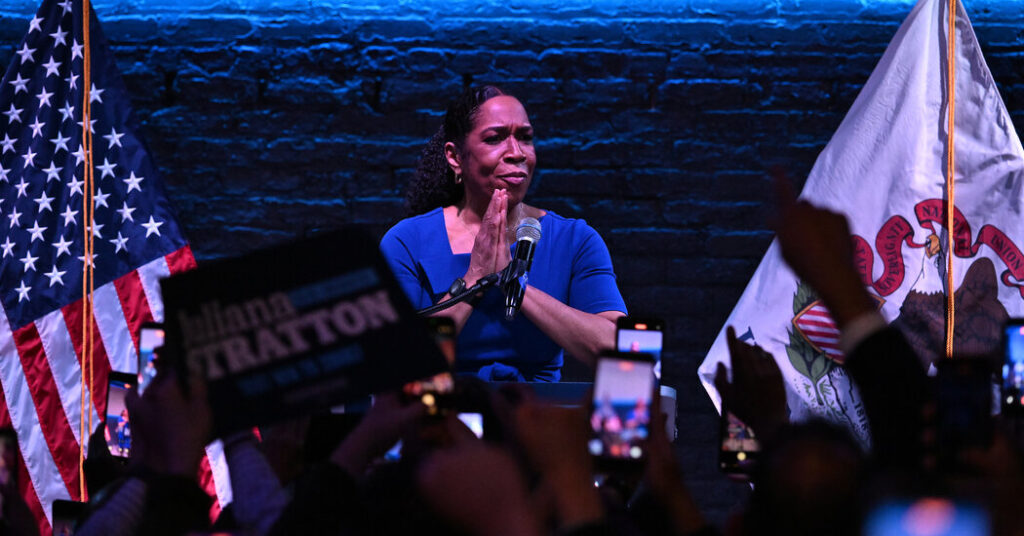
Lt. Gov. Juliana Stratton won the Democratic nomination for Senate in Illinois on Tuesday, beating out two veteran members of Congress, Representatives Raja Krishnamoorthi and Robin Kelly, in a race shaped in part by issues of identity. Divisive House primaries also played out across the Chicago area.
While there is not much general-election suspense in heavily Democratic Illinois, the outcomes did offer a snapshot of the party’s mood — and centers of power — as the midterm election year gets underway.
To break it down, we’re turning to a method you may have last seen used in your high school yearbook: a superlatives list.
Proudest governor
Gov. JB Pritzker of Illinois used his influence and millions of his own dollars to back Stratton in the Democratic Senate primary. She is now on track to become only the sixth Black woman to serve in the U.S. Senate. She could also be a potent ally for Pritzker if he finds himself making his case to Black voters in a 2028 Democratic presidential primary, as my colleague Reid Epstein noted earlier this week.
Most notable comeback
Former Representative Melissa Bean, a centrist Democrat, was wiped out of Congress in the Tea Party wave of 2010. On Tuesday, with the benefit of a well-funded campaign, she climbed her way back, defeating rivals including the progressive tech entrepreneur Junaid Ahmed in the race to represent a strongly Democratic district that stretches across the northwest Chicago suburbs.
Worst attempt at a comeback from a corruption scandal
Jon Stewart once joked that if you’re the governor of Illinois, and you find yourself flanked by former governors of the state on your left and your right, “chances are the room you’re in is jail.” But while there is a long history of Illinois politicians who have navigated legal woes, on Tuesday that was not such an effective credential for running for Congress.
More than a decade after pleading guilty in a corruption scandal that sent him to federal prison, former Representative Jesse Jackson Jr. tried to mount a comeback. Instead, he was soundly defeated by Donna Miller, a Cook County commissioner.
Most likely to be parsed by partisans
Was it a great or terrible night for the American Israel Public Affairs Committee, the major pro-Israel lobbying organization?
As a factual matter, it was a mixed night for the groups aligned with AIPAC that spent heavily to shape the outcomes of several Democratic House primaries. But between the organization’s supporters and its growing chorus of critics within the Democratic Party, expect the arguments to go both ways.
To AIPAC and its backers, the results show the weakness of the far left, where the criticism of Israel is most vehement. To AIPAC’s detractors and skeptics, the results signal the toxicity of the brand in Democratic politics, and show how support for Israel continues to erode. Still others argued that some of the results highlighted support for a nuanced approach.
Take the liberal Ninth District of Illinois. The far-left candidate Kat Abughazaleh lost — but the winner, Mayor Daniel Biss of Evanston, ran as a sharp critic of AIPAC. State Senator Laura Fine, who had the support of groups tied to the organization, was in third as of early Wednesday morning.
Biggest loss for crypto
The Democratic Senate race. The cryptocurrency industry’s main political group, Fairshake, spent about $10 million in an effort to stop Stratton. Clearly, that did not work.
Most exorbitant watch party refreshments
Representative Raja Krishnamoorthi was a well-funded Senate candidate — but that was not necessarily evident at his watch party. Attendees wanting to buy water or soda had to fork over nearly $13, while wine cost $21.87 at the cash bar. At Stratton’s party, by contrast, there was an open bar for attendees and a spread of gourmet sandwiches.
Dan Simmons and Kim Bellware contributed reporting.
Katie Glueck is a Times national political reporter.
The post The Buzziest Outcomes From the Illinois Races appeared first on New York Times.