Facing growing pressure from international agencies and foreign governments, Pakistan said on Wednesday that it would pause its campaign of airstrikes against its neighbor, Afghanistan, for five days of Eid al Fitr celebrations, which mark the end of the holy month of Ramadan.
Shortly after Pakistan’s announcement, the Taliban spokesman, Zabiullah Mujahid, announced a pause in the military operation from Afghanistan.
The Pakistani airstrikes have taken a heavy toll on civilians, although Pakistan has claimed to be targeting military facilities.
A senior United Nations official in Afghanistan said that 143 civilians were confirmed dead following a Pakistani airstrike on a drug rehabilitation center in Kabul on Monday. The U.N. official, who spoke on condition of anonymity to discuss an ongoing U.N. investigation into the strike, said they expected the death toll to rise. At least 119 others were injured, the official said.
The attack on Monday was the deadliest single strike in an escalating conflict that has already killed hundreds and displaced 40,000 people in Afghanistan and put Pakistan on edge, as officials have braced for retaliation.
Pakistan has carried out dozens of airstrikes on military infrastructure that have also hit or damaged health facilities and civilian homes. Afghanistan has responded with border raids and rudimentary drone attacks.
Until Wednesday, both Afghanistan and Pakistan had vowed further escalation in the conflict, ignoring calls by China, a close partner to both, to engage in talks. Pakistan’s information minister, Ataullah Tarar, said in a social media post on Wednesday that the pause in the military campaign came at the request of Saudi Arabia, Qatar and Turkey.
A top Afghan government official called for talks to de-escalate the conflict.
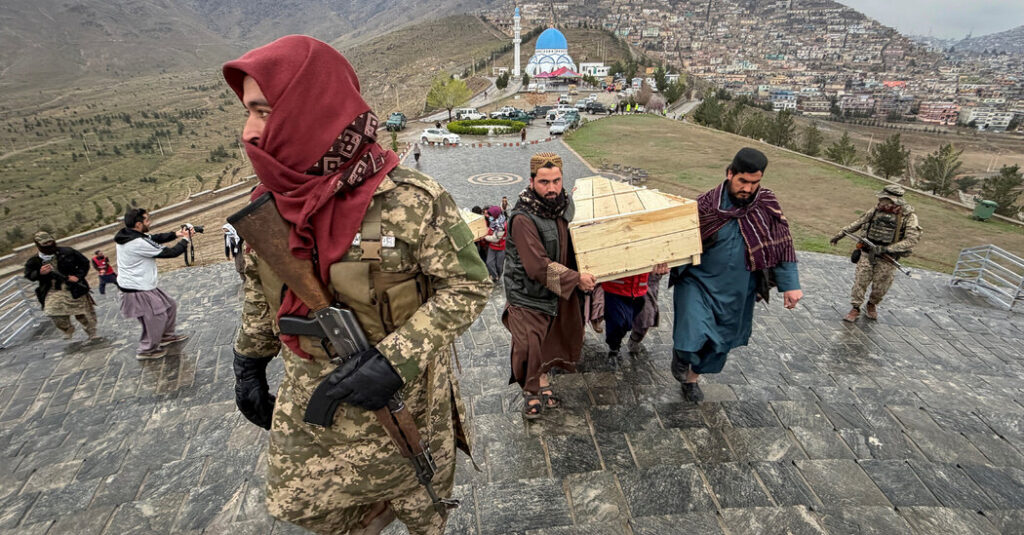
“We do not have the spirit of revenge. Our doors for dialogue and negotiations are open,” said Afghanistan’s interior minister Sirajuddin Haqqani, who for years oversaw the Taliban’s most lethal suicide squads. Mr. Haqqani spoke during the funeral for dozens of the victims killed in Monday’s strike on the drug rehabilitation center, named Omid, or “Hope,” in Dari.
The Omid facility sits in a former U.S. military base less than three miles from Kabul’s international airport and is run by the Afghan Interior Ministry, which also manages the country’s counternarcotics department.
Pakistan claimed responsibility for the strike but maintains that it had targeted a “military terrorist ammunition and equipment storage site.”
A senior Pakistani military official, speaking on condition of anonymity to describe the ongoing military campaign, said Pakistan was aware that the Taliban government had hosted a drug rehabilitation center years ago. He said the military had intelligence that the broader compound housing the center was also used to train suicide bombers and store drones.
The official didn’t respond to a follow-up request for details on that intelligence, or about whether Pakistan was aware that the drug rehabilitation center was still operational at the time of the strike.
“Those who were killed were drug addicts, and they were all civilians and innocent people,” Mr. Haqqani said at the funeral ceremony. “They had no connection with any military group or government.”
Pakistan has vowed to punish the Taliban government in Afghanistan for harboring an Islamist terrorist group, known as the Pakistani Taliban, that has staged hundreds of attacks on its soil in recent years.
The Taliban government has denied hosting the group, despite repeated assessments from U.N. independent experts that it has enjoyed a safe haven in Afghanistan and financial support from the country’s leadership.
Pakistan’s ultimate goal for its military campaign remains unclear.
“The minimum Pakistan will do is what we’re seeing now,” Qamar Cheema, a Pakistani security analyst, said about the airstrike campaign. “The maximum we could see is elimination of the top leadership.”
Privately, Afghan officials and top representatives of international institutions in Kabul say they believe that Pakistan might be seeking to topple the Taliban government. The United States has said that Pakistan has a right to defend itself — a stance that Pakistani officials have said that they interpret as a green light to conduct their operations.
Amid fear of retaliation for its air raids on Afghanistan, Pakistan has tightened security in its major cities. Officials have barricaded the capital, Islamabad, with dozens of checkpoints, reducing the number of entry points into the city from over 100 to 25.
A senior police official in Islamabad, speaking on condition of anonymity because he was not authorized to speak publicly about security measures, said intelligence officials feared that the Pakistani Taliban and allied militant groups could attempt to strike Pakistan with encouragement from the Taliban government in Kabul. He cited recent statements by the groups threatening new attacks.
Although the Pakistani government and military have so far enjoyed wide public support for the campaign, some political figures have expressed growing concern over the humanitarian cost of the cross-border conflict.
Three Pashtun ethnic political parties issued a joint statement earlier this week urging both governments to de-escalate.
“Unless there is a clear change in Pakistan’s policy toward Afghanistan,” the statement read, “The continuation of this war will put civilian lives at even greater risk.”
Elian Peltier is The Times’s bureau chief for Pakistan and Afghanistan, based in Islamabad.
The post Pakistan Pauses Afghanistan Airstrikes After Outrage Over Civilian Deaths appeared first on New York Times.