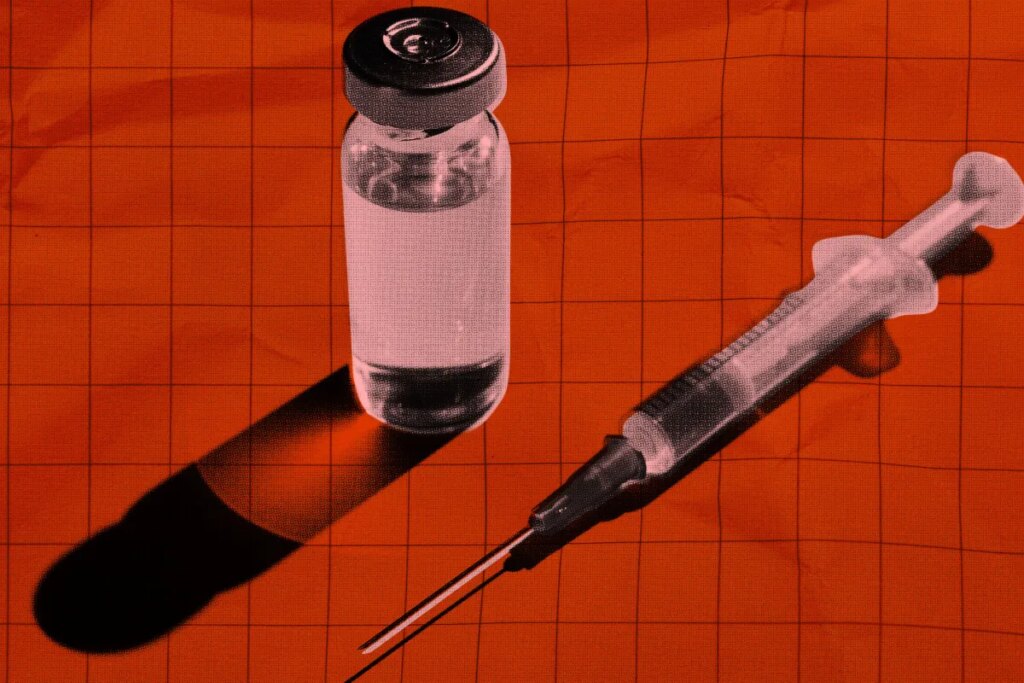
Peptides — those injectable, ingestible, spreadable, sprayable compounds that seem to be taking the health nuts of the world by storm — aren’t going away. Whether ordered from Temu or eBay, or haggled from a strip mall wellness clinic in the San Fernando Valley, it’s easier than ever to get your hands on a stack of the experimental substances. But once you have them, is it wise to put them in your body? As always, if you gotta ask, you probably already know the answer.
First, it’s important to understand what a “peptide” actually is. Basically, they’re chains of two or more amino acids, the essential building blocks of proteins. Our bodies are full of peptides and a handful — like the popular class of weight-loss drugs known as GLP-1s — are available from legitimate pharmaceutical companies.
On the whole, however, the “peptides” that have TikTok influencers, biohackers, and even the Trump administration buzzing are generally untested and unreliable. They’re typically sourced from Chinese and Russian labs, and even if the compounds are chemically pure, their effects on the human body are hazy and potentially dangerous.
As observed by GQ health and fitness writer Dean Stattmann, some of the most popular peptides are on the US Food and Drug Administration’s list of “category 2 substances,” which effectively bans pharmacies from administering them, and doctors from prescribing them.
That designation, though likely to be overturned for at least 14 peptides in the coming weeks, means the amino acids are largely untested in clinical trials. Though reclassifying peptides as category 1 drugs will spur renewed testing, opening the floodgates could have immediate repercussions as looks-maxxers inject substances whose short- and especially long-term health effects are largely unknown.
“The debate isn’t about whether peptides work,” Sanjiv Lal, chief innovation officer at the medspa, Beverly Hills Rejuvenation Center, told GQ. “It’s about which ones have enough evidence and regulatory oversight around them.”
One case-in-point is a 2025 research survey of BPC-157, an experimental synthetic peptide derived from stomach acid. According to the research paper, the substance — which can be ordered straight from China by way of eBay — can indeed help your bones grow, as TikTok influencers will happily tell you. As the researchers note, however, that comes with a theoretical side-effect in the form of tumor cell growth.
Peptide-boosters might rush to point out the positive findings of previous studies, which is fair enough. In response, critics might note that the vast library of BPC-157 research spans a whopping three papers, representing a grand total of 30 human patients — not nearly enough to rule out the risks of long-term use.
A particularly jarring moment came on a recent episode of PJ Vogt’s acclaimed podcast “Search Engine,” when he asked tech anthropologist Jasmine Sun — who’s been reporting deeply on the cultural rise of peptides — whether the tech and health optimizer crowds in China are taking the peptides that the country’s pharmaceutical sector is selling in such quantities to people overseas.
“I don’t think so,” she laughed. “I asked some family friends who are in China, I have some other friends in China who have been poking around, and they seem to think the Americans are freaking crazy. Like ‘you guys are insane, I don’t know why you’re doing this.’ China manufacturers a lot of fentanyl, and they’re not doing that either.”
As with anything, just because you can, doesn’t mean you should — especially when we’re talking about injecting gray market goo straight into your gut.
More on health and wellness: GLP-1s Are an Environmental Catastrophe
The post Is It Safe to Inject Gray-Market Chinese Peptides? appeared first on Futurism.