WE (THE PEOPLE OF THE UNITED STATES), by Joshua Bennett THE PEOPLE CAN FLY: American Promise, Black Prodigies, and the Greatest Miracle of All Time, by Joshua Bennett
Contemporary America often gives poetry short shrift, treating it as esoteric and niche compared to nonfiction. But in the case of the poet and scholar Joshua Bennett’s two new publications, that would be a mistake. His book-length poem “We (the People of the United States)” carries as much historical research and intellectual heft as his essay collection, “The People Can Fly.”
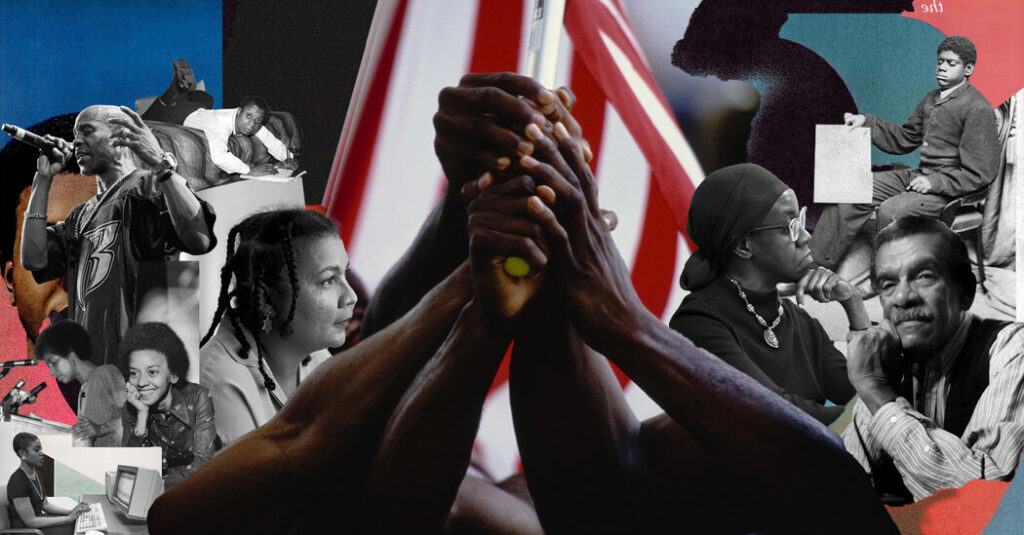
Like fraternal twins, the volumes have distinctly different features but similar DNA. Poetic lyricism suffuses both books, which catalog Black achievers in the arts, letters and sciences from the 1700s to today. The poetry volume “We” links itself to the nation’s 250th anniversary, while “The People Can Fly” was published in February to mark the 100th anniversary of Black History Month.
“We” opens with a half-dozen pieces loosely about family. A recurring theme is Bennett’s double role: He is a son trying to bridge generational divides with his father, and he is himself father to a young boy. The second part expands to include historical figures and great (mostly Black) Americans — several of whom, such as the astronaut Mae Jemison and the poet Nikki Giovanni, also appear in “The People Can Fly.”
Bennett published his debut poetry collection, “The Sobbing School,” in 2016, earning a Ph.D. in English from Princeton University the same year, and since then he has moved comfortably between poems and works of nonfiction. In “We,” his fourth book of poetry, he uses line breaks to marvelous effect, sometimes bifurcating a word to highlight its multiple meanings and associations: “We slap/boxed until it turned to scrap/-ping, unexpectedly, scuffles/blossoming from schoolyard/play.”
Each work in the book’s second part is titled after a specific American locale, from Corinth, Vt., to Kahalu’u Bay, Hawaii. The locations mostly represent the birthplaces of well-known figures — as in “Gary, Indiana,” dedicated to the Jackson 5, or “Talbot County, Maryland,” dedicated to Frederick Douglass. (There, in little more than half a page, Bennett name-checks Abraham Lincoln alongside four literary figures: Gwendolyn Brooks, Derek Walcott, Sir Walter Scott and Homer. More than showing off, Bennett is showing out in the positive Black vernacular sense: demonstrating his erudition for shared delight with the reader.)
Bennett’s poetry combines structural elegance with taut rhythms harking back to his undergraduate days in the New York slam poetry scene. “Yonkers, New York” captures the oral qualities of his flow: “God of the boom-/bap emanating from your big sister’s room/that carries you an ocean away, and back,” before concluding, “God of pure math,/the sea’s unchecked wrath, this untamed love, this reaching/out into the warmth of all that blue, and gray, without shame.” In layered metaphor, the text calls to mind the shifting hues of water, the colors of Civil War uniforms and the nation itself, with all its wrath and love and reaching. God bless America, indeed.
Several epigrams in “We” refer to a much older book-length poem: the “Georgics,” Virgil’s look at ancient agrarian life. Virgil appears again in “The People Can Fly,” where we learn that as a teenager Gwendolyn Brooks not only sought out the classics, she also translated sections of the Roman poet’s writing from the original Latin.
Origin stories of precocious talents like Brooks’s form a through line in “We” and in “The People Can Fly.” A blend of memoir, cultural history and literary criticism, “The People Can Fly” lets Bennett consider Black excellence through the lens of the child prodigy and the savant. Bennett details his own experience being “destined for a path that would further the cause of our people’s freedom.” The book opens with a scene of him delivering weekly sermons to a congregation of his parents and sister at the tender age of 4, continuing into an adulthood of accolades.
“The People Can Fly” could easily have been devoted entirely to Black poets and preachers, those curious marvels (to paraphrase Countee Cullen). Bennett displays a well-honed gift for the kind of parsing and exegesis that characterizes both fields: “the remix, the riff, organizing pieces of what I saw and heard … into a living archive.” Like the best professors, he excels at illuminating a text and synthesizing the work of other scholars, exploring every angle to reveal previously unseen facets.
Bennett chairs the humanities department at M.I.T., and his lens as an educator is especially evident in the chapter “Auto-Bibliography,” which imagines a syllabus for a future memoir class that would include Frederick Douglass and DMX, June Jordan and Joan Didion. This chapter also includes a brief, lovely bit of genealogy, tracing his grandparents’ meet-cute in a North Carolina strawberry field before they came north in 1944 during the Great Migration: “In their collective flight from a world that demanded blood and called their very living a crime, they crafted something that could not be killed.” The story of his grandmother, living in the Bronx while running successful beauty shops in Harlem and raising a family, is worth a book of its own.
Despite a detailed introduction that outlines each chapter and its rationale, the many parts of “The People Can Fly” function more like a literary anthology or mind map, replete with tangents. Notions of disability and giftedness frequently appear. Bennett explores historical records of “spectacular” Black people like Thomas Fuller, considered a human calculator in the 1700s, and “Blind Tom” Wiggins, who had perfect auditory recall and wrote his first composition at age 5 while still enslaved. He also discusses his younger brother’s childhood diagnosis of autism, and contemporary efforts to codify that condition’s causes and symptoms.
Both books reckon with what it means “to bear a history of those barred from all manner of human thriving,” and the ongoing impacts of exclusion as legal policy and accepted cultural norms. At one point in “We,” “Bennett tells the story of Jupiter Hammon, an enslaved writer and preacher, who in 1761 became the first Black man to publish a poem in America: “We must/imagine scores of poets honing songs/in sugar fields, underground, held/within the belly of ships.” In a similar vein, in “The People Can Fly,” he quotes an interview with Mae Jemison: “I’m not the first or the only African American woman who had the skills and the talent to become an astronaut. I had the opportunity.”
Taken together, “We” and “The People Can Fly” offer not necessarily an antidote but a record of ascension. “I realized that what I was looking for was not simply a single, incandescent voice within a larger tradition,” Bennett writes toward the end of “The People Can Fly,” “but a sprawling, transtemporal collective, an endless ensemble.”
These texts remind us there is power in the collective body of a people and their culture. There is power in pressing on in the face of obstacles and opposition.
WE (THE PEOPLE OF THE UNITED STATES) | By Joshua Bennett | Penguin Poets | 90 pp. | Paperback, $20
THE PEOPLE CAN FLY: American Promise, Black Prodigies, and the Greatest Miracle of All Time | By Joshua Bennett | Little, Brown | 261 pp. | $30
The post In Poems and Essays, a Writer Celebrates Black Excellence appeared first on New York Times.