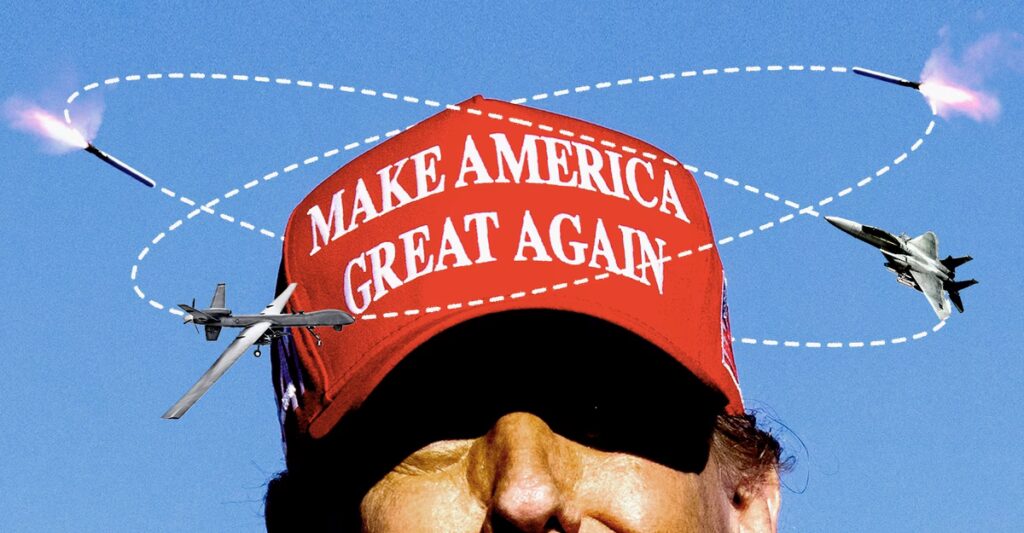
After a decade of trashing American allies as freeloaders, President Trump is begging for their help in opening the Strait of Hormuz, the waterway adjacent to Iran sometimes referred to as the “jugular” of the world economy.
Those allies aren’t exactly jumping at the chance to join Trump’s war on Iran—not a single one has taken the offer. That leaves the president trapped in a needless war of choice that he started and is unable to finish. Iran’s leverage over the global economy is increasing as oil prices rise and the strait remains closed to the U.S. and its allies.
Now, basically anyone could have told Trump that spending the past few years antagonizing allies with aggressive tariffs, belligerent arm-twisting, and imperial dismissiveness would hurt him when the time came to ask those same allies for help. But this isn’t a simple strategic miscalculation or even a typical Trumpian incompetence—it’s the result of a particular ideological fantasy of American independence from foreign alliances, one that is oblivious to how those alliances long served American interests. Americans are learning the hard way that the economic costs of the autarky pursued by Trump are far worse than those of the “globalism” he opposes.
Margaret Thatcher once declared that “there is no such thing” as society. She always insisted that what she meant was that “society was not an abstraction, separate from the men and women who composed it, but a living structure of individuals, families, neighbours and voluntary associations.“
Trump, however, and the Trumpified Republican Party, might actually subscribe to the way her critics understood her point—that society doesn’t exist, and that therefore none of us has any responsibilities or obligations to anyone else, other than the ones we choose to have.
Life is more complicated than that, especially when you’re trying to make war on a state that can close a strategic waterway that is crucial to the world economy. The Trump administration seems to have neither anticipated nor planned properly for the closing of the Strait of Hormuz, through which much of the world’s oil is transported. Iran has begun firing at ships in the strait, dissuading commercial traffic from transiting it. Energy prices are almost certain to rise, but so are prices on other products—you need energy to transport goods to meet global market demand. The possibility that the war might destabilize the world economy either was not part of the Trump administration’s plans for this capricious, ill-advised, and arguably unconstitutional military venture, or was not taken seriously. American war planners seem to have not factored in that, despite being adversaries, the U.S. and Iran are interconnected in vital ways that waging war on Iran would disrupt.
Nor did they foresee the effect on American alliances. Israel joined the attack on Iran, but other U.S. allies in the Gulf who did not are nonetheless facing attacks from the Iranian military, and reportedly reconsidering the wisdom of their dependence on the United States. On Monday, Trump told reporters that Iran wasn’t “supposed to go after all these other countries in the Middle East.” He said, “They hit Qatar, Saudi Arabia, UAE, Bahrain, Kuwait,” and “nobody expected that. We were shocked.”
[Adam Serwer: The American king goes to war]
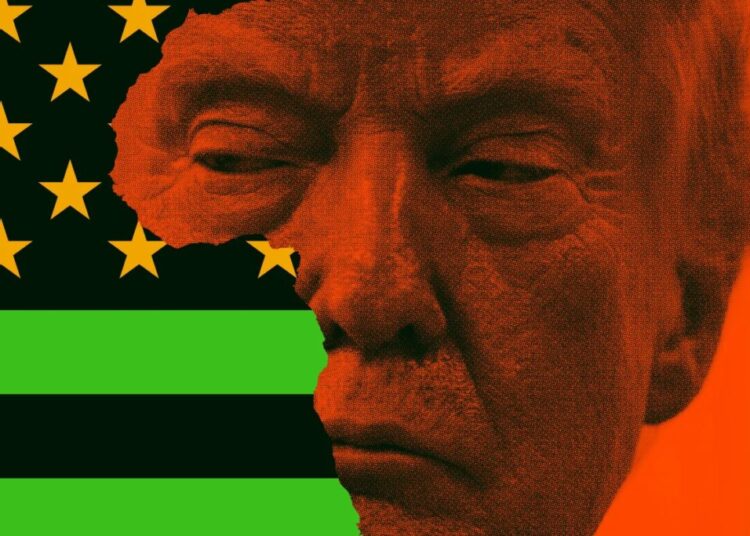
Trumpian ideology sees interconnection as a form of tyranny—even if those who adhere to it benefit from others’ labor and money. “My attitude is we don’t need anybody,” Trump announced after none of America’s allies offered to help open the strait. “We’re the strongest nation in the world.”
This fantasy of complete independence is a long-standing part of American culture. Thomas Jefferson, himself a relatively soft-handed gentleman farmer who left the hard labor to the people he had enslaved, extolled the virtues of the yeoman farmer. The political scientist Richard Hofstadter described this mythic figure as “the incarnation of the simple, honest, independent, healthy, happy human being.” The irony, Hofstadter noted, was that it was really rich, educated men such as Jefferson who romanticized this extremely difficult lifestyle. The typical yeoman farmer wanted to be integrated into the market so that he could sell his crops at a profit and escape his hardscrabble circumstances. That romantic “self-sufficiency” was in fact “usually forced upon him by a lack of transportation or markets, or by the necessity to save cash.”
Nonetheless, this yeoman remained “a mass creed, a part of the country’s political folklore and its nationalist ideology,” which is why even in the 2000s George W. Bush liked to be photographed “clearing brush” at his ranch in Texas.
If you could show Jefferson trad memes, he might chuckle at how little American political propaganda has changed in nearly three centuries. Trump’s fixation on “manly jobs” such as mining and trucking, both harshly hit by his tariffs, is, like many of his worst qualities, an American obsession taken to the point of self-defeating farce. Hofstadter noted in the 1950s that “the agrarian myth came to be believed more widely and tenaciously as it became more fictional,” which may help explain our current nostalgic obsession with an idealized rural past.
This fixation on the stoic manly figure who needs no one may have also obscured the extent to which the United States benefited handsomely from the global economic and political order it constructed by hook and by crook after World War II. That system allowed former colonial empires to retain their high standards of living in relative peace without maintaining territorial empires that were no longer economically or politically viable. One might see the collapse of that order under Trump as a just or needed outcome, but most Americans may miss it—and what comes next could be worse.
This distorted strain of American individualism came to the fore during the coronavirus pandemic but was present earlier as well. If nothing else, the pandemic revealed how dependent we are on others—and a lot of people didn’t like that. Some people thought the evidence didn’t justify the restrictions, that they went too far and could have unintended consequences. But plenty simply didn’t like being told that they should stay home because emergency rooms were filled with people who couldn’t breathe. They didn’t like being told that they should get vaccinated in order to stop the spread of the disease or make it less lethal for those more vulnerable. They didn’t like adhering to restrictions because nurses or meatpackers or grocery workers were dying. Why should I have to change my behavior because it might affect someone else? That’s ridiculous.
Except that there is such a thing as society, and we all share the consequences when collective problems are left unsolved.
[From the March 2026 Issue: America vs. the world]
Too many Americans believed that Trump’s mass deportation could occur without forcing families into hiding, cutting into businesses’ profits, or shooting people dead in the street. They believed that tariffs could replace global trade and revive the manufacturing industry, making the U.S. self-sufficient, when instead the burden has fallen on American farms and firms. They couldn’t see that when people lose their jobs, or go sick or hungry, it becomes everyone’s problem eventually. This desire to be severed from others culminates in the trad fantasy of a wife who keeps the homestead clean while her husband runs a self-sufficient ranch, the whole family secure with their MREs, AR-15, and safe full of gold collectibles when the apocalypse comes.
The most important of these fantasies is the idea that a strong man can bully and dominate his way into getting what he wants, without any consequences or backlash. “We live in a world, in the real world,” the Trump adviser Stephen Miller told CNN in January, “that is governed by strength, that is governed by force, that is governed by power.” This is a schoolyard bully’s naivete masquerading as realism: If the strong always triumphed over the weak, we would remember wars in Vietnam, Iraq, and Afghanistan as triumphs rather than embarrassing failures.
Still, this is the great theory of MAGA: that might not only makes right, but that might can be wielded recklessly, because no one else is strong enough to stop you. Now the United States is at war, the global economy will face disaster if the strait remains closed indefinitely, American allies are reconsidering their reliance on the U.S., and Iran’s previous theocratic leader has been replaced by an even more hard-line successor. The outcome of the conflict itself cannot be known yet, but one thing is certain: Most all of us will be affected, one way or another.
Society is a lot like reality. It exists whether you believe in it or not.
The post How ‘America First’ Became ‘America Alone’ appeared first on The Atlantic.