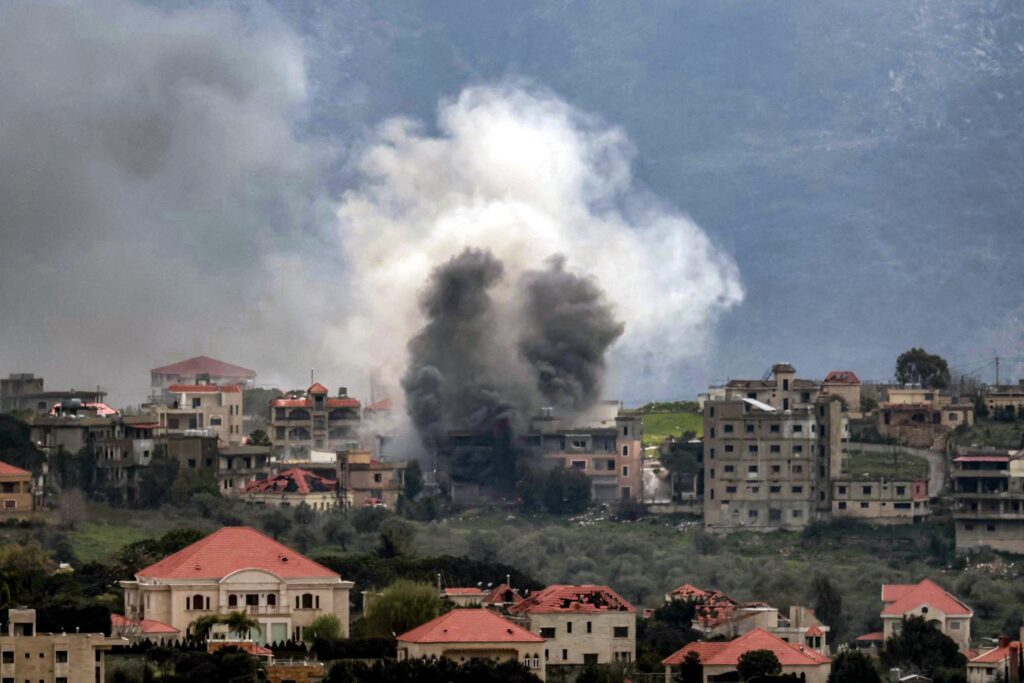
BEIRUT — Shiite Muslims in Lebanon who form Hezbollah’s base of political and popular support are increasingly furious with the Iranian-backed militant group for dragging them into another war, as Israel carries out waves of airstrikes and plans to intensify ground operations.
Hezbollah’s launch of rocket, drone and missile attacks on Israel to avenge the death of Iranian Supreme Leader Ali Khamenei has drawn a fierce response by Israel, which in turn has forced more than 1 million people to flee — many displaced for the second time in less than two years.
“We did not even change our clothes, we fled with our pajamas. I had women and children with me,” said Ali, who had to leave his home in Marjeyoun, in south Lebanon, and is now staying with family in Beirut.
Ali, who spoke on the condition that he is identified only by his first name because of the risk of retribution, said he felt blindsided by Hezbollah’s decision and the humanitarian crisis it created.
The rising public anger is saddling Hezbollah with double-layered existential challenge: Even as some Israeli officials vow to use the current war to destroy the group militarily, Hezbollah’s leaders are at risk of losing political legitimacy within their base, as displaced residents fear that south Lebanon could suffer the same fate as the Gaza Strip and end up largely reduced to rubble.
The Shiite community is “caught between a rock and a hard place” and now faces a reckoning, said Filippo Dionigi, a professor of international relations at the University of Bristol and author of a book about Hezbollah.
“They see Hezbollah as the organization that has represented their interests and their security,” Dionigi said. “But they also are realizing that Hezbollah is leading them into conflicts that exact a very high cost on them.”
“A non-state actor needs some legitimacy to exist,” Dionigi added. “If that is missing, it turns only into a self-interested organization.”
Hezbollah has long relied on political support in predominantly Shiite areas, including south and east Lebanon and the southern suburbs of Beirut, where it supplanted the Lebanese government as the main provider of basic services. This popular support propped up the group even as it faced criticism or outright opposition from domestic rivals over its operations in Syria and Yemen, and the support continued through wars with Israel in 2006 and again in 2023-2024.
But the decision in early March to attack Israel, handing the Israeli military easy justification for a new aerial bombing campaign and targeted operations by ground troops, is eroding the loyalty among Shiites in south Lebanon that once seemed unshakable. The government in Beirut has also hardened its stance against Hezbollah, demanding the group disarm and cease its military activities.
Several people interviewed by The Washington Post expressed bewilderment at the decision by Hezbollah’s leadership to attack Israel and voiced dismay that the plight of the population seemed to be disregarded — especially during the holy month of Ramadan.
“They didn’t even think about Ramadan, that it was nighttime, and that it was in cold weather. They didn’t think about the people,” said Hadi Mourad, a local Shiite doctor who opposes Hezbollah. The night the war expanded to Lebanon, he rushed to evacuate his parents from a town in the country’s east where Hezbollah holds sway.
Hezbollah’s decision to enter the war is being criticized even by the group’s long-standing supporters. Ghada, a Shiite woman who was still looking for a place to shelter in Beirut — and who also spoke on the condition that she be identified by her first name because of potential retribution — said she always supported Hezbollah publicly. Now, however, she questioned the point of trying to avenge the war against Iran, seeing no benefit for Tehran or the Lebanese people.
“The price we paid was not enough?” Ghada said. “Displacement, destruction, and devastation.”
In addition to the more than 1 million displaced, nearly 1,000 people have been killed since the start of the military hostilities, according to Lebanese officials.
Many of those forced to evacuate have nowhere to go, either because shelters are full, rents are too high or landlords will not rent to them. Many are forced to sleep in their cars or in tents. Recently, Israel has targeted locations housing the displaced, including hotels and the public beach, saying it was targeting Hezbollah and Iranian officials.
Hezbollah joined the war less than 24 hours after Iran confirmed the death of Khamenei, sending a salvo of rockets and drones into Israel, much of which was intercepted.
Even Hamas, Hezbollah’s Palestinian ally, seems sick of war and unwilling to stoke a new conflict on behalf of Iran. In a statement Saturday, Hamas urged Iran to stop firing at Persian Gulf countries and try to find a peaceful solution.
In Lebanon, cracks quickly began to show in Hezbollah’s support. At a cabinet meeting hours after Lebanon was dragged into war, the group’s main political Shiite ally — the Amal Movement, led by parliament Speaker Nabih Berri — voted in favor of a decision banning their military activities. (The government so far has been unable to enforce that decision.)
In a matter of days, Israel issued successive evacuation orders for south Lebanon and the southern suburbs of Beirut, triggering a new wave of displacement similar to that of 2024.
Some Lebanese have taken in displaced family members. Lynn Harfoush is now housing 17 members of her family. “I remember that I started calling my family and telling them they have to leave the southern suburbs of Beirut immediately. They were stuck on the road for four hours.”
Harfoush said that most of her family had long supported Hezbollah but that misgivings had been rising even about the recent decision to drag Lebanon into war. She herself is a former supporter of Hezbollah who broke with the group in 2006 to help lead a secular opposition party.
The effects of the exodus could be felt across the capital, as schools were converted to shelters, roads were clogged with cars and the displaced were lighting garbage on fire to stay warm. At one Beirut shelter, Mourad, the doctor, treated an elderly woman with diabetes whose legs were severely swollen because of how long she waited in traffic to get to safety.
To be sure, Hezbollah still enjoys support in the Shiite community. In addition to its military arm, it has a political wing that for decades has provided its supporters with basic services including education, loans, health care and housing. Many residents do not believe the Lebanese government is capable of doing the same.
Hezbollah has asked its base to remain patient and steadfast, but many wonder how the group can expect such patience when even the Shiite religious authority asked the displaced to not seek shelter on its property before finally relenting two weeks into the conflict.
Supporters have been growing unhappy with Hezbollah for some time now.
The fall of the Assad regime in Syria cut off Hezbollah’s direct support lines from Iran, and a new Lebanese government has clamped down on the group’s sources of financing, making it increasingly hard for Hezbollah to rebuild after the 2024 war.
There were also frustrations with Iran. At a Q&A for a book-signing by Iran’s foreign minister in Beirut this year, one partisan chided the minister for his country’s lack of support during the last war with Israel.
Additionally, many supporters said that the group’s recently named leader, Naim Qassem, lacks the charisma and respect of his predecessor, Hasan Nasrallah, which gives him far less legitimacy in promulgating war against Israel.
“Who could not love Nasrallah?” Ali said. “If anyone from our community said so, they would be lying. Now it is over; we need to live.”
After the 2006 war with Israel, Nasrallah spearheaded a massive reconstruction campaign of the southern suburbs of Beirut and south Lebanon. Under his leadership, the group propped up Bashar al-Assad’s regime in neighboring Syria, and after the Oct. 7, 2023, Hamas attack on Israel, Hezbollah struck Israel from south Lebanon, aiming to pressure Israel into a ceasefire in Gaza.
While the Lebanese government opposed those moves, it was unable to stop them. Hezbollah, meanwhile, retained the unquestioned support of its loyal Shiite base. Supporters defended Nasrallah at demonstrations, on talk shows, in workplaces and on social media. This time around, none of that support has been apparent.
“He stepped into some big shoes. Qassem was always Nasrallah’s deputy and perhaps still looks like it in front of the eyes of the Shiite community,” Dionigi said, adding that he lacks any military wins that would earn him the respect Nasrallah enjoyed, not only within the Shiite community but regionally as well.
Harfoush said that although people’s view of Hezbollah has soured since the start of the war, prolonged Israeli bombardment could reverse that. “People were angry and were furious with Hezbollah,” she said. “But Israel’s blanket evacuation orders did not help. It really touched everyone, and it touched them deeply.”
An Israeli invasion of south Lebanon may foster more resentment. Already, Israeli Defense Minister Israel Katz has warned of a prolonged displacement, saying Shiite residents could “not return to their homes south of the Litani [River] area until the safety of the residents of the north is guaranteed.”
Also for now, given Lebanon’s fragile sectarian political system, there seems to be no alternative for Hezbollah’s base. Shiites who have tried to challenge Hezbollah in the past have been targeted and harassed, including Mourad, who ran against Hezbollah in municipal elections last year.
“If Hezbollah does not end militarily, there cannot be a fair confrontation between the Shiite opposition and Hezbollah,” he said.
While a ceasefire has yet to gain momentum, people like Ghada have had their lives upended and are in limbo. “Our young men and children have died and are suffering from hunger and oppression,” Ghada said. “Fear God, fear God. Enough is enough.”
The post Hezbollah ignites blowback from its base as over 1 million flee war with Israel appeared first on Washington Post.