The Federal Reserve held interest rates steady on Wednesday and officials projected they would still proceed with one quarter-point cut this year, as the war in Iran upended the economic outlook.
The decision marks the second meeting in a row in which the central bank has opted against a policy move, voting to keep rates unchanged at a range of 3.5 to 3.75 percent. Stephen I. Miran, who was appointed to the Fed last year by President Trump, issued his fifth straight dissent and voted for a quarter-point cut.
Officials gathered for their latest meeting as the war with Iran stretched into its third week. Supply disruptions stemming from the conflict have pushed energy prices sharply higher, scrambling the Fed’s economic outlook and injecting yet more uncertainty into the debate around when the central bank may restart rate cuts, if at all.
New projections released alongside the rate decision underscored how divided policymakers remain on this point. The “dot plot,” a chart that aggregates what all 19 officials forecast will happen to borrowing costs over the coming years, showed that most of them still see a path to lower rates this year despite expectations for a trickier path to 2 percent inflation.
Seven officials penciled in a quarter-point cut by the end of 2026, while five others expected a reduction of half a percentage point or more. Seven policymakers projected no policy adjustments at all. By the end of the year, most officials expect both overall inflation and a “core” measure — which strips out volatile food and energy items — to decline to only 2.7 percent this year, a higher level than projected three months ago.
As of January, the core Personal Consumption Expenditures index, the Fed’s preferred gauge of underlying inflation, accelerated to 3.1 percent. It dipped as low as 2.6 percent last April.
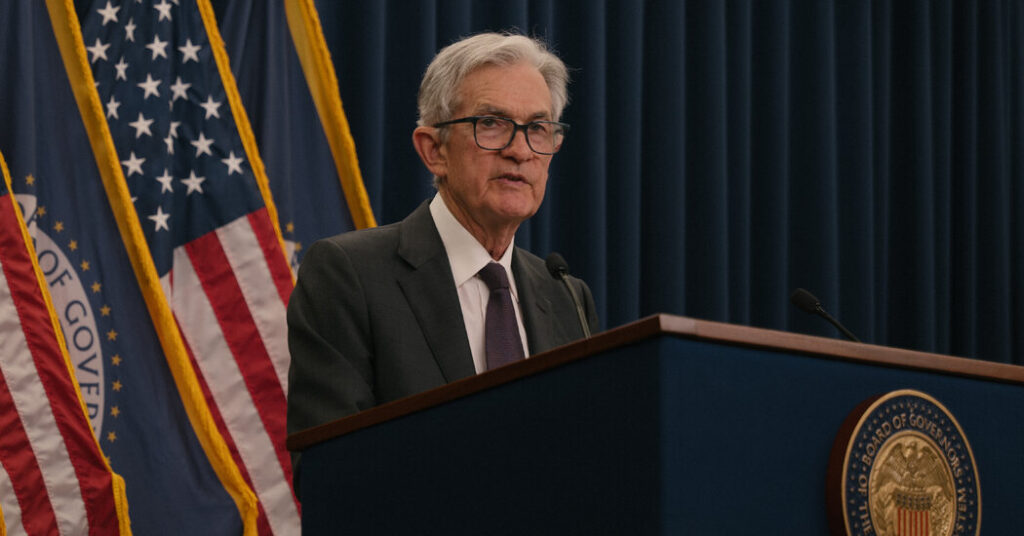
Jerome H. Powell, the Fed chair, on Wednesday repeatedly emphasized during his news conference the high degree of uncertainty associated with the conflict, saying it was far too early to know how inflation and the labor market would be affected.
“The thing I really want to emphasize is that nobody knows,” he said.
Mr. Powell also sought to downplay how informative the latest projections were against this backdrop, quipping at one point that several policymakers said if there were ever a meeting to skip releasing quarterly economic projections “this would be a good one, because we just don’t know.”
The Fed nodded to that uncertainty in its policy statement on Wednesday, saying “the implications of developments in the Middle East for the U.S. economy are uncertain.”
The extent of the economic fallout from the Middle East conflict depends on how long it lasts and the trajectory of oil prices, which have spiked to $108 a barrel as of Wednesday, according to the international Brent crude benchmark. Gasoline prices in the United States have risen to $3.80 a gallon, a roughly 30 percent increase since the start of the war and the highest level since 2023.
A surge in prices of this magnitude is already expected to lift inflation and dent growth to some degree, as businesses and consumers adjust to significantly higher energy-related expenses. But the costs will compound the longer the conflict drags on, raising the possibility of persistent price pressures or an economic downturn.
The combination of the two is particularly hazardous for the Fed, which is responsible for maintaining low, stable inflation and a healthy labor market. Taking steps to tame inflation against this backdrop could portend sharply higher unemployment, while shoring up the labor market would risk worsening the central bank’s inflation problem.
Mr. Powell spoke directly to this dilemma on Wednesday, saying that the Fed was “balancing these two goals in a situation where the risks to the labor market are to the downside, which would call for lower rates, and the risks to inflation are to the upside, which would call for higher rates, or not cutting anyway.”
Mr. Powell acknowledged that no policy action was off the table, but suggested there was still a path to cut so long as some progress was made on getting inflation down. “If we don’t see that progress, then you won’t see the rate cut,” he said.
The Fed was already struggling with both elevated inflation and a softening labor market before war broke out across the Persian Gulf, as it maneuvered through a series of shocks prompted by Mr. Trump’s sweeping global tariffs, immigration restrictions and other policy changes he had introduced since retaking the White House.
For five years now, inflation has remained above the Fed’s 2 percent target, and progress toward that goal in recent months has stalled. Mr. Powell said on Wednesday that the Fed maintaining its inflation credibility was “on everyone’s mind.”
Part of what has helped to ease the Fed’s concerns about inflation is that officials expect the impact of tariffs to fade over the course of the year, enabling inflation to resume its retreat back to 2 percent.
“We’re waiting for that to go through the system so that inflation will go back to what it’s always been,” said Mr. Powell.
Policymakers are simultaneously contending with a labor market that appears increasingly fragile. Layoffs remain low and the unemployment rate has stayed relatively stable around 4.4 percent, but monthly jobs growth has ground to a halt as companies have pulled back on hiring.
Fed officials expected unemployment to steady around current levels this year before declining in 2027. They also marginally revised higher their forecasts for growth, penciling in a 2.4 percent expansion this year. In 2027, they expect the economy to grow 2.3 percent.
Wednesday’s meeting is expected to be Mr. Powell’s second-to-last gathering as chair. His term ends on May 15, although he technically can stay on as a governor until 2028.
Mr. Trump has tapped Kevin M. Warsh, a former Fed governor, to take over as chair, but his path to confirmation by the Senate is riddled with roadblocks.
On Friday, the Justice Department vowed to appeal a ruling by a federal judge who sought to scupper a criminal investigation that had been launched against Mr. Powell and the Fed over renovations at the central bank’s headquarters in Washington.
Top members of the powerful Senate Banking Committee, which oversees the Fed, said they would block the president’s nominees for the central bank so long as the investigation was active.
Mr. Powell on Wednesday said if no new chair was confirmed by the scheduled end of his term, he would stay on in the top job on a temporary basis. With regard to the Justice Department’s inquiry, he made clear that he had “no intention of leaving the board until the investigation is well and truly over, with transparency and finality.” Mr. Powell continued to demur, however, on whether he would stay on as a governor even if the investigation was dropped.
Colby Smith covers the Federal Reserve and the U.S. economy for The Times.
The post Fed Holds Rates Steady as War in Iran Upends the Economic Outlook appeared first on New York Times.