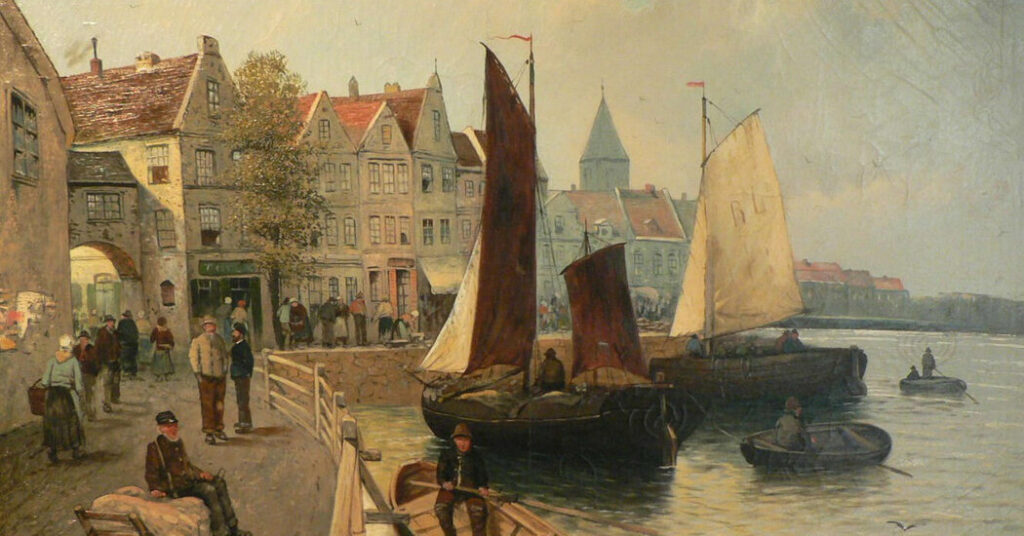
A SCANDAL IN KÖNIGSBERG, by Christopher Clark
The Cambridge historian Christopher Clark is known for his doorstop volumes about monumental events, including the 1848 uprisings that convulsed Europe and the crises that culminated in World War I. His new book, “A Scandal in Königsberg,” is minuscule by comparison; well short of 200 pages, it’s about the size of a novella.
But the “small vortex of turbulence” that is his subject has been on Clark’s mind for decades. In the 1990s, he came across some files detailing a sex scandal that rippled through the Prussian city of Königsberg (now Kaliningrad, Russia) between 1835 and 1842. Two Lutheran priests were brought to trial and sent to prison, though they were exonerated of the most salacious charges.
In a prefatory note, Clark suggests what drew him so insistently to this particular micro-historical moment was how these priests were victims of scurrilous rumors long before the advent of mass communications and social media. He goes on to emphasize the episode’s “fabular power,” adding coyly, “Resemblances to present-day persons and situations, though not intended, cannot be ruled out.”
It’s a tantalizing setup, even if the incessant churn of news in the last few months alone has arguably changed what qualifies as “present-day persons and situations.” Clark is an elegant and evocative writer, and “A Scandal in Königsberg” offers a brisk account of a 19th-century sex panic that captivated the public and ruined lives. But of course one of the biggest stories right now is about rich, powerful men abusing young girls and getting away with it for years. The extreme debauchery in the Epstein files is not a fake scandal that was weaponized; it’s a real horror that was covered up.
Still, Clark tells his story with verve. The curtain opens on 1830s Königsberg, “bathed in the amber glow of the late Enlightenment” decades after the 1804 death of the city’s most famous inhabitant, Immanuel Kant. Königsberg was also the staging ground for Napoleon’s doomed campaign against Russia. Yet despite its illustrious history, the town was looking a bit shabby and past its prime. Its streets were narrow and the houses dark. Königsberg’s gates, according to a contemporary account, were “of mediocre construction.” One resident philosopher described it as a place where “everything exists in a state of almost.”
In this milieu, a couple of Lutheran clergymen stood out. Johann Wilhelm Ebel of the Old City Church and Heinrich Diestel of the Haberberg Church were popular figures with very different personalities. Ebel was a mild-mannered preacher who was an empathetic guide to his parishioners; his friend and associate Diestel was more confrontational, strutting through town “like a Hussar commander.”
Ebel had been inspired by the esoteric teachings of a spiritual seeker named Johann Heinrich Schönherr, who believed that the world began when a “fire ball” collided with a “water ball.” Clark adds that such a bizarre theory nevertheless refracted real-life innovations in the age of steam.
The Prussian authorities weren’t keen on such eccentricities. Sectarian deviations from Lutheran and Calvinist traditions were viewed as dangerous threats to political stability. Ebel, for his part, resisted the rationalism that suffused his theological education. In Schönherr’s teachings he found an approach that touched him more deeply than dry appeals to reason. Early in his career, around 1814, Ebel’s rivals reported him to the authorities, accusing him of corrupting the youth by straying from official doctrine. Yet Ebel prevailed. Even the theological establishment recognized the importance of making room for “religious experience.” He was cleared of wrongdoing and became a celebrated preacher, whose sermons attracted a following among Königsberg’s elite.
The real persecution would take place two decades later. As a longhaired, charismatic figure with markedly progressive notions about gender relations, Ebel had become a trusted confidant to his women parishioners, sometimes to the annoyance of the powerful men in their lives. One of these men, the incredibly named Count Finck von Finckenstein, accused Ebel of causing the death of two girls by excessive arousal.
“These are the dangers that threaten all girls who join the Ebel group,” Finckenstein declared. “And this is why only women or male hermaphrodites are interested in joining it.” Diestel, coming to the aid of his friend Ebel, sent a furious letter to Finckenstein, calling him a “miserable lying brat” whose “disgraceful libels can only have been fabricated in the latrine of a disgraceful worldview.”
Soon the two preachers were on trial for sexual misconduct, breach of duty and founding an illegal sect. Clark emphasizes that the accusations of sexual depravity had no grounding in reality. The most fervent of Ebel’s detractors were “men with a reputation for moral waywardness,” as Clark puts it. Finckenstein accused Ebel of instructing him to have sex in Ebel’s presence, which turned out to be a matter of sheer projection: Finckenstein had previously told his wife that he wanted Ebel present when he made love to her. Another anti-Ebelian, a doctor, had a “propensity to press unwanted intimacies upon the women in his care.”
Clark proposes a number of reasons that Ebel became a target, including the “queerness of his persona.” For Ebel’s detractors, his manners and sensitivity were an unacceptable assault on the rigid binaries of the patriarchal order. The gentle Ebel was married with children, but his critics cast him as a fey home-wrecker who plied his lady parishioners with dangerous ideas. Finckenstein described him as a “hermaphrodite.”
An unquestioned misogyny, perhaps, helps explain the apparent shamelessness of Ebel’s detractors, whose indignation seemed undimmed by their hypocrisy. Such shamelessness is a privilege long extended to men who want to control women. After all, their predations don’t usually imperil the system — far from it. As Clark says of Ebel’s adversaries, their lecherous actions “ultimately affirmed the order in which they took place.”
A SCANDAL IN KÖNIGSBERG | By Christopher Clark | Penguin Press | 179 pp. | $27
Jennifer Szalai is the nonfiction book critic for The Times.
The post Fake News, Ruined Lives and a 19th-Century Sex Panic appeared first on New York Times.