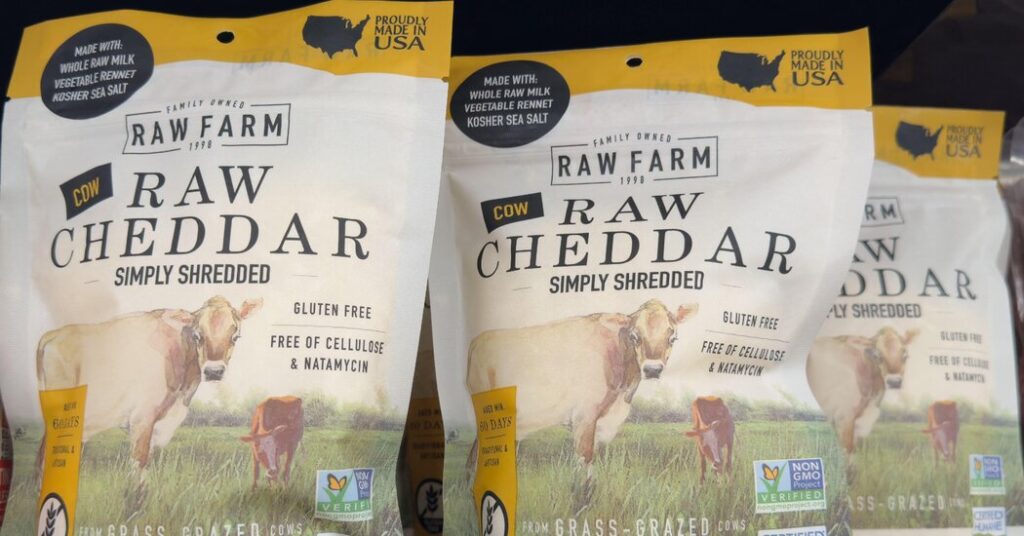
Federal food safety authorities are investigating an E. coli outbreak that has sickened seven people in three states, after some of them said they ate cheese made by a raw dairy farm in California, but the company has denied its products are behind the illnesses.
Five people in California, one person in Texas and one person in Florida became ill with E. coli infections between Sept. 1 and Feb. 13, the Food and Drug Administration said. Three of them told state and local public health investigators that they had eaten Cheddar cheese made by Raw Farm LLC, a family-owned farm whose founder said in an interview on Wednesday that no evidence of the bacteria has been found in its products.
The F.D.A. said that epidemiologic evidence pointed to the farm as “the likely source of this outbreak,” adding that its investigation is looking to determine the source and whether any other products were linked to the illnesses.
In a notice on its website, the Centers for Disease Control and Prevention listed the affected products as the raw Cheddar cheese blocks and raw shredded cheese, and said that consumers should consider not eating them while the investigation is ongoing. Some stores voluntarily pulled the products from shelves, even though official results have not been released, the company said.
Mark McAfee, the founder of the farm, which is spread across 800 acres in Fresno and has 1,200 cows, said the company disagrees with the statements made by the F.D.A. and the C.D.C. about their products and the outbreak.
The farm has an on-site laboratory and technicians, Mr. McAfee said. “We test all of our milk every day and we test cows every week, and all end products,” he said.
Aaron McAfee, the president of the farm, said in an interview that the farm’s technicians conducted 3,238 routine tests specifically for E. coli from Sept. 1 to March 6, including on the barns, plants, on finished products, and on milk.
“All of our product released to the market has a negative certificate of analysis that shows no pathogens detected,” he said.
Public health authorities in California have not taken action against the farm, and state test results are expected on Friday, Mark McAfee said. The California Department of Public Health did not immediately reply to a request for comment on Wednesday.
Raw Farm said in a statement posted online this week that it had tested its products and found them to be “negative for all harmful bacteria,” including E. coli O157-H7, referring to a strain that causes severe intestinal infection in people.
The F.D.A. said E. coli bacteria are genetically similar, which means that people in this outbreak were likely to have shared a common source of infection, but added that it, too, was not aware of any Raw Farm Cheddar cheese products from that time period having tested positive for E. coli.
The farm declined to recall its Cheddar cheese products, the F.D.A. and Mark McAfee said.
Two of the people who became ill were hospitalized, the food agency said, and four of them are 3 years old or younger. No deaths or acute illnesses have been reported from the outbreak, the agency said.
Public health officials have warned for decades that consuming raw dairy products can cause food-borne illnesses, some of which can be serious or even result in death. Milder cases can cause nausea, vomiting, stomach pain, fever, headache and body aches.
Milk can harbor bacteria that is present in cows’ feces, dirt or on the hands of people who are milking them. During pasteurization, milk is heated to kill those microbes, but in raw milk and dairy products made from it, microbes can survive and grow.
Investigators have used a genetic testing method called whole genome sequencing in looking into this outbreak. According to the F.D.A., those tests suggest the ill patients were sickened by a common source.
That is like finding the same “unique fingerprint” of a pathogen in each sick person, said Michael Osterholm, the director of the Center for Infectious Disease Research and Policy at the University of Minnesota.
“Epidemiologically, this is the smoking gun, whether they ever isolate it from the product,” Dr. Osterholm said. It is common for the F.D.A. to recommend that companies stop selling their products based on this evidence, even when they haven’t yet found the same pathogen in the product itself, he said.
Food-borne outbreaks have previously been tied to Raw Farm’s products, including raw Cheddar linked to an E. coli outbreak in 2024. Unpasteurized milk sold by the farm was tied to salmonella infections in at least 171 people, 22 of whom were hospitalized from September 2023 to March 2024.
That outbreak was the largest to be connected to unpasteurized milk in more than two decades, C.D.C. figures showed.
Under a previous name, Organic Pastures Dairy Company, the farm was implicated in E. coli outbreaks that occurred in 2006, 2011 and 2016.
Aaron McAfee said in a video this week that the latest instance was the first time that the farm, established in 1998, had declined a voluntary recall.
“In the past, we have had recalls. We have owned it, whether we agreed or disagreed,” he said in the video. “We have always learned something and we are proud of it. This is different,” he said.
Christine Hauser is a Times reporter who writes breaking news stories, features and explainers.
The post F.D.A. Investigates 7 E. Coli Illnesses as Raw Dairy Farm Denies Any Link appeared first on New York Times.