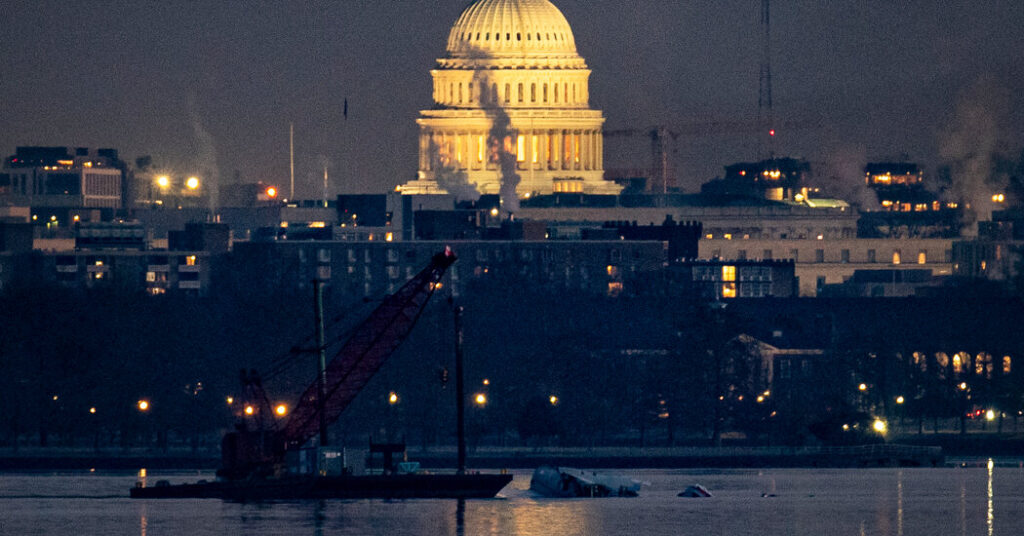
The Federal Aviation Administration is suspending the use of visual separation between airplanes and helicopters near busy airports, a sweeping change aimed at ending one of the key conditions that contributed to last year’s midair collision over Ronald Reagan National Airport that killed 67.
The notice, which takes effect immediately and remains in effect until late 2026, requires air traffic controllers to actively manage the flight paths that helicopters and commercial planes take around busy airports. The announcement ends what had become a common practice at Reagan National of letting the pilots manage their own way through the area, relying only on what they could see to avoid collisions.
Bryan Bedford, the F.A.A. administrator, said in a statement that the agency had “identified an overreliance on pilot ‘see and avoid’ operations” that precipitated the change.
On the night of Jan. 29, 2025, the pilots of the Army Black Hawk helicopter that crashed into American Airlines Flight 5342 requested and were granted permission to use visual separation with flying several minutes before impact — and long before they had registered the presence of the commercial jet in the nearby skies.
During its investigation of the crash, the National Transportation Safety Board collected testimony and other evidence revealing that controllers had come to rely on visual separation as a way of reducing an often punishing workload. Reagan National is home to the country’s busiest runway, and the nearby airspace sees heavy helicopter traffic from the military, emergency services, local police departments and private transport services.
Within weeks of the crash, the F.A.A. rerouted the path the Army helicopter had been traversing — Route 4, which ran along the Potomac River — to move it farther from the airport. It also limited the practice of using visual separation between helicopters and commercial aircraft close to that airport.
But the use of visual separation had not been similarly constricted at busy airports nationwide, until now. The change will affect large and midsize airports, including New York’s LaGuardia Airport.
Visual separation is used primarily by pilots of helicopters and smaller planes, and less frequently by commercial jet pilots, who commonly rely on instruments to manage their way through complex airspace. Controllers use it as a way to keep traffic moving, particularly when one person in the tower is managing both commercial and helicopter traffic, as was the case on the night of the midair collision.
The practice comes with a clear history of pitfalls.
Weather, light pollution and other factors can make it difficult for pilots to see other traffic, and faulty visual separation has contributed to at least 40 fatal collisions since 2010, according to the N.T.S.B.
The N.T.S.B.’s investigation also showed that visual separation was not an adequate fail-safe in the case of the midair collision, as the helicopter pilots did not visually identify the right commercial jet until little more than a second before impact.
The N.T.S.B. pointed to that timing as reason to recommend that all aircraft traversing busy airspace be outfitted with and required to use advanced location broadcasting and tracking technology. Congress is mired in a standoff over whether to require by law that planes carry such technology.
In the meantime, suspending the practice of visual separation is likely to increase the burden on controllers, making it more difficult for individual air traffic officials to safely shoulder a double workload.
That could further strain the national work force of controllers, which is struggling to make up a shortfall of nearly 3,000 positions. The N.T.S.B. investigation found that, despite the national shortage, there were enough controllers on duty at the Reagan National tower the night of the crash to have separated the duties of managing helicopter and fixed-wing aircraft.
“The tragedy over the Potomac one year ago revealed a startling truth: Years of warning signs were missed, and the F.A.A. needed dire reform,” Sean Duffy, the transportation secretary, said in a statement.
The F.A.A. had “identified the need for enhanced protocols at all airports across the National Airspace System,” he said.
Karoun Demirjian is a breaking news reporter for The Times.
The post F.A.A. Ends Use of ‘See and Avoid’ for Helicopters Near Busy Airports appeared first on New York Times.