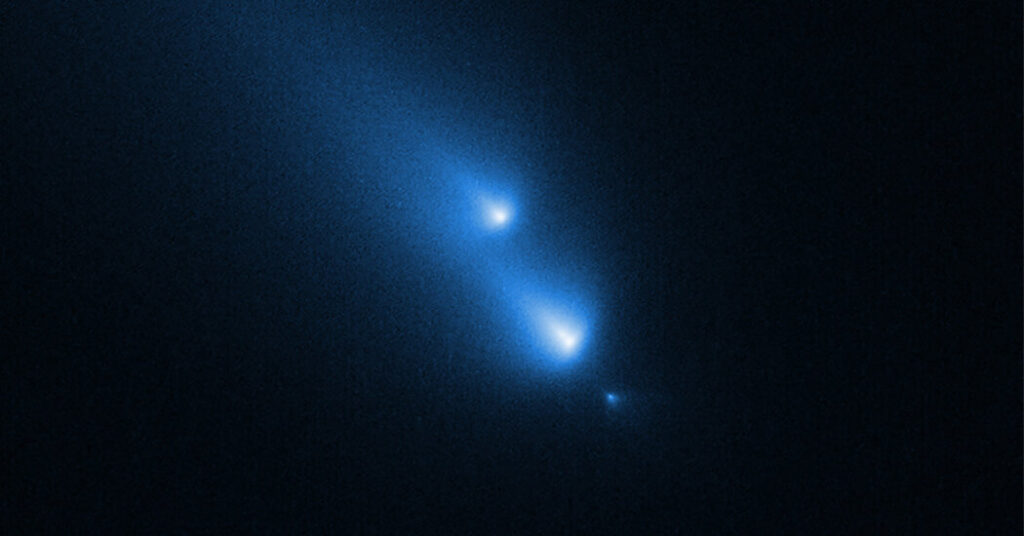
Astronomers on Wednesday announced a stroke of cosmic luck: While using the Hubble Space Telescope, they captured imagery of a comet just as it exploded into fragments.
From Nov. 8 to Nov. 10, the comet — known as C/2025 K1 (ATLAS), or more casually as K1 — was seen erupting and shattering into four, perhaps five distinct shards, each surrounded by an atmosphere of vaporized ices. Ground-based telescopes that were also looking at K1 at the time could only see hazy smudges of light. But Hubble was able to spot each individual fragment in remarkable detail.
Cometary schisms aren’t uncommon.
“This is the sort of thing that’s happening all the time in the solar system,” said John Noonan, a planetary scientist at Auburn University.
But it’s unusual to see a comet just beginning to break apart, he said — and the Hubble telescope observations by Dr. Noonan and his team can offer astronomers the rare opportunity to see inside a comet’s icy heart.
Comets are always barreling through our solar system. While many keep their distance from the sun, some daredevils travel precariously close in, and not all of them survive this scorching-hot slingshot. A comet’s ices can vaporize too explosively, making its core — the nucleus — splinter into smaller pieces that melt away or get blasted back into space as frigid buckshot.
Comet K1, roughly five miles in length, was discovered last May by the NASA-funded Asteroid Terrestrial-impact Last Alert System, a telescopic network focused on planetary defense that’s skilled at spotting bright comets (including the much-discussed interstellar comet 3I/ATLAS).
Astronomers realized K1 would graze the sun at a distance of 31 million miles on Oct. 8.
As this would take K1 closer than Mercury’s average distance from the sun, scientists did not expect the comet to make it out in one piece. And indeed, around Halloween, several ground telescopes spied flashes appearing around the comet: outbursts coming as gas was violently jetted into space.
K1 wasn’t originally on the minds of the researchers who witnessed its disintegration. They intended to use Hubble to study another comet that was closer to the sun. But the telescope is aging, and the researchers were unable to point it where they wanted to look.
“So we targeted this one as a backup target — and it happened to fall apart while we were watching,” Colin Snodgrass, an astronomer at the University of Edinburgh, wrote in an email.
The odds of viewing a comet with Hubble just as it self-destructs are “vanishingly small,” Dr. Noonan said. “I was on vacation when this happened,” he added. But this dazzling display was one interruption he welcomed.
Just as each comet is unique, so is every cometary dissolution. As the team reports in a paper published Wednesday in the journal Icarus, K1’s rupture had unusual features.
Most notably, there was a gap of one to three days from when each fragment was liberated to its subsequent, glittering light show. Each shard’s newly exposed ices should have been vaporized by the sun’s warmth almost immediately. That the telescope didn’t observe such an outcome remains a puzzle.
The exposed innards of K1 could also help to answer an astronomical mystery. It’s not known why short-period comets (those that take less than 200 years to orbit the sun) are less prone to catastrophically fragmenting than long-period comets (whose voyages last more than 200 years). By studying the now-disheveled K1 — a long-period comet — astronomers hope to edge closer to an answer.
The ruins of K1 are currently about 250 million miles from Earth in an area of the sky that lines up with the constellation Pisces. They’re shooting out of the solar system, never to be seen again. That makes it all the more fortunate that K1’s demise was captured on camera.
“When you observe comets a lot, you are going to eventually get weird things,” Dr. Noonan said. “This is another example of that. It was really cool.”
The post Exploding Comet Is Spotted by NASA’s Hubble Space Telescope appeared first on New York Times.