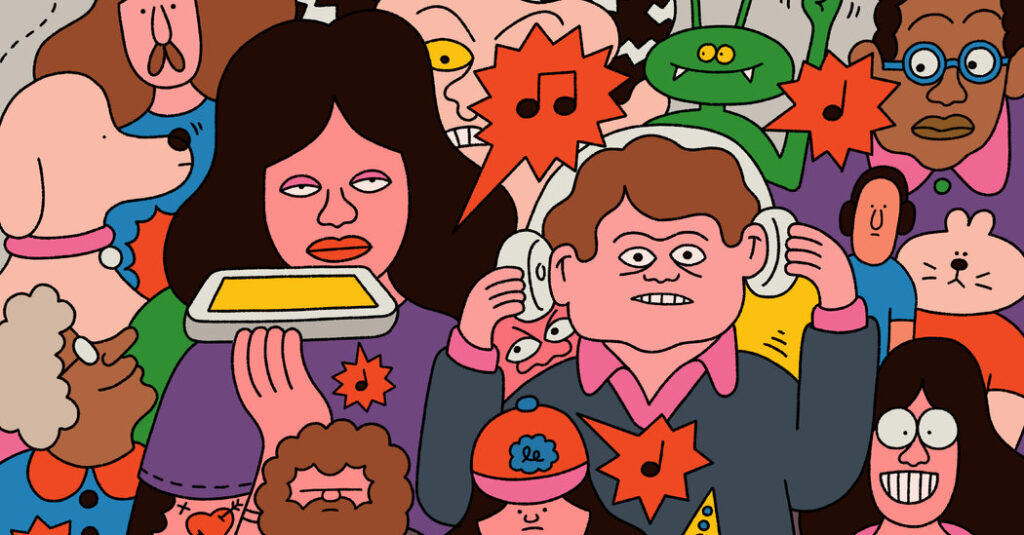
Do you ever wear headphones when you’re around other people? For example, while riding in the back seat of the car? Taking the bus or train to school? Walking from anywhere to anywhere?
Do you ever fear that your earbuds are cutting you off from the world around you?
In “What You Miss When You’re Always Wearing Headphones,” Conor Truax writes about how he came to put away his big “anti-noise” headphones and embrace the chaotic world around him:
A few months ago, I sat in a half-empty Q train on my way downtown. The car was scattered with a handful of people, most of whom looked down at their phones with a pair of headphones around or inside their ears. I wore them, too: noise-canceling ones, with big cups. I was half-interestedly scouring YouTube for a mixtape I first listened to at 13.
Then I found myself absorbed by an unskippable ad. It showed a young man much like myself wandering toward an approaching train, glancing furtively over his shoulder. The station was pale and gray, and passers-by bumped into him with an air of menace. Then he put on his headphones, and they emanated a vibrant glow that transformed the station. The world became hospitable. Aretha Franklin’s voice filled our ears — well, my ears.
By now, playing music and videos aloud in public is widely considered to be a cardinal social sin in the era of ubiquitous headphones. Still, there is a certain segment of the population who seem to take pleasure in inflicting their portable speakers on the world. Every day, whether on the subway in the city or at a park in the suburbs, one of these people will materialize with a grenade-size device carabinered to their hip, playing a mash-up of the most annoying Top 40 hits from the past 20 years, or watching a TikTok video backgrounded by the same song sped up, before quickly scrolling to another video narrated by a blaring robo-voice.
When I ride the Q train, I have daily encounters with an array of noisemakers. There are the Upper East Siders alternately watching news clips from Fox and CNN; buskers hanging upside-down on poles over speakers near Times Square; students playing video lectures on their way to N.Y.U.; WeChat videos in Mandarin near Canal Street; and FaceTimes in impassioned Russian once the train has breached the city’s surface en route to Brighton Beach.
The essay continues:
I usually used the headphones in transient public places: on the sidewalk, on airplanes, on the subway or in the grocery store. These are the crannies of life, what we consider the unavoidable connections we must endure to get to the places and people that populate our real lives. In the past, the racket in these spaces was more communal. Instead of the angry disquisitions of a political pundit or a TikTok video about a movie’s underrated “spicy” scenes, we might have overheard conversations about community goings-on, a new favorite movie, someone’s complaints about their life. These conversations still happen, if less often, but when faced with a medley of individual racket, we’ve found it easier to ignore the communal too.
So much of our lives are spent in these shared places, and the rest of our time we are increasingly stowed away. While suspicion of the world is warranted, we should first try for curiosity. I might not be clamoring for, or even able to understand, the information I can glean from the WeChat calls and N.Y.U. student lectures on my Q train rides. But even ambiently, these sounds pull me from my inwardness to glimpse, however briefly, the broader range of experiences existing all around me, willingly or not.
Students, read the entire article and then tell us:
-
Do you like wearing headphones? Why or why not? How often do you wear them in public? Is it because you love music or podcasts, or is it primarily as a means to escape your surroundings?
-
What’s your reaction to the essay? What lines or details stand out most? How convincing is Mr. Traux’s argument that we are missing out on the world around us when we go through public spaces with our headphones on?
-
What do you think is lost if everyone is isolated in their own private audio bubble — for each of us, and for public life? What are the costs, if any, of continually tuning out the world around us?
-
At the end of the essay, Mr. Traux writes, “I decided it was time to retire my headphones from public life and reacquaint myself with the noisemakers.” Could you go a day, a week or even a month, without putting in your earbuds? Why or why not? What do you think you might notice that you usually ignore? How might you benefit from a headphone fast?
Students 13 and older in the United States and Britain, and 16 and older elsewhere, are invited to comment. All comments are moderated by the Learning Network staff, but please keep in mind that once your comment is accepted, it will be made public and may appear in print.
Find more Student Opinion questions here. Teachers, check out this guide to learn how you can incorporate these prompts into your classroom.
Jeremy Engle is an editor of The Learning Network who worked in teaching for more than 20 years before joining The Times.
The post Do You Spend Too Much Time Wearing Headphones? appeared first on New York Times.