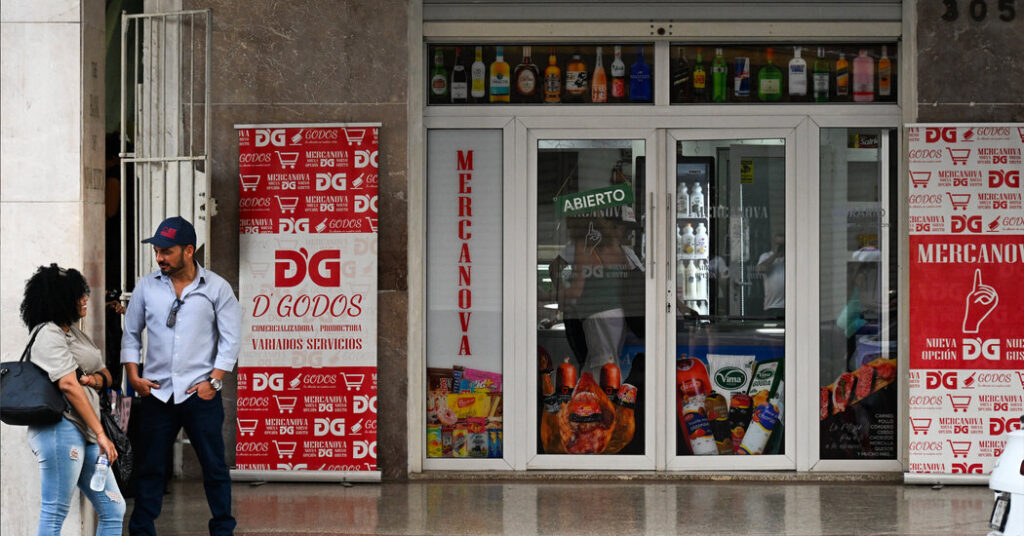
Diana Sainz and her husband, Andrea Gallina, invested big a decade ago when Cuba made a push toward allowing private entrepreneurship.
The couple owns two boutique hotels with restaurants in Havana, three small markets and a production center to sell frozen prepared meals. But with fuel running out and long electrical outages a daily occurrence, 90 percent of this year’s reservations have been canceled. They said they had to lay off dozens of employees.
Under intense pressure from the Trump administration and facing a crippling oil embargo, the Cuban government said this week that new regulations would allow expatriates to own companies and invest in private companies, potentially ushering in the kind of foreign capital small-business owners like Ms. Sainz desperately need.
In a highly anticipated television interview few Cubans actually got to watch — the power was out — Cuba’s deputy prime minister said Cubans who live abroad will soon be able to invest in or own private companies, invest in large infrastructure and conduct banking on the island. But those expecting broad economic change to stave off a humanitarian crisis and loosen the Communist government’s grip on the country were left disappointed.
To the business and legal experts in the United States who follow Cuba’s economy closely, Cuba’s latest package of moves came across as a desperate effort by a government gasping for air but unwilling to make profound changes that would encourage foreign investment and loosen President Trump’s chokehold. The details of the measures were unclear, could take months to implement and would likely run afoul of U.S. law, the experts said.
“I think the most important message is that these measures aren’t enough,” Ms. Sainz said in a video interview from Havana. “They’re a step in the right direction, because any economic reopening is positive, but they’re not enough.”
The Cuban government has faced a severe economic downturn for years, worsened by U.S. sanctions, a faltering electrical grid and mass migration. Mr. Trump, who has said he wants to topple the Cuban government and have the “honor of taking Cuba,” has pushed the country to the edge of economic collapse by blocking foreign oil shipments.
Cuba said it has not had gotten any oil deliveries in months, and experts say the nation is likely to run out soon. The president, Miguel Díaz-Canel, has acknowledged that his country is in discussions with the United States to negotiate the country’s difficulties.
The Times reported on Monday that the Trump administration is pushing for the ouster of Mr. Díaz-Canel, who is widely seen as a figurehead lacking real political clout.
Secretary of State Marco Rubio, referring to Cuba, told reporters on Tuesday in the Oval Office that “the people in charge, they don’t know how to fix it, so they need to get new people in charge.”
It is unclear who might replace Mr. Díaz-Canel, but the Cuban government appeared to float one possible candidate: Óscar Pérez-Oliva Fraga, the deputy prime minister and a relative of Fidel and Raúl Castro, who got a rare moment in the spotlight when he announced the new economic policy on Monday night.
He described the measures as an “important change.”
“The doors of our country are open to the participation of the Cuban community residing abroad,” he said. “The magnitude of the businesses will depend on the capacity and the real possibilities to undertake them. There is no limitation from an administrative or legal point of view that prevents it.”
He stressed that investments would not be limited to small companies and could include infrastructure and agriculture. Cuban expatriates could participate in investment funds for economic and social development projects, he said.
Robert L. Muse, a lawyer in Washington who specializes in business in Cuba, said he sent a note to the Cuban Embassy’s commercial attaché asking whether the measures would apply to Americans who are not of Cuban descent.
To comply with a longstanding U.S. trade embargo on Cuba, the measures announced by the Cuban government would require licenses from the U.S. Department of Treasury. But Mr. Muse said he thinks it would be illegal for the U.S. government to offer Cuban Americans licenses to operate in Cuba if the same opportunity was not offered to other Americans. He said he received no reply from the Cuban Embassy to his query.
Pedro A. Freyre, a Cuban American lawyer in Miami and an expert on Cuba’s regulatory landscape, said investors would have to see drastic changes to Cuba’s regulatory framework, a credible legal system, a stable and strong local currency and guarantees against excessive taxation.
“This is a day late and a peso short,” Mr. Freyre said.
Many experts noted that Cuban Americans who fled in the 1960s did so because their businesses were confiscated, and so they and their descendants would be hard pressed to return to Cuba without basic legal guarantees.
Representative Nicole Malliotakis, a Republican from New York, said the Cuban government seized her grandfather’s gas station shortly after Fidel Castro took power in 1959. There should be no investment, she said, until the entire government is replaced.
“Why would anyone invest in Cuba knowing that this is a regime that stole businesses and property from people, and there’s a rigged legal system?” she said. “There’s been no recourse to challenge anything.”
Mr. Rubio, who is Cuban American and whose office has been conducting the negotiations, appeared to agree.
“Cuba has an economy that doesn’t work,” he said Tuesday. “What they announced yesterday is not dramatic enough. It’s not going to fix it.”
“So they’ve got some big decisions to make over there.”
Joe Garcia, a Cuban American a former Democratic member of Congress from South Florida who helps supply private businesses in Cuba, said the announcement left too many concerns. For one, Cuba said expatriate investors would require a special visa to enter the country.
“I was expecting more,” Mr. Garcia said. “To have a modern market economy, you need a certain amount of freedoms, which they are never willing to give their own citizens, foreign investors and certainly never to Cuban expats.”
Paul Johnson, the Chicago-based co-chair of the United States Agriculture Coalition for Cuba, which pushes for more agricultural trade between the two countries, was in Havana on Tuesday and said he had a chance to ask Cuban officials about the announced changes.
He said the new measures remove the requirement for Cubans abroad to reside in Cuba in order to own businesses. As an American, he said too can invest in a private business, although the government’s announcement focused on Cubans abroad.
He acknowledged that investing in Cuba would be risky, but said it would take people like him to first take the plunge.
“It’s pretty incredible to be sitting in front of the Cuban government saying you or a U.S. company can have your own business in Cuba,” Mr. Johnson said. “It’s groundbreaking. I have been doing this 25 years, and I have been waiting for opportunities like this.”
Zolan Kanno-Youngs and Edward Wong contributed reporting from Washington.
Frances Robles is a Times reporter covering Latin America and the Caribbean. She has reported on the region for more than 25 years.
The post Cuban Americans Will Be Allowed to Own Businesses in Cuba, but Is That Enough? appeared first on New York Times.