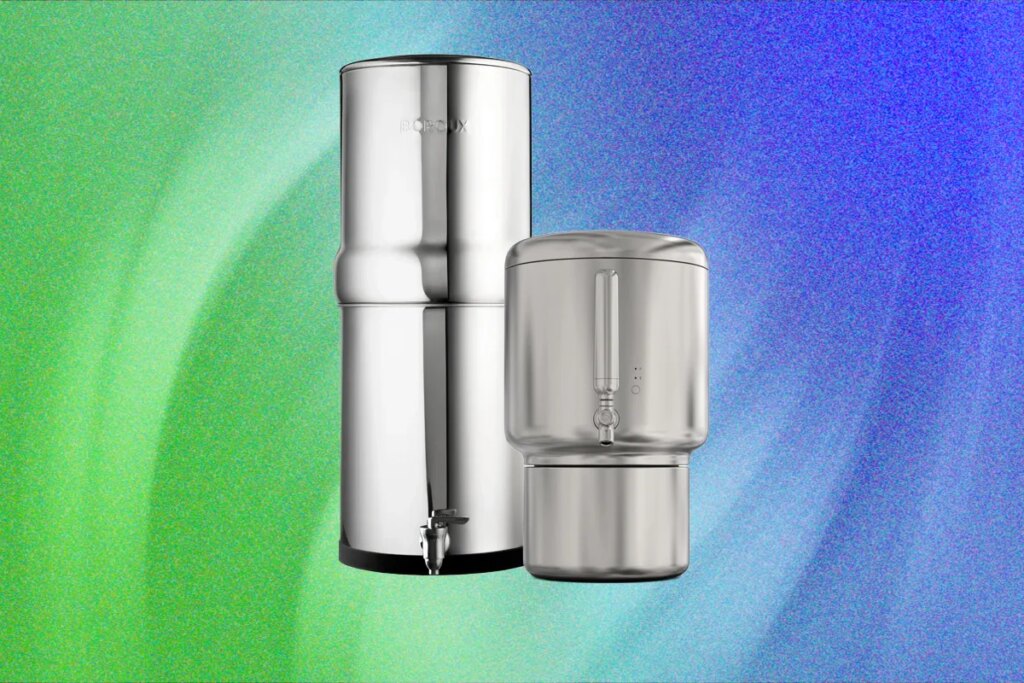
I will admit that the popularity of those giant, stainless steel, gravity-fed water filters remained a mystery to me for some years—even as multi-gallon water filter systems from brands like British Berkefeld and Berkey seemed to proliferate equally among lovers of doomsday prepping and holistic wellness retreats.
I have been testing much different breeds of water filters for more than a year now, including reverse osmosis filters and water pitchers. But often, the big water filter tanks have seemed as much like status symbols as functional items. They’re good-looking in an industrial stainless-steel sort of way: an expression of a lifestyle and a stately point of pride. If you see a big gravity-fed filter, you know the person in question is serious about wellness, survival, or both.
What changed my mind about these big stainless steel filters was microplastics. Most water filter pitchers are made of BPA-free plastic. But as new research shows that bottled-water drinkers ingest tens of thousands of excess microplastic particles, wellness lovers have begun to look askance at water filters that are themselves made of plastic.
A newer generation of gravity filters has leaned into this, removing all—or nearly all—points of contact with plastic. And so I put a pair of these new-school filters to the test. The Boroux Legacy Water Filter System ($419) is a handsome gravity-fed filter system from a former Berkey distributor whose livelihood was disrupted by Berkey’s fight with federal regulators (see below). The Rorra Countertop System ($549) is a newer-school, celebrity-endorsed filter from a trio of serial entrepreneurs, with smart features that include sensors for both filter and water levels.
In testing each, I assessed ease of setup, plastic content, total chlorine reduction, and changes to dissolved solids or pH. I also pored over each filter’s NSF/ANSI certifications and independent testing results.
Benefits and Detriments of Gravity-Fed Water Filter Systems
Gravity-fed water filter systems gained their biggest prominence in the United States with a system called the Berkey—whose makers began in 1998 as a distributor for a much older filter system called the British Berkefeld. Amid legal troubles for Berkey (see below), a newer generation of gravity-fed filters has risen to prominence.
Multi-gallon filters like this are imposing beasts—as much statement pieces as water filters. They’re big, holding a gallon or more. They live on your counter or your table, and take up significant space there. But because they are so large, they are difficult to fill and slow to filter. In my early testing, gravity-fed filters like the new Boroux and Rorra don’t necessarily filter water any better out of the box than plastic pitchers that can fit in your fridge door, or in-line filters under your sink. And because they don’t fit in your fridge, your water is room temp.
But convenience is relative. The jugs on gravity-fed filter systems are big enough on an overnight refill to provide a day’s worth of water for most families, for sipping and cooking and coffee. I find this can be easier than the constant cycle of filling and waiting that plagues smaller water pitchers, especially for large families, coffee lovers, or avid cooks. And whereas most water pitchers require regular filter re-ups, the Boroux filters advertise that they need replacement only once a year. (More on this claim later).
But especially, both Rorra and Boroux have shed nearly all plastic from their devices, especially in areas that come in contact with filtered water. Boroux, in particular, has taken the extra step of attaining certification for microplastic filtration. And so if microplastics are a main concern, the new generation of gravity-fed filters does quite a bit to alleviate these worries.
Best Countertop Water Filter for Performance: Boroux Legacy
Of the two new-school gravity-fed systems I tested, the Boroux is the one I’d trust most, across a range of criteria. It’s the one with the most extensive base of third-party testing. It’s also the one that has pursued international NSF certifications for particulate and microplastic removal, in addition to lead-free manufacturing.
Third-party testing showed efficacy against chlorine, PFAS, and lead. And my own testing showed its efficacy in chloramine-treated water systems, reducing total chlorine by more than 95 percent. The water tasted good. And the Boroux is also the prettiest water filter system I know, which matters quite a bit if it’s going to live in your kitchen for years.
Boroux also sells supplemental fluoride filters, for those worried about fluoridated water. I wasn’t able to test the efficacy of this, because I live in Portland, Oregon, the largest metropolitan area in America without fluoride in its water. But independent, third-party testing backs up these claims.
One reason for Boroux’s performance is simple: Boroux’s filters are a trusted technology, functionally identical to the original Berkey black filters made with a mix of activated carbon and antimicrobial silver. In fact, they’re made by the Berkey filters’ original manufacturer, Clearbrook, which also separately sells its own filters.
Berkey is not currently selling those filters. The company is instead embroiled in a long fight with the Environmental Protection Agency, which issued a stop-sale notice in 2023 on Berkey’s classic black activated-carbon filters, saying the company’s antimicrobial claims meant the Berkey water systems were being sold as unregulated pesticides. Berkey’s maker, New Millennium Concepts, has since been fighting this order in court, but has also newly endorsed an Indian-made filter called the Phoenix that WIRED has yet to test.
Berkey’s stop-sale order left its distributors in the lurch, including the owners of Boroux. Boroux improvised, and figured out how to bring filters with the same formulation to market while complying with the EPA’s regulations. The most simple difference is in the claims made by each manufacturer. Boroux quite carefully denotes that the antimicrobial silver in its filters are meant to extend the longevity of the black carbon in its filters, but doesn’t advertise that the filters kill microbes in pond water or well water—long a benefit touted by Berkey lovers.
Activated carbon filters work through adsorption, providing a tortuous and porous surface that causes contaminants to cling to its surface, including PFAS and chlorine and heavy metals, according to third-party testing by IAPMO. But this process doesn’t remove beneficial dissolved minerals like calcium and magnesium from your water. This means the water still tastes good. Reverse-osmosis filters, which zero out all dissolved solids in your water, often require remineralization to be palatable.
Carbon filters like Boroux’s have an additional benefit: You can scrub them and reprime if they clog, rather than be forced to replace them. Boroux recommends regular cleaning to extend the lifetime of the filter to a year.
The downsides of the Boroux, however, are matters of convenience. Its 3-gallon filter system is not just big but tall. If you fill it in the sink, it’ll be quite heavy and awkward to lift back onto a counter or stand. Unless you have a big hose, you’ll likely have to fill it up with water pitchers. It’s also slow, requiring more than three hours to filter a full 3-gallon tank. The system also has no sensors to warn you when filters need replacement, or when water is getting low. The system works best if you refill the water overnight.
Setting Up the Boroux Water Filter
LargeChevron
On the one hand, the Boroux water filter system is as simple as it gets: There’s a 3-gallon reservoir on the top, and one on the bottom. You screw in a pair of plugs, and a pair of filters. The water flows through the filters and comes out cleaner.
But setup on the Boroux isn’t always intuitive, requiring careful reading of the instructions. And because activated carbon filters are stored dry, they must be “primed” before use by running water through them forcefully.
This is an obnoxious process to do manually with the Boroux, involving little silicone attachments and lots of potential splashing. I’d recommend you also buy the brand’s ingenious automatic priming pump ($40), which automates this into a 90-second process and looks charmingly like a little outboard motor while doing so.
Priming, plus install of the plugs, as well as two “foundation” filters and possibly two additional fluoride filters, will likely take more than an hour on initial setup. Once you’ve got the process down, however, swapping and priming filters is pretty painless if you’ve got the pump. Get the pump.
You’ll also need to run at least one full cycle through the system before drinking the water. On first use, a lot of activated carbon will leach into the water from the filters, and you’ll both taste and see it. This probably won’t be harmful, but why drink charcoal? This adds an additional three hours to the initial setup time.
Total setup time: 4 hours Setup Grade: 4/10 (or 6/10 with automatic priming pump)
Filter Performance and Certifications
LargeChevron
There’s testing and there’s testing. Many water filter companies, especially new ones, don’t pursue costly certifications via accredited bodies like the National Sanitation Foundation and the Water Quality Association—especially not for every single substance among potentially hundreds filtered. But certification is more rigorous than just a single third-party test, and it matters.
Through the WQA, Boroux is certified to remove microplastics and the smallest class of particulates from water, down to a half a micron. The company also obtained certification for being lead-free.
For other claims, you have to dig into the company’s independent third-party testing, which comes from a reputable lab: IAPMO R&T. The gist is that if you’re using two filters, Boroux’s filters will remove the majority of chlorine and chloramine from 12,000 gallons of water, multiple decades’ worth of drinking water for a single person. My own chloramine testing mirrored the independent lab results: Total chlorine was reduced to minuscule levels, less than 0.1 parts per million.
Lead at neutral acidity is cleared for 8,000 gallons. But for other substances, including PFAS and a number of heavy metals, the testing only goes up to about 800 gallons—maybe a year’s use for a family of three. Indeed, Boroux recommends filter replacement once a year, at $150 a pop. Reduction of PFAS is impressive, mirroring previous testing by independent testing body Environmental Working Group on Berkey’s water filters.
Long story short: 800 gallons is still quite good performance at 99 percent clearance—better than results by Rorra and many other filters. While you’d want to see full NSF certifications, the results are still heartening.
NSF Certifications (WQA): Particulates, microplastics, lead content in manufacturing
Independent testing (IAPMO): 80 substances including PFAS/PFOA, lead, cadmium, mercury, chlorine/chloramine, volatile organics, many pharmacueticals
Performance and certifications: 8/10
Plastic Content
LargeChevron
If you’re filtering microplastics, you probably don’t want a lot of plastic in contact with the water. In Boroux’s case, there are a couple plastic elements: There’s a plastic base on the main filters, which keep the filters from staying in contact with water in the upper charmber. There are also plastic stoppers in the top filter tank.
Why am I not worried about this? That’s still just unfiltered water in contact with the plastic. The filters are designed to remove 99 percent of microplastics, and there are no plastic points of contact for filtered water. And unlike many water filter systems, the spigot is metal, not plastic.
Plastics score: 9/10
Convenience
LargeChevron
How big is too big? The Boroux Legacy tests this.
The compact system, which I didn’t test, is a comparatively petite 1.8 gallons on top and bottom. But the full-size system is 2 feet tall, and 9 inches wide, requiring quite a bit of airspace.
When full with 3 gallons of water, it’ll also weigh more than 25 pounds. Speaking as a large and capable man, with more than 200 pounds on my frame, I still had a difficult time moving it out of the sink and onto its stand after filling. This means you’ll likely fill with multiple pours of another pitcher.
The Boroux also filters slowly, over the course of more than three hours. This makes it most suitable for overnight filtering. If you start from an empty tank, you won’t be able to get a glass of water out of it for at least 20 minutes.
This said, the 3-gallon tank is big enough that you likely won’t need to refill it during any given day, even as a family. So if you incorporate topping off the Boroux into your nightly routine, you likely won’t ever need to worry about running out of filtered water even if you use it for cooking.
Convenience: 6/10
Aesthetics
LargeChevron
The Boroux is simple, handsome, and stately, available in stainless steel or painted black or white. A wooden stand, sold separately, adds rustic charm for tabletop pouring. The device advertises a sort of utilitarian luxury and looks clean. Some have lamented the lack of a handle for the lid, instead of a little lip.
For aesthetic reasons, but also because the damn thing’s tall enough already, I disagree heartily. A handle would ruin the simplicity.
But note that you shouldn’t get the white- or black-painted models if you don’t want to worry about paint potentially chipping off the stainless steel. I do love the matte white aesthetics, and only saw this problem where the lid fits, which isn’t visible. But paint will require additional nervous care while replacing filters.
Aesthetics: 8/10
Best Countertop Water Filter for Convenience: Rorra
The Rorra Countertop system is in many ways a wonderfully well-designed device. It contains sensors that tell you when to refill water or change its filter. Its 1.5-gallon reservoir capacity means it’s small enough that you can lift it easily and store it in the fridge, but large enough you won’t be stuck in an endless cycle of refilling.
Its flashy, newfangled electrostatic nanofiber filter—a technology used commonly in air filters during the Covid-19 years to capture microbes—is also very fast, filtering water twice as fast as the Boroux.
I won’t call the device pretty so much as utilitarian, but ease is ease, and Rorra keeps it easy in terms of daily use. Unlike the Boroux, you’ll never curse its size. You will need to replace the filters once every three months, which is a significant expense at $65 a pop, but setup is easy. Luckily the filters don’t require priming, and can just be slotted into a waiting sheath. Setup with this filter system is as easy as it gets.
But unlike Boroux, Rorra did not pursue full NSF certifications, instead noting that its filters were independently “tested by the NSF.” Such independent testing is welcome, but not as rigorous as the full certification process followed by Boroux for microplastics and particulates. Rorra also tested for fewer substances, and tested PFAS and lead only up to 200 gallons. This is about as much water as a family might use in three months, but it doesn’t leave a lot of leeway for heavier water users.
Filter replacement expense aside, the Rorra is nonetheless the gravity-fed filter that would fit best into my daily routine. And because I prefer to drink cold water but not ice water, I love that it’s able to fit in my fridge.
Setting Up the Rorra Water Filter
LargeChevron
The Rorra looked briefly daunting to me, as I pulled it out of its box and tried to figure it out. I couldn’t figure out what I was supposed to do. That’s because I didn’t really need to do anything.
You just put the filter in its housing, run a gallon of water through it (which you then discard), and setup is done. No messy or obnoxious filter priming. No spigot assembly. No screwing in filters with a bunch of washers. What a world. The only time-consuming step is that it takes 20 minutes for the first gallon of water to run through it.
Total setup time: 22 minutes Setup Grade: 10/10
Filter Performance and Certifications
LargeChevron
Rorra is to be commended for undergoing third-party testing and making the results public. Up to about 200 gallons in most cases, testing by the NSF showed near-total reductions in chlorine, lead, a host of volatile organic compounds, PFAS and PFOA, particulate matter, and microplastics.
This said, Rorra has not yet obtained actual certifications from the NSF, so naming standards and declaring that the product is “tested by the NSF” is a somewhat dubious bit of marketing sleight of hand. Most substances are tested only to 200 gallons, and not quite as many substances are tested as Boroux.
This said, Rorra’s transparent, independent testing is still admirable—and a rare quality in the often hazy world of water filters. Rorra reduced total chlorine to nearly undetectable levels, 0.01 parts per million, in my home testing. It also very slightly reduced water hardness, a surprising result.
NSF Certifications: None
Independent testing (NSF): PFAs/PFOA, lead, chlorine/chloramine, volatile organics, many pharmaceuticals
Performance and certifications: 6/10
Plastic Content
LargeChevron
Rorra approximately equals the Boroux in avoiding plastic. As with Boroux, the fitler’s end caps are plastic. The Rorra also uses silicone O-rings. But in general, the filtered water doesn’t touch plastic. And so we’re in pretty great shape, for those who don’t want plastic in their water.
Plastics score: 9/10
Convenience
LargeChevron
Rorra excels at convenience, except for one thing: The filters need to be replaced quarterly, at an expense of $65. Luckily, filter replacement is as easy as discarding the old one and putting the new one in its housing.
But otherwise, the Rorra seems dang near optimized. The top tank holds a gallon, while the bottom tank of filtered water holds 1.5 gallons. This mismatch would bother me, but it’s actually a feature, not a bug. When the bottom tank drops down to a half-gallon, a little light turns on. This is your signal to put another gallon of water up top. Brilliant, actually.
Another light signals when filter performance is reduced, and it’s time to replace the filter. Rorra also offers a subscription service, so new filters arrive automatically each quarter.
Setup is minimal. And, even nicer, when you pull it off its base the system is small enough to fit in your fridge: only about a foot high.
Convenience: 9/10
Aesthetics
LargeChevron
I will admit to having not particular feelings about the look of the Rorra. It is a clean-lined, stainless steel, somewhat industrial-looking thing, with a spigot handle I wish weren’t plastic. It reminds me of something that might hold coffee at a large event.
Aesthetics: 6/10
Power up with unlimited access to WIRED. Get best-in-class reporting and exclusive subscriber content that’s too important to ignore. Subscribe Today.
The post Boroux Versus Rorra Countertop Water Filters, Tested Head to Head appeared first on Wired.