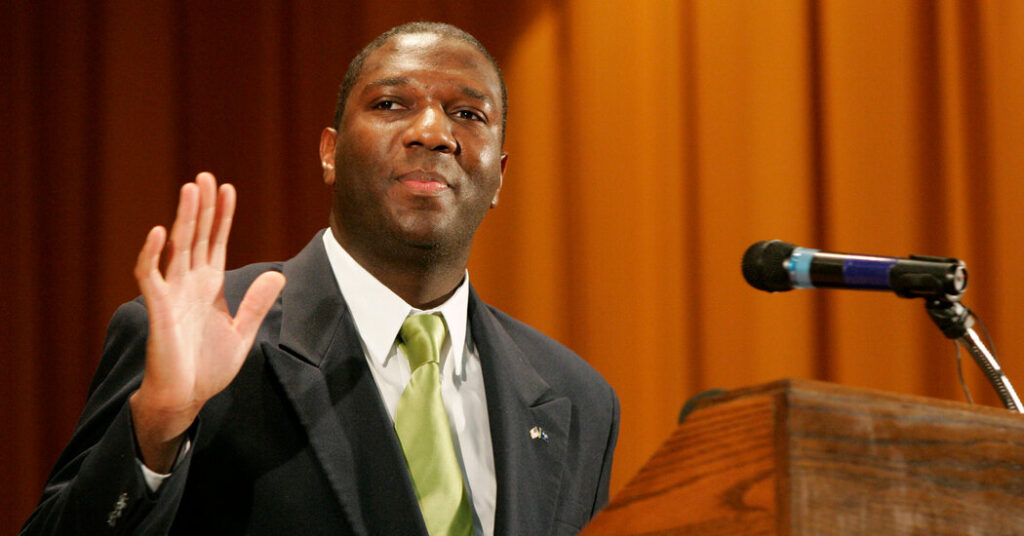
Alvin M. Greene, an unemployed Army veteran from South Carolina who shocked Democrats by winning the party’s nomination for the U.S. Senate in 2010 without making an effort, and whose bizarre candidacy held an element of pathos as he stumbled unprepared into the national media headlights, died on March 3 in Manning, S.C. He was 48.
His death, in a hospital, was confirmed by his brother James, who declined to state the cause.
The Pew Research Center determined in July 2010 that Mr. Greene had received more attention across 52 major news outlets than any other candidate so far that year. He had vaulted into the news cycle a month earlier by decisively winning a primary and becoming South Carolina’s first Black major-party nominee for Senate.
Mr. Greene seemed to have spent little more than the $10,440 filing fee to run, and to have barely left the home he shared with his father in rural Manning, southeast of Columbia, the state capital. He did not give a speech, hire staff or put out a yard sign. He owned neither a cellphone nor a computer.
“There really is no explanation for why he won,” Carol Fowler, the chairwoman of the state Democratic Party, said after Mr. Greene’s primary defeat of Vic Rawl, a former state lawmaker and judge who had held 80 campaign events across South Carolina.
There was speculation that Mr. Greene, then 32, benefited from having his name appear first alphabetically on the ballot, or because “Greene” with a final “e” was a surname familiar to African Americans in the state who guessed they were choosing a Black man.
Mr. Greene insisted his victory was no fluke and that he won because voters agreed with him on issues, though he struggled to articulate his views and could not point to any substantial effort he had made to inform voters of his candidacy.
In interviews, he often rambled, repeated himself or failed to complete a thought.
“The people have spoken,” he told The Washington Post after his victory. “The people of South Carolina have spoken. The people of South Carolina have spoken. We have to be pro-South Carolina. The people of South Carolina have spoken. We have to be pro-South Carolina.”
On CNN, the anchor Don Lemon asked the soft-voiced Mr. Greene if he was “mentally sound,” adding, “Quite honestly, you don’t sound OK.”
“I’m OK,” he replied.
Reporters soon uncovered that Mr. Greene had been forced to retire from the Army in August 2009 and, months later, faced a felony obscenity charge for showing pornography to a University of South Carolina student and asking to go to her dorm room — allegations he denied.
These issues had not emerged during the primary campaign, because no one took Mr. Greene seriously. He skipped the state party convention and never filed required paperwork with the Federal Election Commission.
There were questions about whether Mr. Greene’s filing fee had been paid by mischief-making Republicans. Representative Jim Clyburn of South Carolina, the House majority whip, called for an investigation.
The state Democratic Party held a hearing about the election, which Mr. Greene did not attend, but the party found no evidence of fraud and rejected calls to rerun the primary.
The State Law Enforcement Division investigated Mr. Greene’s finances and cleared him of wrongdoing. It said he paid the filing fee with his Army savings, as he had said all along.
In an interview with The New York Times in July 2010, Mr. Greene was less animated about the coming general election battle with Senator Jim DeMint, the Republican incumbent, than about his involuntary discharge from the Army.
He complained of not being promoted once in over six years of active military duty. He hinted that his decision to run for office was born of anger with his superiors.
Asked if he had objected to his treatment while in uniform, he said, “The only way I can object is my campaign now, to get this country moving forward.”
In the general election in ruby red South Carolina, Mr. DeMint polled 61 percent to Mr. Greene’s 27 percent, with a third-party candidate winning 9 percent.
Alvin Michael Greene was born on Aug. 31, 1977, in Florence, S.C., one of three sons of James S. Greene Sr. and Claudette (Lawson) Greene. His father was a soil conservationist with the U.S. Department of Agriculture and also a barber, and his mother, who died when Alvin was 11, was a florist.
He received a bachelor’s degree in political science from the University of South Carolina in 2000, then joined the military and served in the Army and in the Army and Air Force national guards.
He said in interviews that the Air Force also discharged him involuntarily. He enlisted in the Army in 2007, served in South Korea as a supplies specialist and was forced out in 2009 before the end of his three-year commitment.
Following his foray into electoral politics, Mr. Greene remained unemployed until his death, his brother James, his only immediate survivor, said in an interview.
In 2011, Mr. Greene accepted a deal to avoid a trial on the obscenity charge by participating in a program of counseling and community service.
That same year, he entered a primary for a state House seat from Manning, his hometown. He won 37 votes, finishing last in a four-way primary.
Trip Gabriel is a Times reporter on the Obituaries desk.
The post Alvin Greene, a No-Show Senate Nominee Who Won Primary, Dies at 48 appeared first on New York Times.