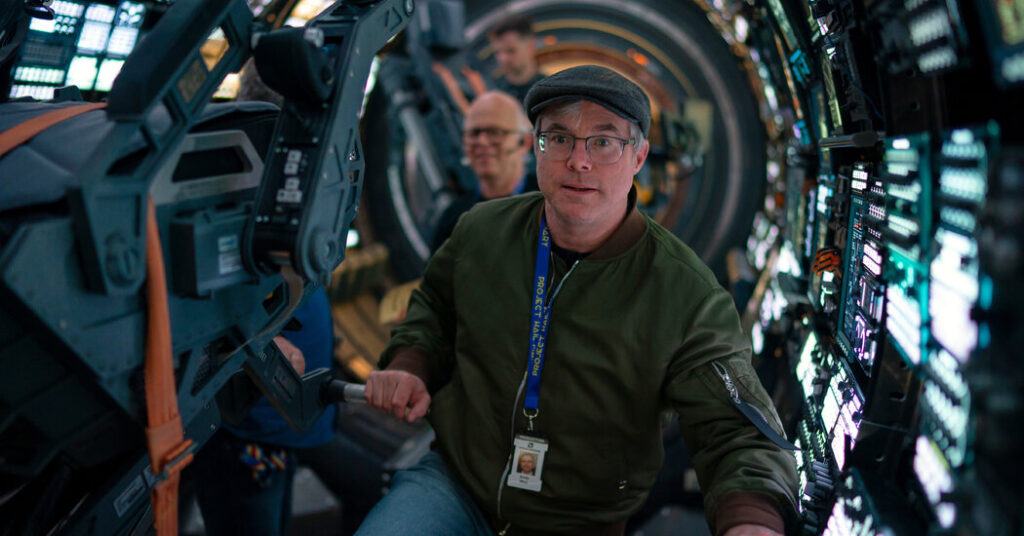
Andy Weir’s “Project Hail Mary,” published in 2021, is a story about humanity’s last-ditch attempt to save Earth from “astrophage,” a fictional, star-eating algae that has infected our sun. The book chronicles the journey of scientist-turned-science-teacher Ryland Grace, who wakes up on a spaceship and ultimately befriends Rocky, an alien from a planet called Erid that is completely unlike Earth but which faces the same threat.
On Friday, a film of the same name releases in theaters; it’s the second book by Mr. Weir to have been adapted for the big screen, following “The Martian” in 2015. The new movie, which stars Ryan Gosling as Dr. Grace, only flicks at the deep dive Mr. Weir took into physics, biology, rocket science and more to bring aliens and interstellar space travel to life.
“I try to be scientifically accurate,” Mr. Weir, the child of a physicist and an engineer, said to a room full of scientists at NASA’s Jet Propulsion Laboratory in Pasadena, Calif., last month. “That’s my whole shtick.”
In a subsequent interview, the writer and newly minted film producer talked about the science underlying “Project Hail Mary” and the process of adapting the written word into a feature film. This conversation has been condensed and edited for clarity.
How did you come up with the idea for the book?
I was thinking about what we would do if, with our current morals, beliefs and ideas, we had a mass-conversion fuel. Not in some weird future, but like right now. We could be colonizing the solar system. We could have cities on Mars.
Just to clarify: A mass-conversion fuel is something that stores a huge amount of energy in a relatively tiny amount of mass, like with nuclear power. It’s far more efficient than a fuel that requires combustion, like gasoline.
I was thinking about that, and how to explain how we might get that technology. People could invent the mass-conversion fuel, but that seemed like a MacGuffin. Maybe they find a crashed alien spaceship — but the other technology on that ship would be more interesting. What if we found some alien fuel independent of a ship? But then you use it, and it’s gone. So you have to be able to make more fuel with the fuel itself. What if it absorbs energy and makes more of itself? That sounded a lot like life.
There has to be a reason that fuel ended up on Earth. If you’re a mold or something, you’d need to basically live on the surface of a star to get enough energy to do that. So I made astrophage, which is like an algae. But instead of living in the ocean, it lives on a star and spores out to other stars.
I had my excuse for how astrophage ended up in our solar system, how humans had access to it and how we could reproduce it. But I had to make sure none of it got on our own sun, because that would be catastrophic.
The astrophage would consume too much of the sun’s energy, eventually throwing Earth into another ice age.
And then I realized that was the story. Forget about my city on Mars or the politics between planets — that problem was the story. I just needed a solution that involved an interstellar trip. And I worked from there.
You strove for scientific accuracy when writing “Project Hail Mary.” What was it like adapting that for the big screen?
It’s a matter of space and time. You really have to abbreviate. Sci-fi writers don’t need to explain in so much detail that it enables readers to solve problems. They just need enough to understand the plot.
For the movie, a lot of it was just kind of a “Hey, trust us — hopefully you believe us when we tell you that if you accelerate at 1.5 g for this long, you experience about four years of time while Earth had 13.” The viewers take our word for it.
It sounds like you worked through that math yourself.
I did. I found the equations for the rocket stuff online. That’s how I got that you need two million kilograms of astrophage for a 100,000-kilogram spaceship — although that got scaled up in the movie.
Eridians don’t understand relativity, so I also calculated how to get from Erid to Tau Ceti, the star where Rocky and Dr. Grace meet, without accounting for it. I do calculations wrong by mistake all the time, so I might as well do them on purpose.
I’m proud that the only true violation of physics in the story is something you have to go down to the quantum level to find. Trillions of neutrinos, tiny particles that rarely interact with matter, pass through us every second. But astrophage can store neutrinos using a made-up property I called “super cross-sectionality.” They don’t bother trying to explain this in the film.
Why make Rocky incompatible with an Earthlike environment?
A lot of space opera-style stories are the great era of exploration in the 1700s projected into a science-fiction setting. The Enterprise goes out and visits strange new worlds, like how Marco Polo visited the Orient. When he met people from the Orient, they could be in the same room and breathe the same air and eat the same food, because they were also human. So if you want to evoke that feeling, you make those concessions with the aliens.
But I didn’t want to do that. I mean, shoot, there are things on Earth that have incompatible environments. If you swap the locations of a shark and a camel, they’re both going to die.
I didn’t set out for Rocky to be as alien as possible. What I did was not have any restrictions on my speculative evolution of what this alien is like.
What was that process like?
When I wrote “Project Hail Mary,” it was believed that there was an exoplanet very, very close to a star system called 40-Eridani. (Now it looks like the planet might not actually be there at all.) For the plot, I needed life based on liquid water. So I asked, how can you have liquid water on a planet so close to its star?
The water would boil off unless there was a high atmospheric pressure. Drive up the pressure, and you drive up the boiling point of water. So I knew the planet had to have a thick atmosphere and really hot water.
A star will blast the atmosphere off a planet that’s too close. It helps if the atmosphere is made of heavy molecules, like Venus with its carbon dioxide. For Erid, I decided on ammonia. I also decided that Erid had a magnetic field. Both of those keep the atmosphere from blasting off.
Then I needed life to evolve in that environment. I made Eridian bodies like biospheres, so the oxygen and carbon cycles happen internally. With a thick atmosphere, I doubted sunlight would reach the surface, so there was no point in developing vision.
I ended with an alien comfortable in an environment with water at 210 degrees Celsius — 410 degrees Fahrenheit — and a high-pressure atmosphere made of ammonia. That’s pretty incompatible with Earth.
What role do stories like this, so grounded in science, play in advancing scientific knowledge?
I’ve never bought into the idea that science fiction authors are visionaries. I think sci-fi authors are science dorks with the ability to write books.
The science dorks who actually do the science are the ones changing the world. Anything that a science fiction author thinks of has probably already been thought of by an actual scientist. They just didn’t write a book about it; they wrote an academic paper.
So the difference is that you aren’t confined by the bounds of peer review.
I’m also not confined by the boundaries of physics. When it gets down to it, I can break physical laws. You can’t do that as a physicist.
But scientists come up with the same stuff. They just go through a more rigorous process to prove or disprove, and refine.
Katrina Miller is a science reporter for The Times based in Chicago. She earned a Ph.D. in physics from the University of Chicago.
The post A ‘Hail Mary’ for Earth, Built on Solid Science appeared first on New York Times.