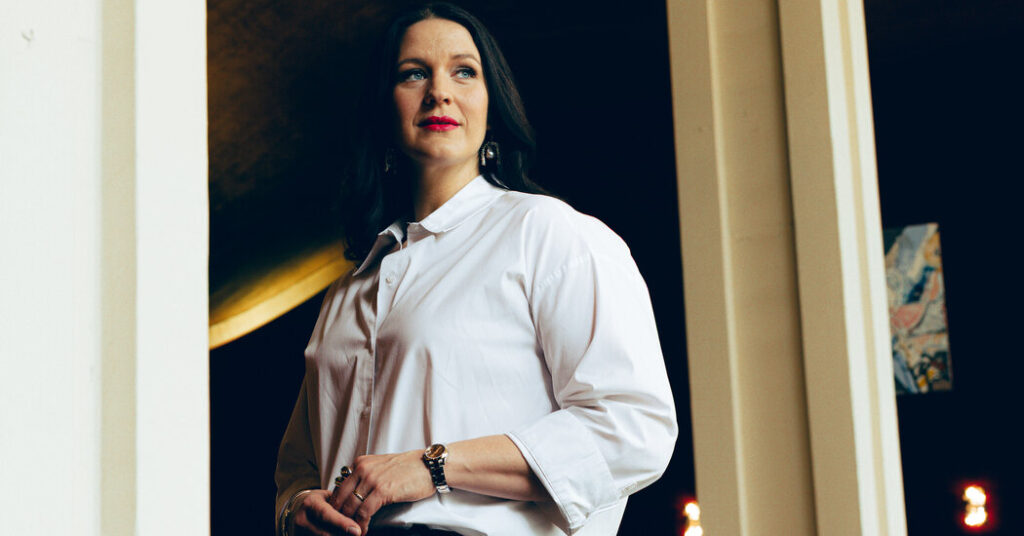
Even when you’re listening from many rows back in the opera house, the soprano Lise Davidsen makes an impact, flinging high notes into the audience like spears.
But hearing her in full cry just 10 feet away is an altogether different experience.
In a basement room at the Metropolitan Opera last month, rehearsing a new production of Wagner’s “Tristan und Isolde” that runs through April 4, Davidsen was going over a heated scene near the end of the first act.
“Das schwurt ich nicht,” she sang — “I swore it not” — and on the final word she unleashed an A flat, steely but wrapped in richness and warmth, that felt like palpable pressure against my face. I shivered, as if the note were flowing through my body.
“It’s hard to talk about this voice without sounding silly,” said Ekaterina Gubanova, a co-star in “Tristan.” “When we’re really, really close, it’s literally a physical sensation.”
Isolde is one of the most difficult roles in opera, swerving over a four-hour score from vulnerable to raging, scorching to ethereal. Davidsen’s triumphant performance would be impressive under any circumstances. But she has climbed this soprano Everest for the first time — in January in Barcelona and now at the Met — just months after giving birth to twins.
It has been a stretch of personal fulfillment and professional acclaim. But over several interviews, Davidsen, 39, said this period has also been immensely challenging emotionally.
“The voice was fine,” she said of coming back to work after having children, “but my head. …”
Transforming the body and causing sweeping hormonal changes, pregnancy is rarely easy for opera singers, who need precisely calibrated physical and mental resources to produce great waves of unamplified sound. The process has been known to contribute to vocal crises.
When she was first trying to get pregnant a few years ago, Davidsen worried most about her instrument.
“How’s my voice going to change?” she recalled wondering. “I was scared that a C-section would literally ruin my breath support. I was scared that the hormones would affect my vocal cords, in terms of swelling and all these things.”
It was clear on opening night at the Met on March 9 that Davidsen’s cords are gloriously intact. Joshua Barone wrote in a New York Times review that her soprano “can rattle your skull with its resonance and leave you awed by power you almost never hear in the human voice.” Her sound, he added, “carried even at its smallest.”
And yet she feels newly ambivalent about that sound. Of returning after becoming a mother, she said, “Singing felt like such a silly thing to do.”
She emphasized how grateful she was to be doing classic roles at major houses, and how much she still cared about opera. And she acknowledged that hormone swings made it tough to confront big decisions about the future.
But she said that she planned to take time this summer to consider the coming years — in which, among other things, she is scheduled to take on Brünnhilde in the epic “Ring,” the pinnacle of a Wagnerian soprano’s career, at the Met and elsewhere.
With her husband, Ben Adler, who frequently travels with her, she will take stock and decide whether she wants to significantly curtail the career that has made her one of the defining artists of her generation. What is certain is that something in her has shifted.
Singing “has been my world, my everything,” she said. “And now it’s not.”
DAVIDSEN’S BROTHER HAD children early, and her sister, who has a son, always knew she wanted to be a mother.
What Davidsen had was her voice.
“If there’s a God — I don’t know, but if so — this is my gift,” she recalled thinking. “And for many years I was persuaded by that, and happy about that.”
Though her parents divorced when she was young, she was raised in a tight-knit community in Norway.
“This is what I view as the right way to bring up children,” she said. “To be able to be there for them all the time. To be able to see the soccer practice, all these things.”
As she was building a career, that didn’t seem possible. She was traveling constantly and focused on her voice and herself, with seemingly little space for much else. When she met Adler, he made it clear he wanted children; she made it equally clear he might have to find someone else.
But about three years ago, she was at the Met singing in Strauss’s “Der Rosenkavalier,” about a woman painfully aware of the passage of time. She and Adler took a walk in Central Park.
“Suddenly I was like, maybe we should do this,” she said.
Once she had made that decision, conceiving became almost an obsession. “When we started,” she said, “I thought, Oh, if it doesn’t work I’m going to be fine. But I was not fine at all.”
She had two miscarriages, the first in Chicago in fall 2023 while she was singing the title role in Janacek’s “Jenufa,” an opera about a young woman whose baby is killed. The second came the next spring in Paris, where she was appearing in Strauss’s “Salome.” In both cases, she told almost no one, trying to keep her private and professional lives separate.
“With ‘Salome,’ I had a show the day after or something,” she said. “And as much as it was hard, at least I had the sense of being able to do a thing. I could sing. But mentally it took a lot from me.”
She and her husband visited a fertility doctor, who told them that nothing seemed physically amiss.
“I said I’d rather not do the IVF unless I have to,” she said, “because I know these hormones affect the voice. It’s extremely affecting on the body. I wanted to try the natural way as long as possible.”
It worked. She became pregnant and delivered the twins last spring. No C-section was needed, but she did have to have emergency surgery right after giving birth because of internal bleeding.
There wasn’t much time to recover. Since opera seasons are planned years in advance, Davidsen knew that Isolde was coming — and that the start of rehearsals in Barcelona would be just six months later.
She was relieved that her voice had emerged unscathed from the whole experience. She had given her last stage performances in March 2025, and had stopped singing, even to practice, a couple of weeks before the twins were born in late May. She then stayed quiet a couple of weeks more — perhaps a month total. When she began to test things out again, she sounded great.
And though Isolde was hardly easy, it never seriously fazed her. She had worked over the past few years with coaches in Denmark, England and Norway, and tried out the second act in concert in November 2024. Her voice is simply made for Wagner and Strauss — more, perhaps, than for some famous Italian roles she has taken on, like Puccini’s Tosca.
“I didn’t know if I could sing Tosca,” she said. “But for Brünnhilde and Isolde, it’s just there. It was much more about when than if. I didn’t have to look through it. I just knew, it’s now. I’ll never be more ready than I am now.”
The reviews in Barcelona were raves. But the rehearsal process was almost unbearable.
“I cried almost every day when I left them,” she said of the twins. “I felt I failed at work and failed at home — this complete sense of lack of being enough, as the expectations build and build.”
By opening night she was more exhausted than exhilarated. “It gave me very little, unfortunately,” she said. “It meant little to me.”
IN THE MET’S PRODUCTION, Isolde gives birth to a child near the end of the opera, an act that emphasizes cycles of renewal rather than the grim endpoint of death. The director, Yuval Sharon, came up with the idea well before he knew that Davidsen was pregnant.
She worried that the staging would be too literal, bringing back traumatic memories. “It was surprisingly close to home,” she said. “Even if, for me, it was a happy ending and no one died and it’s fine, the fear was real for me and my husband. It was just a surprise to suddenly be faced with it onstage.”
She and Sharon rehearsed the scene together alone. He said: “She told me about the challenges she had had with pregnancy, at which point I told her that if this was getting in the way of her performance, it could be cut. It’s not worth it.”
But the sequence ended up being stylized and poetic enough that Davidsen was able to view it as “very beautiful” rather than triggering.
And having her sing Isolde’s final “Liebestod” to a baby — rather than, as usual, to the dead Tristan — makes the aria freshly tender and intimate, a lullaby.
“The love aspect I can recognize, this love that goes beyond anything,” she said. “That I have felt now, for my husband and for my kids, in a way I’d never done before.”
A couple of days after opening night, she said that her mental state was better than it had been in Spain. “I enjoyed it a bit more,” she said. “I felt a bit more present.”
But she said again that she planned to use the summer to think, before she returns to New York to open the Met’s season with Verdi’s “Macbeth” in September.
“I would like to do the things I have planned, and I hope it will get a little easier than it is now, emotionally,” she said. “But I don’t think I want to add anything at the moment. And if I have to cancel, we’ll look at it. It’s four of us now, and if it doesn’t work for them, it doesn’t work for me.”
Of course, artists sometimes have second thoughts about their second thoughts. In 2009, a year after her son was born, the soprano Anna Netrebko told me she was “not that passionate anymore about singing and all this stuff.” Seventeen years later, Netrebko is still busy performing.
“I hear it in her voice,” Tomasz Konieczny, another of Davidsen’s “Tristan” colleagues, said of her. “There’s a beautiful energy. She wants to work. She wants to be a singer, and continue this beautiful career.”
Paula Suozzi, a staff director at the Met who has become a friend of Davidsen’s, said, “I told her: ‘You’re not going to know until you know. You have to give yourself grace, take it one step at a time.’”
Davidsen reiterated how special it is to do what she does.
“I don’t want the audience to think, ‘She doesn’t want to be there,’” she said. “That’s not the case. I chose to be there. It matters.”
But, she added, “to pretend I’m who I was before, it’s impossible.”
Zachary Woolfe edits and writes obituaries for The Times.
The post With Twin Babies, the Opera Star Lise Davidsen Wonders What Comes Next appeared first on New York Times.