Zohran Mamdani would like to talk to New Yorkers about Coroticus, a British warlord who pillaged the Irish countryside in the fifth century.
St. Patrick, Mr. Mamdani recounted on Tuesday, was unable to persuade Coroticus’s soldiers to stop their rampage. “Overcome by grief, he wrote, ‘All I can do is what is written: Weep with those who weep,’” the mayor said. “It is no small act to weep with those who weep. It is a choice, one that many do not make.”
His mention of the warlord, and the saint’s ministry to his victims, came in wide-ranging remarks on Mr. Mamdani’s first St. Patrick’s Day as mayor of New York City.
In the remarks, delivered at an event on Tuesday morning and then in a video posted on social media, the mayor spoke expansively about Irish history and focused on “the solidarity the Irish have shown with the downtrodden and forgotten,” in particular with Palestinians.
Mr. Mamdani’s comments were a notable departure from the St. Patrick’s Day greetings offered by past mayors, and reflected the moral weight attached to the Palestinian cause by both him and many people in Ireland, where support for Palestinians is widespread.
The comments came after Mr. Mamdani, a Democrat, told reporters on Monday that he had “not thought a lot about” whether he supported the reunification of Ireland, a cause that New York mayors, eager for Irish American votes, traditionally endorse.
By Tuesday morning, he appeared to have given quite a lot of thought to Ireland.
Kevin Kenny, the director of Glucksman Ireland House, a research center at New York University, said he was struck by how Mr. Mamdani had used the history of Ireland to tell a story that was broader, and more contentious, than the one typically told by elected officials on St. Patrick’s Day.
“He touches on themes of nationalist resistance, themes of hunger and famine, themes of discrimination,” Professor Kenny said. “It is a carefully coded communication because he is implicitly — and, at the end, explicitly — discussing very sensitive issues in the world today, especially concerning Israel, Palestine and Gaza.”
The remarks were par for the course for Mr. Mamdani, who came of age in the pro-Palestinian movement and expresses his support for Palestinian rights with a frequency matched by no past mayor of New York City — a stance that has made many pro-Israel New Yorkers wary of him.
But some critics took issue with his mention of Palestinians on St. Patrick’s Day. David Carr, the minority leader of the New York City Council and a Staten Island Republican, accused the mayor of exploiting a religious holiday to score political points on an unrelated issue.
“I’m not sure what’s worse: the Mayor’s false take on history, or his co-opting of a Catholic feast day that is central to Irish faith, culture, and identity to fit his distorted political ideology,” Mr. Carr wrote on social media. “Not every road leads back to Gaza.”
Bill Donohue, the president of the Catholic League, a conservative group that describes its mission as “protecting and defending the holy church,” also criticized the mayor, who is Muslim, saying he had turned a St. Patrick’s Day message into “a radical Muslim rant.”
“Mamdani’s obsession with demonizing Israel was on full display,” Mr. Donohue said.
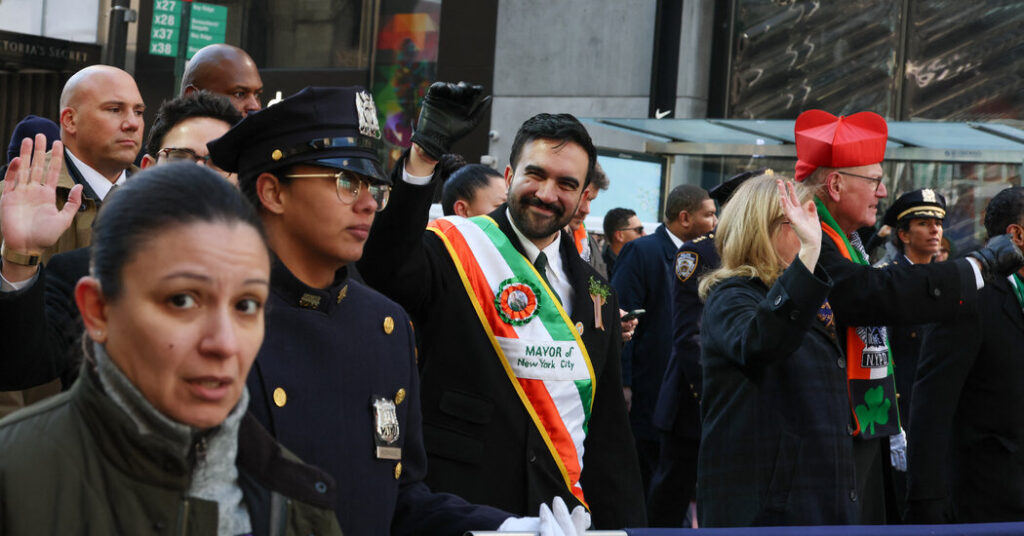
Mr. Mamdani’s speech at the morning event, a breakfast in honor of Mary Robinson, Ireland’s former president, came at the start of a busy day for the mayor. He went on to attend Mass at St. Patrick’s Cathedral and then marched in the St. Patrick’s Day Parade, one of New York City’s largest annual public events.
Speaking to a roomful of Irish dignitaries and prominent Irish Americans at the breakfast, Mr. Mamdani squeezed roughly 1,600 years of Irish history and culture into just a few minutes.
“As we know, it was on Irish soil that the British Empire developed their colonial project,” the mayor said. “And yet when I think of the Irish, I do not think first of oppression; I think of resistance, I think of unity, I think of corned beef and 96-minute Troy Parrott goals and The Pogues’s ‘Fairytale of New York.’”
Mr. Mamdani concluded with praise for Ireland’s opposition to apartheid in South Africa and support for a Palestinian state. He hailed Ms. Robinson for standing “steadfast alongside the people of Palestine.”
“Over the past few years, as we have witnessed a genocide unfold before our eyes, there has been deafening silence from so many,” Mr. Mamdani said. “For those who have long cared about universal human rights and the extension of them to Palestinians, silence is nothing new. Palestinians are so often left to weep alone.”
Professor Kenny said the mayor’s comments sounded like something you might hear from an elected official in Ireland. There, references to the country’s anticolonial tradition are common, and the Palestinian cause is broadly popular among elected officials and voters, many of whom see parallels between the Israeli-Palestinian conflict and their own centuries-long struggle against the British.
That view of the conflict diverges sharply from what had long been the prevailing dynamic in the United States, where support for Israel has been embraced by elected officials and voters from both parties.
But public opinion has shifted since the start of the war in Gaza, which began after the Hamas-led terrorist attack on Israel on Oct. 7, 2023.
According to a Gallup poll released last month, more Americans now sympathize with Palestinians (41 percent) than with Israel (36 percent). Between 2001 and 2025, Gallup said, Israel “consistently held double-digit leads in Americans’ Middle East sympathies, with the gap averaging 43 points between 2001 and 2018.”
When Ms. Robinson spoke at the breakfast on Tuesday, she said that St. Patrick’s Day was an occasion on which to embrace both joy and sorrow, especially while so many people “are living under the shadow of war” in the Middle East, Africa and elsewhere.
“Our own history holds memories of famine, exile and conflict,” said Ms. Robinson, who served as Ireland’s first female president from 1990 to 1997 and later as the United Nations High Commissioner for Human Rights. “Perhaps because of that, many recognize echoes of Ireland’s past in the suffering of others today, in the pain of displacement and the enduring human longing for dignity, justice and self-determination.”
Liam Stack is a Times reporter who covers the culture and politics of the New York City region.
The post Why Mamdani Mentioned Palestinians in His St. Patrick’s Day Message appeared first on New York Times.