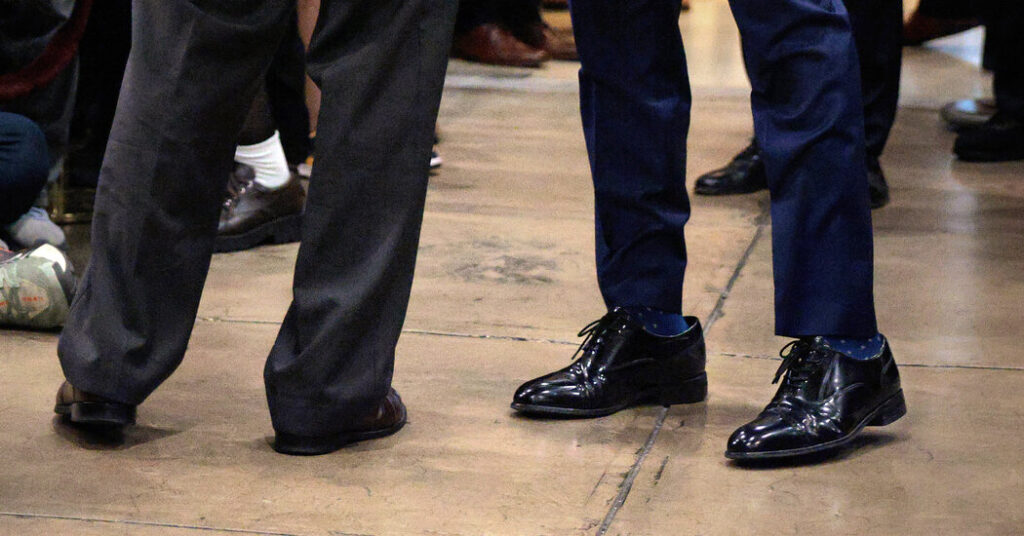
Members of the Trump administration have some big shoes to fill: Their own.
In recent months, Secretary of State Marco Rubio, Vice President JD Vance and Secretary of Transportation Sean Duffy have all been photographed wearing shoes that look a half-size or so too large for them. A gap as wide as a finger sits between the back of the shoe and their socked heels.
The tale of the administration’s too-big shoes began when President Trump told The New York Times in January that he had recently purchased four new pairs for both Mr. Rubio and Mr. Vance (whom he referred to as “kids”).
“I never like cabinet members walking in sneakers,” Mr. Trump said on the Fox commentator Brian Kilmeade’s radio show last week. “Sneakers are wonderful, but I don’t want my cabinet members wearing sneakers, so I’ll get them a pair of shoes. It’s a gift from Donald Trump.”
He added, “Now they look all spiffy and nice.”
A representative for Florsheim, a Wisconsin-based dress shoe company, confirmed to The Times that a White House assistant had placed orders and that the shoes had been shipped to an address in Fairfax, Va. Dozens of pairs were delivered to this address, according to the company. Florsheim’s standard cap-toe dress shoes sell for $145. They are not made in America.
Mr. Trump does not aim for precision in his gifting. The Wall Street Journal reported last week that Mr. Trump often guessed a person’s size. Men’s shoe specialists were not at all surprised that Mr. Trump appeared to be guessing too big. Men, they said, often buy the wrong size when buying their own shoes. And they almost always estimate too large.
“It definitely starts with, ‘I’m the big man, I wear the bigger shoe,’” said Kevin Wright, the operations manager at Brick + Mortar, a specialty shoe shop in Seattle. Men tend to seize on the largest size they ever were at any point. If a man wore a size 11 athletic cleat in high school, he’ll forever be convinced he’s an 11, not the 10 he truly needs in a dress shoe.
“It’s a macho thing,” agreed Sean Moran, the owner of Dashing, a high-end shoe store in Chicago. “It’s still based on that whole your-shoe-size-is-your-package-size thing.”
Mr. Moran’s clients are footwear obsessives — his shop is the sort of place that charges $25 just to properly measure your foot — but he did recall a customer several years ago who requested a size 9 when he was in fact a 6. “I’m like, It’s $1,400, you’re buying the wrong size,” he said, but when the man looked at his proper, smaller shoe, he replied, “No, I just can’t wear these.”
Mostly, though, shoe sellers felt that men bought the wrong size shoe just because they didn’t know any better.
“The prevalence of sneakers and casual shoes distorted the sizing of dress shoes,” said Young Yoo, who owns Gentlemen’s Footwear in San Diego. “Men were measured once like 10 years ago and then they get fixated on that number.” That number might work for sneakers, which have pliable padding all around. In Mr. Yoo’s experience, a man’s sneaker size is nearly always larger: If a customer is a 10 in Nike, he’ll more likely be a 9.5 in some American-made Alden dress shoes.
It’s expected, Mr. Yoo said, for there to be some open space in a shoe, but the gaps visible in photos of the cabinet members were “ridiculously too much,” he said.
Steven Taffel, the owner of Leffot, a high-end men’s shoe store in Manhattan, said that a fresh-from-the-box leather dress shoe shouldn’t squeeze, but it should “hug the foot.” Shoes, after all, are not static objects. “Your body weight gradually presses into the footbed, and leather soles become more flexible over time,” Mr. Taffel said.
There is, he said, one relevant rule to heed: “If you can stick a finger into the heel of your shoe, it’s not just a poor fit, it’s not a very good look, either.”
Jacob Gallagher is a Times reporter covering fashion and style.
The post Why Do Men Buy Shoes That Are Too Big? appeared first on New York Times.