Tornadoes did not hit the nation’s capital on Monday, and many meteorologists on the internet are extremely sorry. “What a HORRIBLE forecast by meteorologists—especially myself,” Matthew Cappucci, of the weather app MyRadar, posted on X on Monday after the tornado warnings that prompted schools, businesses, and museums to close across the Washington region had fizzled into your average rainy day.
Brady Harris, who calls himself “Weathers #1 HYPE Man,” wrote that meteorologists had “screwed up the Forecast BIG Time today.” He pledged to do better. In wrap-around shades and a T-shirt featuring a kitty-cat in a lightning storm (his handle is StormCat5_), Harris explained to his followers in a video: “I made the prediction. You have to own it. And you have to tell people, you know, publicly, that, ‘Hey, I messed up.’”
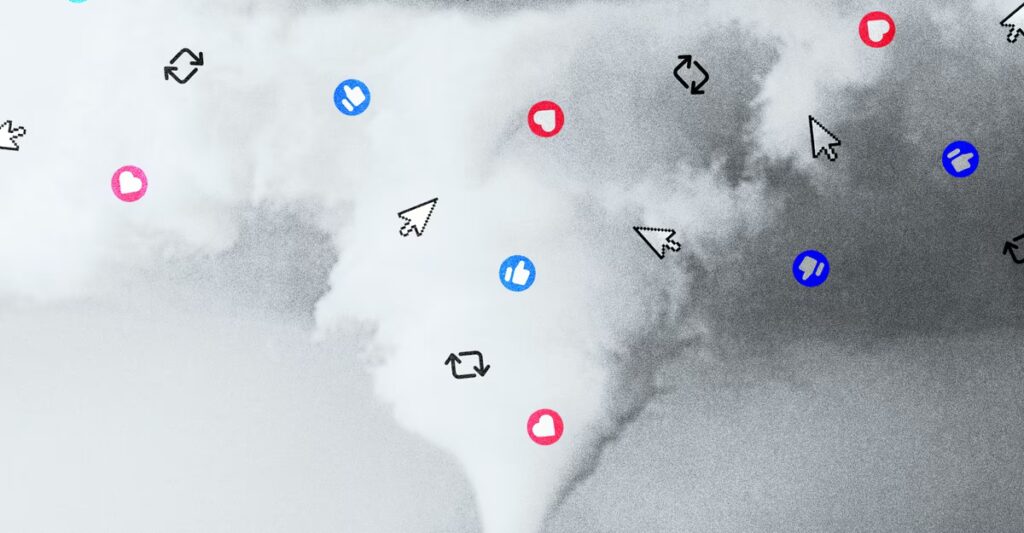
Surely, the weathermen of the world hold some sincere remorse here for a situation that alarmed the Mid-Atlantic, sent parents scurrying to retrieve their kids, grounded hundreds of flights, and disrupted daily life for millions of people. But the abject tenor of some of the apologies—following the ominous buildup about the prospect of destructive tornadoes—has become its own minor storm system. When a threat looms and throngs of forecasters and weather fans, some highly credentialed, others less so, all weigh in online, the incentives to make both the forecast and failings dramatic go up. In the attention economy, who wants to tune in for un-extreme weather?
“Social media certainly drives what I call the hype machine,” Jeffrey Halverson, an expert on D.C.-area weather and a professor at the University of Maryland Baltimore County, told me. “I think severe thunderstorm forecasting”—which includes tornados—”could benefit from better communication of uncertainty.”
For snowstorms, the National Weather Service puts out a range of possible outcomes, building that uncertainty more explicitly into the forecasts. But tornadoes are particularly hard to predict. And although they happen in the Washington region—a 2002 twister killed three people and destroyed large swaths of La Plata in Southern Maryland—they are far more rare than in the South or the Great Plains.
The day before the storm, the National Weather Service’s Storm Prediction Center put the threat at Level 4 out of 5 for a swath of the East Coast from Maryland to the Carolinas—a “moderate” risk but one that means severe storms would be widespread. It was the first such warning for the region in more than two years. That got everyone’s attention, Halverson told me. Meteorologists are always thinking about their responsibility to warn the public about impending dangers. Many started sounding the alarm.
It worked: School systems across the D.C. region began weighing their options. Many decided to close early on Monday. But not all of them. In Loudoun County, Virginia, public schools superintendent Aaron Spence told me that he and his team wrestled with the decision on Sunday night and the next morning. They, too, were looking at weather models now, and those suggested that if they ended school early, students would likely be traveling in the middle of whatever the storm was delivering—around noon to 2 pm in his county. “So really, truly, had we done an early dismissal that would have been precisely the time our elementary students would have been on buses,” Spence said. He was worried, too, about kids staying home alone if the forecast proved correct: The schools had designated shelters, backup power, access to food. They decided to keep the kids there and during the tornado warning, which lasted for about 45 minutes in the late morning, had them shelter-in-place, away from the windows.
But as neighboring districts closed early, Spence’s restraint was not particularly popular, and he heard a lot of criticism about the decision. He doesn’t hold it against the meteorologists, though, even if the forecast was off. “I always in these moments hope and appreciate when our parents extend us patience and grace, because these are very difficult decisions. So I would extend the same patience and grace to these meteorologists,” he told me.
As it turned out, thick cloud cover on Monday morning kept the sun from warming up and destabilizing the atmosphere in a way that could fuel tornadoes. In retrospect, Halverson said, he believes the National Weather Service would have been prudent to wait longer to see how conditions evolve before such a stark warning. “A lot of us in the community thought a Level 3 would have been more appropriate,” he said. Some local weather fans, such as Logan Giles, who writes Beltway Weather Today on Substack, defended the forecast, writing on X that “you can’t call this a bust. Numerous gusts over 65 mph with the strongest gust for D.C. since 2012, 68 mph.”
But, as the online weather discourse broke into for-and-against apologies by meteorologists, he told me perhaps a mea culpa was warranted, if only because the warnings disrupted so many people’s day. “I think it deserves an apology when people’s lives are impacted,” he said.
Others, including Halverson, would like to see the self-flagellation calm down. He thinks forecasters are pretty genuine people for the most part who don’t want to cause unnecessary stress, even though sensationalism has become more common in online weather talk. “So there’s a lot of soul-searching today,” he told me. “I don’t think that apologies are warranted. Please, let’s not get into the business of apologizing for acts of God that one, we can’t control and two, we still don’t know a lot about. That’s a slippery slope.”
Cappucci told me that more than a million people have watched his video admitting that “my forecast was a poor one.” Even though the pieces for a weather disaster were in place, he felt he should have communicated better about the possibility of a bust when it became more apparent on Sunday evening. “We thought we had the juice, we had the spin, we had the jet stream dynamics, we had all these different things,” he told me. “What we didn’t look for enough were potential off-ramps, potential limiting factors or failure modes.”
Cappucci, who is 28 and one of the younger meteorologists in the area, works on forecasts for radio, print, tv, and a weather app. He is also one of the most followed and tries to keep an ongoing dialogue with his audience. Cappucci has seen how other forecasters can make thousands of dollars a month with an average-sized social media account posting outlandish weather reports. And he told me he regularly gets blamed for bad forecasts, because viewers often don’t distinguish who said what.
That so many people have now seen him say he was wrong “is certainly a humbling thing,” he said. “And yet, in the long range, I genuinely believe that the humbleness and humility of addressing one’s faults professionally garners more trust in the long range.” Getting people’s attention is part of his job but, he said, keeping their trust is his ultimate goal.
The post Who Will Apologize for D.C.’s Tornado Bust? appeared first on The Atlantic.