White House officials on Tuesday outlined narrow adjustments the administration would make to federal immigration enforcement operations to answer Democratic demands for major changes in exchange for funding the Department of Homeland Security.
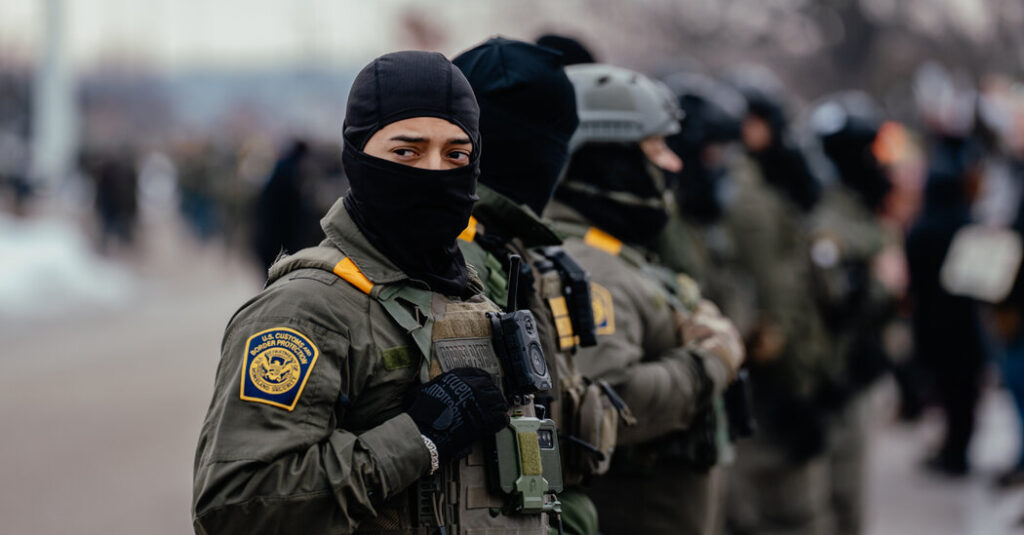
In a letter to Senate Republicans, the administration ignored several of Democrats’ top priorities, including blocking immigration officers from wearing masks to shield their identities and requiring them to obtain warrants from judges to enter private homes or businesses. And the proposal did not address Democrats’ call for a use-of-force policy, a central demand they made after federal immigration officers killed two American citizens in Minneapolis.
But the letter, sent to two top Republicans overseeing funding for the Department of Homeland Security, suggested that the White House, which once took a hard-line stance defending its aggressive enforcement tactics, was open to at least some moderation to make a deal to reopen the department.
The letter came on the 32nd day that the department has been shut down, and as travelers are experiencing growing delays at U.S. airports as the spring traveling season gets underway, with Transportation Security Administration officials who are working without pay calling out sick or quitting.
In the letter, Tom Homan, the White House border czar, and James Braid, a top legislative affairs aide, said that the administration was open to enforcing “the use of visible officer identification,” something that Democrats have called for, and requiring federal immigration officials to identify themselves and state their law-enforcement agency when asked. Their proposal would exempt undercover officers.
They also wrote that White House would limit “civil immigration enforcement activities” at “certain sensitive locations” like hospitals and schools, though they proposed an exception for “immediate needs like national security, flight risks and public safety.”
Democrats have demanded that immigration officers be prohibited from conducting enforcement near locations like child-care facilities, churches, polling places and courts, and they will likely request a clear definition of “sensitive locations” as a condition of accepting a deal.
Mr. Homan and Mr. Braid also said the administration would “expand the use” of body cameras, except for undercover officers, and require that footage be retained. That offer appeared to fall short of Democrats’ demands that all immigration officers be required to wear body cameras.
In two areas, the Trump administration said it would adhere to a legal status quo that Democrats have repeatedly accused federal officials of violating.
Mr. Homan and Mr. Braid said that officials would no longer block lawmakers from conducting unannounced oversight visits of immigration detention facilities. House Democrats sued the Homeland Security Department over policies that sought to limit those visits, and a federal judge has blocked the department from implementing them.
And the White House officials also said that the administration would follow “existing law and practice of not deporting any U.S. citizen” and codify its practice of not knowingly detaining American citizens unless they violated federal or state law. Democrats have argued that federal immigration officials have not done enough to ensure that they are not arresting and detaining American citizens.
The letter, sent to Senator Susan Collins of Maine, the chairwoman of the Appropriations Committee, and Katie Britt of Alabama, who leads the panel that oversees homeland security funding, appeared intended to bolster Republicans’ efforts to pressure Democrats. Mr. Homan and Mr. Braid accused Democrats of failing to engage in a good-faith effort to reach a compromise.
Senator Chuck Schumer, Democrat of New York and the minority leader, accused the White House on Tuesday of failing to engage on requirements around masks and warrants and suggested that the Trump administration’s offer remained unacceptable.
“They haven’t budged on those,” Mr. Schumer said. “They’ve got to get serious.”
A senior White House official, who spoke on the condition of anonymity to discuss ongoing negotiations, said that the White House was open to more discussion around areas beyond those mentioned in the letter.
Michael Gold covers Congress for The Times, with a focus on immigration policy and congressional oversight.
The post White House Offers Narrow Immigration Enforcement Changes As Talks Drag On appeared first on New York Times.