Democratic voters in Illinois will pick nominees in five major open races on Tuesday — one United States Senate seat and four House contests — that will provide an important signal of the priorities of the party base heading into the midterm elections this fall.
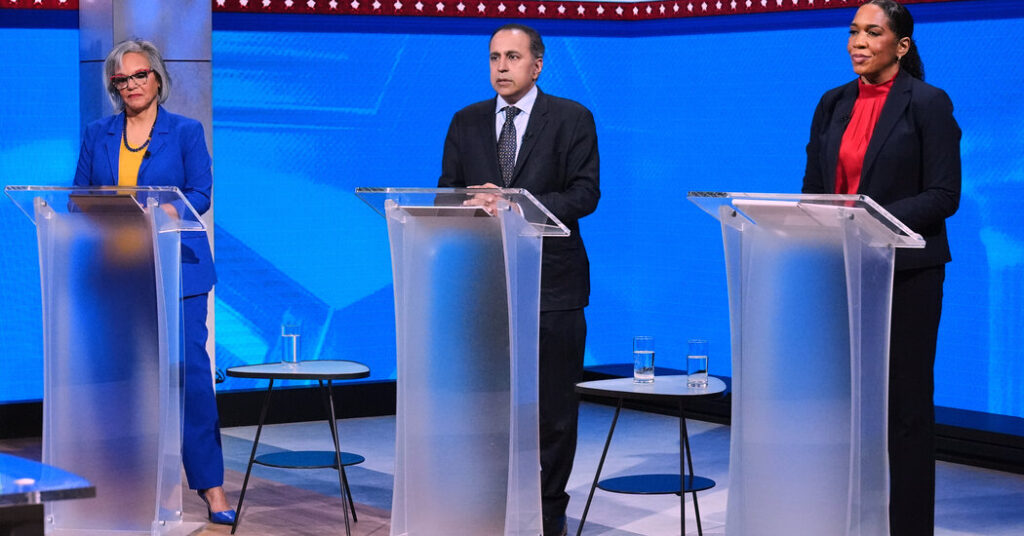
The headline contest, for the open Senate seat of retiring Senator Dick Durbin, a Democrat, features three main candidates who have tussled repeatedly over identity politics: Representative Raja Krishnamoorthi, Lt. Gov. Julianna Stratton and Representative Robin Kelly. Both Ms. Stratton and Ms. Kelly are Black women, and leaders in the Black community have expressed fears that they will divide Black voters and hand the seat to Mr. Krishnamoorthi, who is Indian American.
Four House Democrats are not seeking re-election — two retirements, plus Ms. Kelly and Mr. Krishnamoorthi — creating an unusual number of congressional openings. Special interest groups have poured cash into the breach, with an extraordinary sum in super PAC spending, more than $32 million, flowing into those four House contests alone.
The A.I. and crypto industries have spent heavily, as have a constellation of groups with links to the American Israel Public Affairs Committee. However, disclosure deadlines for PACs allow the true source of millions of dollars in campaign spending to remain hidden from voters until after they have voted on Tuesday.
Most of the House races are taking place in districts in and around Chicago, where Democrats dominate. As a result, primary winners will do more than provide an early answer to what sells with Democratic voters right now; they will also be overwhelming favorites to take office next year.
Here is what to watch:
A contested Senate primary about representation
In its final stages, the Senate contest has centered on talk of race, representation and cash.
Mr. Krishnamoorthi would be only the second Indian American ever elected to the Senate, after Kamala Harris. Ms. Stratton and Ms. Kelly are seeking to become the sixth Black woman to serve in the Senate. Some groups supporting Mr. Krishnamoorthi have closed the campaign running ads explicitly boosting Ms. Kelly, drawing accusations that they are trying to siphon the support of Black voters away from Ms. Stratton.
Mr. Krishnamoorthi has prepared to run for the open seat for years, out-raising his rivals and amassing a $30 million war chest. But Ms. Stratton got her own boost from a super PAC funded by the man who made her his lieutenant governor: Gov. J.B. Pritzker, who is seeking to elect an ally ahead of a potential 2028 run for president. The race is also seen as a test of his sway at home.
The crypto industry’s spending for Mr. Krishnamoorthi has drawn scrutiny, while crypto-funded ads have questioned the source of some of Ms. Stratton’s super PAC cash.
All three have run relatively progressive campaigns. Ms. Stratton has promised to “abolish ICE,” as opposition to President Trump’s deportations has risen in importance for Democratic voters, while Mr. Krishnamoorthi has vowed to “abolish Trump’s ICE.”
Jesse Jackson Jr. attempts a comeback
The last time he served in Congress, Jesse Jackson Jr., the son of the Rev. Jesse Jackson, the civil rights leader who recently died, was forced to resign and later pleaded guilty and went to prison for fraudulently spending campaign cash on lavish personal items.
Now he’s making a comeback in Ms. Kelly’s seat, in Illinois’s Second District.
Despite the younger Mr. Jackson’s well-known name, one of his rivals, County Commissioner Donna Miller, has received more financial support: $4.4 million from a new super PAC with links to AIPAC.
Mr. Jackson has, in turn, received a boost of more than $1 million from a super PAC linked to the artificial intelligence industry. The crypto industry, meanwhile, has targeted a progressive state senator, Robert Peters, with negative ads. Mr. Peters has the backing of Senators Bernie Sanders and Elizabeth Warren as well as the Congressional Progressive Caucus.
A scrum with a late twist in Illinois’s Ninth
This was not an open seat when Kat Abughazaleh, a 26-year-old researcher who built an online following even before running for office, announced her campaign in early 2025, pressing an argument for generational change against Representative Jan Schakowsky, 81.
But after Ms. Schakowsky decided to retire, the field became more crowded, with Laura Fine, a state senator, and Daniel Biss, the mayor of Evanston, among those who entered a race that has drawn the most outside spending of any House contest in Illinois.
Much of the money has gone to support Ms. Fine, including $4.4 million from a different super PAC, Elect Chicago Women, which has ties to groups that work closely with AIPAC. The super PAC spent a further $1.4 million opposing Mr. Biss.
There has even been an unusual late effort to back a fourth candidate, Bushra Amiwala, who is seen as a long-shot and is critical of Israel. The ads call Ms. Amiwala the “real deal” and were paid for by yet another super PAC that shares vendors with groups linked to AIPAC. Ms. Amiwala distanced herself from the supportive ad, saying it “disgusted” her.
The super PAC has spent nearly $1.2 million on ads attacking Ms. Abughazaleh, who is Palestinian American.
Another moderate former congresswoman attempts a comeback
The last time Melissa Bean served in Congress — ending with her 2010 defeat during the Tea Party wave — she was a Blue Dog Democrat.
Her comeback attempt in the seat Mr. Krishnamoorthi is vacating has pitted her against Junaid Ahmed, a progressive tech consultant who has the backing of Senator Bernie Sanders, Senator Elizabeth Warren and a prominent left-wing group called Justice Democrats that has targeted moderate incumbents.
Ms. Bean has benefited from millions of dollars in super PAC support, from sources including the A.I. and crypto sectors and an AIPAC-linked group.
Two other candidates in the race are Kevin Morrison, a county commissioner, and Yasmeen Bankole, a former aide to Mr. Durbin, who has endorsed her.
Crypto and AIPAC spending in another House primary
The seat of Representative Danny Davis, who is retiring, has drawn a particularly large crowd of candidates.
Most of the money spent so far has gone to support Melissa Conyears-Ervin, the city treasurer of Chicago, who has benefited from nearly $5 million from the United Democracy Project, which is supported by AIPAC.
Meanwhile, the crypto industry has spent $2.5 million opposing Mr. Davis’s pick to succeed him, La Shawn Ford, a state representative who supported regulations opposed by the industry.
Other candidates include Richard Boykin, a former county commissioner; Kina Collins, a progressive organizer; Anthony Driver, a labor leader; and Thomas Fisher, an emergency room doctor.
Joseph Geevarghese, the executive director of Our Revolution, a progressive group that sprang from the 2016 presidential campaign of Mr. Sanders, said all the races on Tuesday would test how much money matters this year in Democratic primaries.
“Illinois will be a bellwether for the rest of the primary season in terms of where grass-roots energy stands as it stacks up against big money,” Mr. Geevarghese said.
Shane Goldmacher is a Times national political correspondent.
The post What to Watch in Tuesday’s Illinois Primaries, and Where the Money Went appeared first on New York Times.