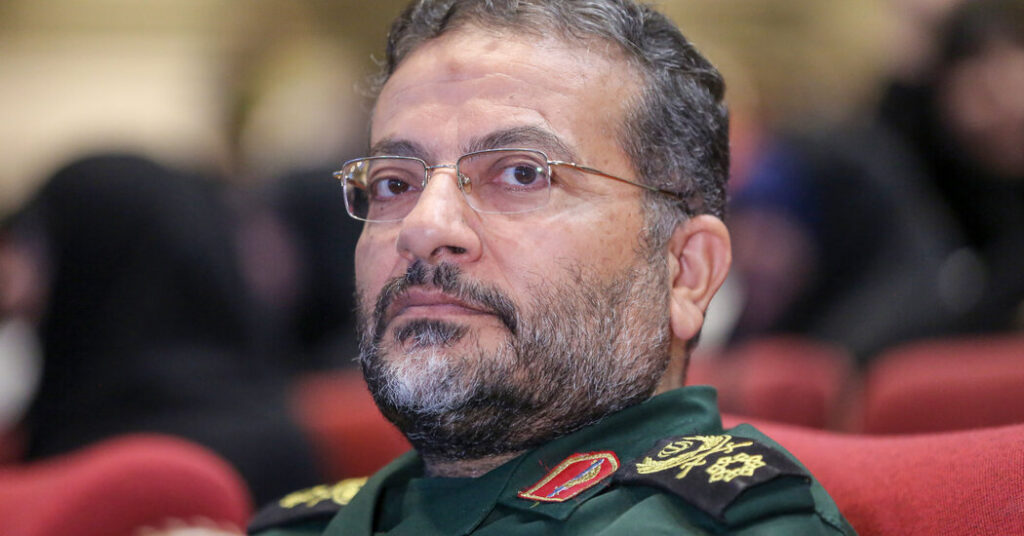
Israel said on Tuesday that it had killed the commander of Iran’s Basij militia force, Gholamreza Soleimani, as well as the country’s top national security chief, Ali Larijani, striking at the heart of Iran’s security establishment as the Middle East war entered its third week.
The Basij is a large, plainclothes paramilitary force that by some estimates has as many as one million active and reserve members. It is part of the powerful Islamic Revolutionary Guards Corps. For decades, the militia has played a central role in crushing dissent, including during the brutal crackdown on the nationwide anti-government demonstrations that erupted in January.
Its members are embedded in neighborhoods, universities and workplaces, giving the government a pervasive presence in everyday life.
Israeli and American strikes have frequently targeted Basij bases and headquarters as the war has become a regional conflict over the last two weeks.
The targeting of the Basij underscores how the U.S. and Israeli campaign is aimed not only at degrading Tehran’s military power, but also at weakening the domestic security networks that underpin the Islamic Republic.
Prime Minister Benjamin Netanyahu of Israel said in a statement that the killings of Mr. Soleimani and Mr. Larijani were aimed at sapping the Islamic Republic’s hold on power and creating the conditions for a popular revolt. “We are undermining this regime in the hope of giving the Iranian people an opportunity to remove it,” he said.
It was not certain, however, what impact killing Basij’s leaders would have, and analysts said the fall of the Iranian government in the near term was unlikely.
The U.S. and Israel have pounded military, intelligence and police sites across Iran, yet there is little indication that the government’s deeply entrenched and ideologically driven security forces are collapsing. In recent weeks, the Basij has actually expanded its presence on the streets, setting up checkpoints across Tehran and other cities as the Iranian authorities have sought to maintain control.
The deaths of Mr. Soleimani and Mr. Larijani were announced as the Iranian authorities were bracing for potential protests. On Tuesday night, Iranians will begin celebrating Nowruz, the Persian new year, by gathering in the streets and jumping over bonfires. The government has warned citizens to remain inside and not take to the streets, saying Israeli agents were planning to turn the celebration into chaos and unrest.
Checkpoints have been set up in some cities and a heavy security presence has been reported.
Euan Ward is a Times reporter covering Lebanon and Syria. He is based in Beirut.
The post What is the Basij? appeared first on New York Times.