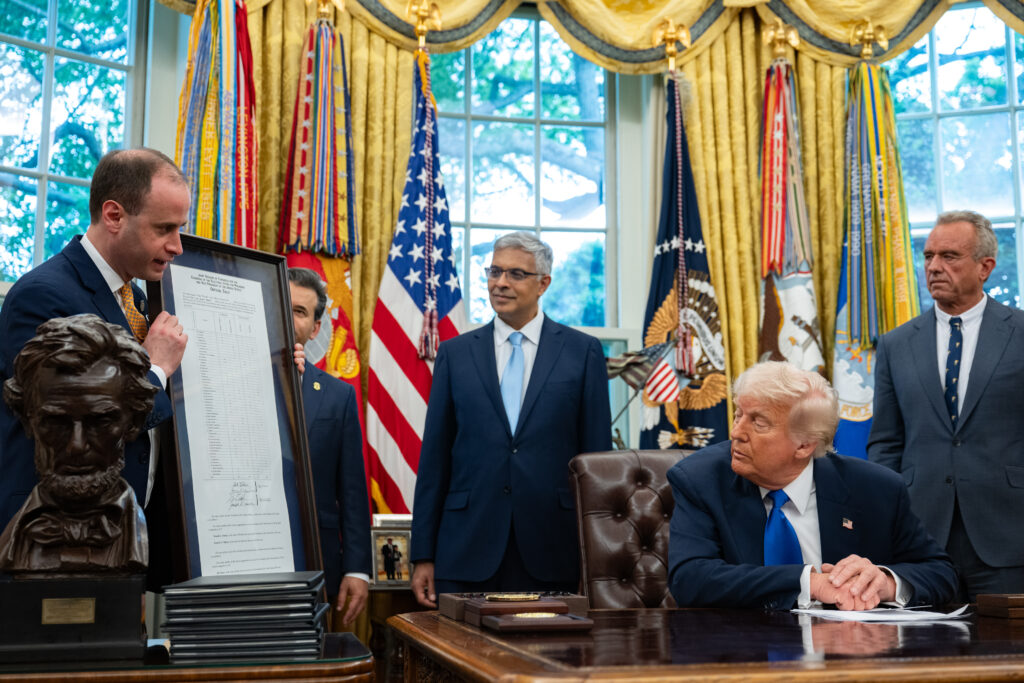
President Donald Trump’s appointees to the federal planning commission that controls the fate of his White House ballroom project are not legally qualified to serve, critics say — raising the possibility of a court challenge.
The federal law governing the National Capital Planning Commission requires that commissioners have “experience in city or regional planning.” Appointees have traditionally been professionals in planning, architecture or historic preservation.
Trump’s three appointees to the commission — White House staff secretary Will Scharf, White House deputy chief of staff James Blair and Office of Management and Budget associate director Stuart Levenbach — lack that required expertise, according to watchdog groups, several former members of the commission and congressional Democrats.
The dispute over the three appointments highlights a broader question about whether the administration is following legal requirements for positions meant to be filled by experts. Critics say the same pattern is evident at the Commission of Fine Arts, the other panel reviewing the ballroom building proposal. Trump has filled several seats there with political allies, including Chamberlain Harris, his 26-year-old executive assistant whose desk sits just outside the Oval Office.
When Congress created the arts commission 116 years ago, it directed presidents to appoint “well-qualified judges of the fine arts.” Previous commission members have included Frederick Law Olmsted Jr. and Daniel Burnham.
Whether such expertise requirements are legally enforceable remains unsettled. Since Trump’s second term began, Justice Department lawyers have argued in multiple court battles that the Constitution, in granting the president authority to appoint “officers of the United States,” gives him unfettered power to pick federal officials.
Trump’s opponents deny his power is that absolute. They say replacing experts with political loyalists undermines the legitimacy of federal agency decisions. In the case of the planning commission, the appointments could expose its decisions, including any vote on the ballroom project, to legal challenges.
“Those appointments were not just a crude political power play. They were unlawful, and they destroy the credibility of the vote on this project if those individuals vote for it,” Jon Golinger, democracy advocate with the Public Citizen, a liberal advocacy group that often opposes Trump, told the commissioners last week as they assessed the ballroom project.
Scharf defended his qualifications in a testy exchange in which the two men interrupted and talked over one another. “To say that I lack the credentials to serve on this commission is, frankly, insulting,” he said.
He has touted his 18 months of work as policy director for Missouri Gov. Eric Greitens (R), including with the state’s Housing Development Commission, Department of Economic Development and Development Finance Board.
During that time, Scharf said, he worked with the Missouri legislature to recommend shrinking by nearly two-thirds the state’s historic preservation tax credit program, which proponents had credited with the revitalization of downtown St. Louis. Scharf said he also led the state’s real estate tax credit programs and in 2018 helped designate “opportunity zones,” which Greitens pitched as a way to invest and spur economic growth in poor communities.
“I dealt with regional planning and development issues extensively,” Scharf said Monday in an email.
Levenbach has a PhD in marine ecology. Since February 2025, he has served as an associate director at the Office of Management and Budget, overseeing natural resources, energy, science and water issues. In January, Levenbach was appointed to an additional post as the government’s chief statistician.
In an email to The Washington Post, Levenbach said that, in his role at the Office of Management and Budget, he frequently deals with proposals to build and renovate federal buildings. He also encountered them during the years he was responsible for the budget of the National Oceanic and Atmospheric Administration.
Levenbach said he gained experience in the eight months he served on the White House’s Council on Environmental Quality. During that time, he helped “streamline” the environmental review federal agencies must legally complete before undertaking major projects.
“I have found my background to be highly relevant since I began work as a Commissioner, including having personally visited many of the locations where projects have come before the NCPC,” he said.
Blair rose to power by leading Trump’s 2024 election campaign, which earned him a job as White House deputy chief of staff. He now runs the White House’s political operation.
Blair did not respond to questions about his experience with planning.
The White House defended Trump’s appointees, saying he “only selects the most talented and qualified people possible.”
“These individuals possess a wealth of experience that reflects the values of everyday Americans and President Trump’s vision to make America great again,” White House spokesman Davis Ingle said in a statement. “The White House is grateful for all of the hard work and time spent by the National Capital Planning Commission in reviewing the plans for what will be the greatest and most beautiful Ballroom anywhere in the world.”
At the public hearing earlier this month, Golinger called on all three appointees to resign, or at least recuse themselves from participating in the ballroom project “rather than risk jeopardizing the legal validity of that vote,” citing the law requiring presidential appointees have planning experience.
In previous administrations, the expertise requirement “didn’t come up because we all had relevant, serious years of experience in those areas required by [law],” said Teri Hawks Goodmann, a Biden appointee who served as commission chair until July when Trump fired her to install Scharf instead.
A current commission official, who spoke on the condition of anonymity to avoid retribution from the Trump administration, said previous presidents abided by norms in making their picks.
The expertise requirement “hasn’t come up because people have played by the rules to this point and they appoint people who are actually qualified to be in the roles,” they said.
Bryan Clark Green, an architectural historian, historic preservationist and Virginia Tech professor, said he went through a rigorous, roughly year-long process before Biden appointed him to the commission.
Green suspects an important part of his application was his service on the city of Richmond’s architectural review and urban design committees. Having reviewed eight years’ worth of projects on both committees, he had learned where they tended to fall short and how to provide feedback that spurred architects, planners and agencies to go back to the drawing board, make the requested changes and return with a stronger proposal.
“You start to see patterns,” Green said. “You know the places to look where you’re likely to have problems.”
Clark, who attended the commission’s March 5 meeting, said the comments from the commissioners revealed their inexperience or unwillingness to dig into the nitty-gritty details of the ballroom project. They didn’t ask about the building’s location, size, height, seating capacity or architectural features — all routine questions. They spoke about the need for a White House ballroom but not the details of the proposal before them.
“Those kinds of comments … don’t move the needle. They don’t do anything to make the project better and that should be the goal of everyone there,” he said.
Cultural Heritage Partners, a law firm specializing in historic preservation that is suing the Trump administration over plans to paint the Eisenhower Executive Office Building entirely white, analyzed the qualifications of 11 presidential appointees to the commission from the Trump, Biden and Obama administrations. It found Biden’s appointees — a city planner, an architectural historian and a land-use lawyer who had served on a county planning board — had the strongest backgrounds in land-use policy, historic preservation and planning, along with a “moderate” level of political and administrative experience.
Obama-era appointees had limited to moderate experience across those disciplines, the law firm’s analysis found. Commissioners who served during Trump’s first-term had minimal to limited expertise in the technical fields but strong political and administrative backgrounds.
“Trump’s second-term appointments represent a major shift,” the analysis said.
Some congressional Democrats also criticized Trump and vowed to use their limited oversight powers to investigate the president’s appointments to both the planning and fine arts commissions.
“These Commissioners are meant to be independent experts—not henchmen helping the President build his vanity projects,” Sen. Richard Blumenthal of Connecticut, the top Democrat on the Senate’s permanent subcommittee for investigations, said in a statement.
The post Trump appointees aren’t legally qualified to vote on ballroom, critics say appeared first on Washington Post.