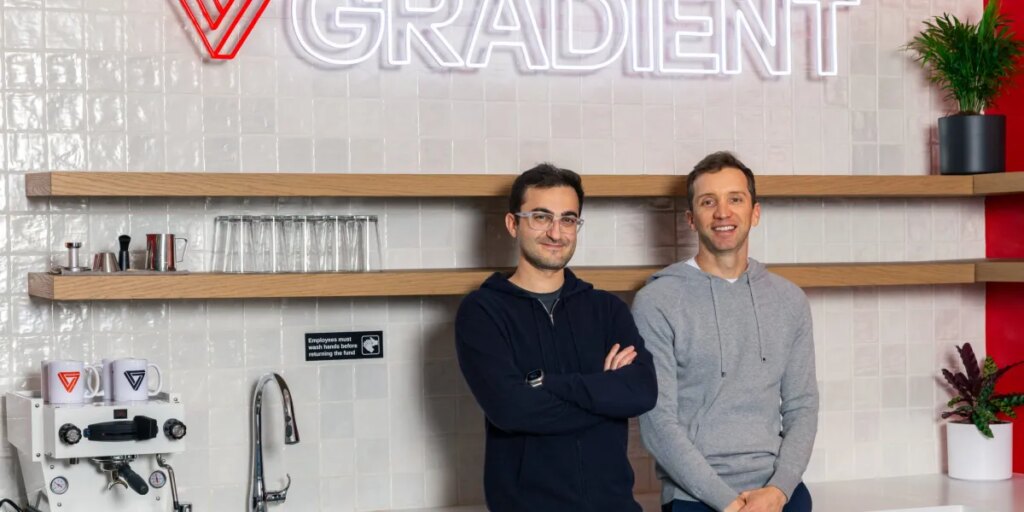
In 2017, Darian Shirazi and Zach Bratun-Glennon knew they weren’t exactly working on the coolest new thing.
“I remember going to happy hours with other startup investors and pre-seed founders,” said Shirazi. “I’d say I was at Gradient, and people would say ‘oh, the AI thing. I haven’t done that. Are there AI startups? I certainly don’t see them and AI doesn’t seem that interesting.’”
Shirazi and Bratun-Glennon, both engineers by background, were there at the very beginning, as Google stood up Gradient in 2017, expressly for the purpose of backing AI companies early. It was one month after Google’s famed “Attention Is All You Need” paper came out. AI, as a technology, was clearly on the precipice of change. But as a business use case, it was niche at best.
“You really had to be a nerd to actually realize that this was a big deal,” said Shirazi. “Everyone was talking about crypto and ICOs at the time.”
Bratun-Glennon points out that, even though Gradient in some sense came from Google’s C-suite, “it really was a niche idea at that point and didn’t resonate with everyone right away.” LPs outside Google were wary. “I think people thought we sounded like the quantum computing people, and no one wanted to do a dedicated quantum fund,” said Bratun-Glennon, previously corporate development deal lead at Google.
Much has changed. The AI boom has taken on a cascading life of its own, and now it seems like every firm is AI-focused. With this backdrop, Gradient closed its $220 million fifth fund, the team confirmed exclusively to Fortune. Gradient, which focuses entirely on seed and pre-seed AI companies, has backed Lambda, Oura, Sona, Writer, Airspace Intelligence, and Krea. The firm’s exits include CentML (acquired by Nvidia reportedly worth more than $400 million), Prepared (acquired by Axon), and Streamlit (acquired by Snowflake for a reported $700-$800 million). Gradient declined to disclose previous fund sizes.
“From 2017 to 2021, we saw 100 companies a year that fit our thesis,” said Shirazi. “And post-ChatGPT, we started to see 1,500 to 2,000, which is now consistently the number of companies we see per year.”
In this clamor, Shirazi and Bratun-Glennon have seen their due diligence process change. They’ve increasingly been leaning more on their own engineering abilities, writing code to test that the products prospective founders are bringing to them are actually working. The two also have hesitations about the frenzy. Gradient won’t, for example, fund foundational model contenders, full stop. The mega-seed rounds also give Shirazi serious pause.
“Large seed rounds that are $100 million-plus or one billion-plus… I’ve never seen a startup raise more than, say, $10 million in a seed round and be successful,” he said.
Gradient, in this fifth fund, is in some sense starting over: Google will remain a notable LP, but Gradient has taken on outside LPs for the first time, starting with inbound interest from institutions. Shirazi and Bratun-Glennon also now own the management company. The move came, in part, because of inbound demand, but also with a view to the future.
“I do believe this is the largest platform shift in history, and the biggest value creation event in technology ever,” said Bratun-Glennon. “Is there an intervening two or three year air gap? There’s a risk to that, but on a ten-year horizon it’s an amazing place to be.”
A long way from the Silicon Valley parties, where people wondered whether AI startups even existed.
See you tomorrow,
Allie Garfinkle X: @agarfinks Email: [email protected]
Submit a deal for the Term Sheet newsletter here.
Joey Abrams curated the deals section of today’s newsletter. Subscribe here.
The post The Google-backed AI investors nobody took seriously in 2017 just raised $220 million appeared first on Fortune.